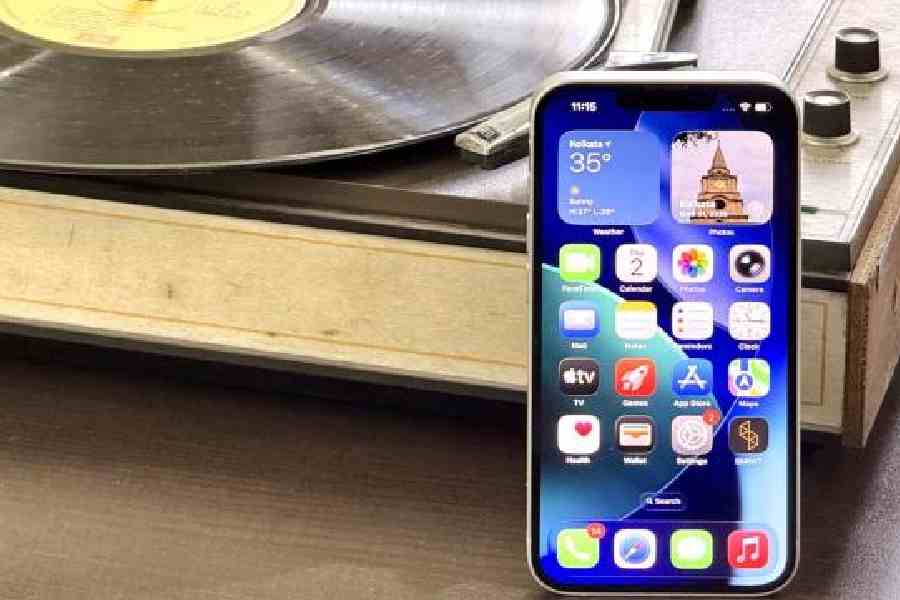
Last year, when the iPhone 16e came out, it offered a solid iPhone experience, giving you roughly 80 per cent of what the iPhone 16 had, but at a lower price. It missed a few tricks, most notably MagSafe technology. With the iPhone 17e, Apple gets very close to the iPhone 17.
The design of the iPhone 17e remains the same as the 16e, complete with clean looks and premium materials. It has an aluminium band running around the phone, frosted glass at the back that does a fine job of hiding scratches and fingerprints, and Ceramic Shield glass on the front with an anti-reflective coating.
The phone itself feels lovely in hand. It’s light, compact, and arguably the smallest iPhone Apple makes right now. It’s an absolute joy to use.The iPhone 17e carries that compact charm many people adore, especially those who once swore by the iPhone Mini. If you want something that’s easy to use one-handed, or if you simply prefer a smaller device, this fits the bill nicely. Even as a secondary phone alongside something like a Pro Max, it slips into your routine without skipping a beat.
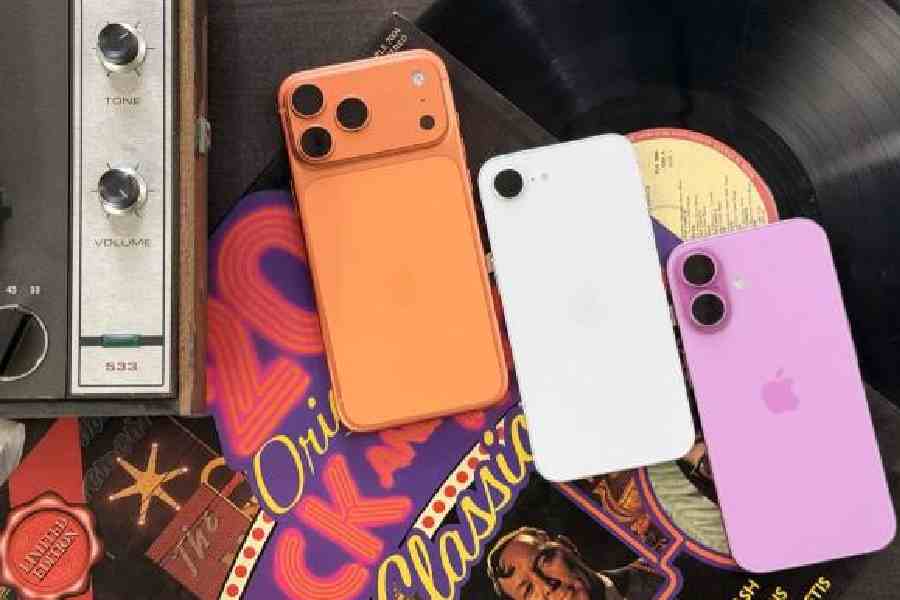
iPhone 17e (centre) flanked by iPhone 17 Pro Max (left) and iPhone 17. Picture: The Telegraph / Mathures Paul
Compared to something like the Google Pixel 10a, it’s a touch lighter and easier to hold. The build quality is exactly what you’d expect — aluminium frame, glass front and back — all very polished and unmistakably Apple. The button layout remains familiar: Action button and volume rockers on the left, power button on the right.
A small change that makes a big difference
There is one notable change this time — and it’s a big one for many — MagSafe is finally here.If you already own MagSafe accessories, you can jump straight in. If not, it opens the door to a whole ecosystem of wallets, power banks, mounts and more. It adds a layer of flexibility that was sorely missing before.
Having MagSafe on the iPhone 17e is important because more and more people are using the technology. Many in India are discovering the advantages of MagSafe. It is a proprietary magnetic system developed by Apple, allowing for the easy attachment of chargers and accessories. It uses a ring of magnets on the back of the phone to ensure precise, secure alignment with chargers for faster wireless charging, while also enabling accessories such as wallets and stands to snap on effortlessly.
MagSafe chargers, stands, cases, wallets, camera accessories, and more snap easily to the back of iPhone 17e, providing seamless alignment with a wide ecosystem of accessories. Further, the phone supports Qi2 for fast wireless charging up to 15W compared to 7.5W Qi wireless charging on iPhone 16e.
You can, for example, buy a MagSafe stand and place the phone on it horizontally, turning it into a rather smart-looking clock while it charges at the same time. Or you can attach a wallet carrying your essential cards to the back of the phone. The magnet is strong and holds attachments firmly in place. There are also several third-party manufacturers offering a wide range of MagSafe-compatible products.
Considering this, it’s a very welcome and much-needed upgrade over the iPhone 16e. Another premium feature is the IP68 rating for dust and water resistance, which is always handy — better safe than sorry.
Steady everyday experience
The display remains a 60Hz panel. Yes, the difference is noticeable if you place it side by side with something like the iPhone 17 Pro, but let’s not split hairs.
Someone choosing the iPhone 17e likely knows their usage pattern. This isn’t aimed at those chasing cutting-edge specs. For a 6.1-inch display, 60Hz is perfectly serviceable. Unless you’ve got a higher refresh rate phone right next to it, it does the job without raising eyebrows.
It’s a Super Retina XDR 6.1-inch OLED display — edge-to-edge and exactly what you’d expect from Apple.
Colours look vibrant, text is crisp, and HDR content pops nicely. Whether you’re watching videos or endlessly scrolling, it’s a thoroughly pleasant viewing experience.
Apple’s Face ID continues to work like a charm, though it still sits inside the familiar notch — no Dynamic Island here. Durability has also improved, with Ceramic Shield 2 front offering better scratch resistance and improved handling of reflections, which proves useful under harsh lighting.

The 48MP Fusion camera captures stunning photos, including snazzy portraits, and 4K Dolby Vision video. Picture: The Telegraph / Mathures Paul
Audio is handled by a stereo speaker setup that delivers clear, loud sound with surprising depth. There’s even a bit of bass in there, which is no mean feat for a phone this size.
Ticking all the right boxes
The iPhone 17e runs on the Apple A19 chip — the same chipset found in the iPhone 17. In day-to-day use, it feels snappy and responsive. Apps open quickly, navigation is smooth, and benchmarks show it comfortably ahead of most rivals in this segment.
While the chipset is the same, there are still a few meaningful differences between the iPhone 17e and the iPhone 17.
The iPhone 17 gets a more powerful GPU thanks to an extra core, which mainly translates to better gaming performance. That said, most users are unlikely to notice the difference in everyday use.
If that’s something you care deeply about, you’re better off looking at the Pro models anyway, with their six-core GPU and more advanced cooling.Speaking of differences, Apple has put its N1 chip in the iPhone 17, but not the 17e.
This is Apple’s custom networking chip, and it gives the former phone a few benefits. The iPhone 17 gets Bluetooth 6, Wi-Fi 7, and Thread. The 17e has lower spec Bluetooth, Wi-Fi, and no Thread support.
Compared to the A18-powered 16e, this is a clear step up. With a six-core CPU (two performance cores and four efficiency cores) and a four-core GPU, it’s built to last for years — even with increasingly demanding AI features on the horizon.
Storage also gets a welcome bump. The base variant now starts at 256GB, doubling last year’s capacity. Given how quickly 128GB can fill up, this extra breathing room is a smart move.
Another noteworthy addition is the C1X cellular modem — Apple’s second-generation in-house modem. Connectivity feels solid, call quality is clear, and data speeds remain consistent whether you’re on the move or indoors. It simply works, which is exactly what you want.
On the software front, it runs iOS 26 out of the box. Everything feels fluid — animations are smooth, apps load swiftly, and the overall experience is polished, as you’d expect.
Battery life hasn’t changed dramatically, but it holds its own. It comfortably lasts a full workday with typical usage — some camera work, streaming on Apple TV, scrolling through Instagram, and general browsing. In other words, it keeps up without breaking a sweat.
One lens, plenty of punch
On the camera side, the iPhone 17e sticks to a single-lens setup, but it’s improved — particularly with portraits.
You get a 48-megapixel Fusion camera capable of delivering 2x zoom at near optical quality through cropping. Compared to the iPhone 17, you miss out on an ultra-wide lens, but Apple manages to keep image quality remarkably close.
Photos come out detailed with excellent dynamic range, rich colours, and sharpness. Portraits show clear improvement — edge detection is clean, processing is quick, and results look impressive as long as lighting is decent.
The main camera is the star of the show. It produces consistently good results with great contrast and pleasing colours. The 2x zoom adds versatility, allowing for slightly tighter compositions without losing quality.
Night performance is decent, though the iPhone 17 does better in tougher conditions. Video recording is another strong suit — 4K at 60fps looks smooth, with solid stabilisation and excellent colour reproduction. Ideal for short-form content, frankly.
Despite having just one camera, it easily holds its own against many Android phones packed with multiple lenses — some of which feel more like box-ticking exercises than meaningful additions.
The 12-megapixel front camera does a reliable job as well. Photos are sharp, colours are natural, and it supports 4K video with autofocus, making it quite versatile.
The call
At the end of the day, the iPhone 17e is a straightforward device once you understand who it’s for.
If you’re coming from an older iPhone — say the iPhone 11 or 12 — or switching from Android and want a reliable, no-nonsense iPhone experience, this makes perfect sense. You’re getting strong performance, a great display, solid cameras, and dependable battery life.
It’s also ideal if you prefer compact phones or simply want something that works without all the bells and whistles. In fact, it’s a cracking choice for teenagers getting their first phone — it does everything they need and then some.
If you’re after high refresh rates, multiple cameras, or features like Dynamic Island, then the iPhone 17 or higher is the way to go. But for most people — and that’s the key point — the iPhone 17e doesn’t put a foot wrong.
Even with a single lens, it can outshine many Android setups. Apple’s attention to detail is evident — even down to the braided cable in the box that’s built to last.
In reality, the hardware is only half the story. The iPhone 17e comes with iOS 26 out of the box, allowing access to a slew of top-end features and Apple Intelligence. Further, the chipset here — A19 — is powerful enough to ensure the phone supports the latest software features that will arrive with future versions of iOS.
Competing phone-makers have had months to develop a more efficient chipset than the A19, only to fall behind. And even though Android makers promise years of software support, in reality it is often just a matter of two or three revolutions around the sun. If you are an owner of an older iPhone from six-seven years ago, or someone looking to switch to an iPhone from a different platform, there has never been a better Apple device to buy
.The iPhone 17e isn’t trying to be flashy. It sets out to be dependable, well-rounded and built to last... and it delivers exactly that, without fuss.