|
|

It appears that the brains behind Odeon either don’t read this newspaper or disregard constructive criticism. Last year, we had lambasted them for bringing both outside productions from Mumbai, as if that city summed up “national theatre”. Continuing to labour under that delusion, Odeon again imported Mumbai plays to fill those two slots. With such a biased track record, by no means can it qualify as the self-styled “the esteemed theatre festival of the city”.
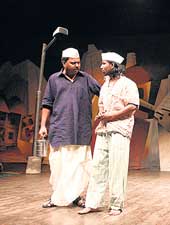
We could forgive the hype if the plays were outstanding, but since they weren’t, we can only blame parochialism or favouritism. Actually, I had looked forward to Theatre Arpana’s Cotton 56 Polyester 84 (picture), as it had won three Mahindra Excellence in Theatre Awards, but it failed to meet expectations. With plenty of good intentions, Ramu Ramanathan researched the story of Girangaon textile mills up to their recent decline due to the nexus between owners, politicians and the underworld, revealing their laid-off labour as the backbone of Bombay’s work ethic. Ramanathan connected this lost heritage with another extinct tradition, the Sangitnatak, by showing his two out-of-work heroes as great fans and even singers of that form. Also, their socialism is contrasted with capitalistic Mumbai today.
Unhappily, translated into Hindi and Marathi by Chetan Datar, the dialogue often sounds more like a history lesson than an artwork, while the songs consume precious time without furthering the action (exactly like Sangitnatak, so, acceptably retro but only up to a point). Ramanathan’s cardinal error is to regress into a typically filmi subplot, where the son of one worker joins a gang to survive, gets involved with the white-safari-suited godfather’s sister, and predictably meets his end in an encounter. As the leading men, Nagesh Bhonsle sings with robust projection and Kumud Mishra makes a fine foil, but the director, Sunil Shanbag, can’t do much with the others.
Banyan Tree’s Still Single was very confused in its approach to sex in the city. The first half made me think I was watching a commercial entertainer in New York or London, peppered with saucy one-liners. Anish Trivedi writes like a clone of Christopher Durang or a risque Neil Simon, displaying no stylistic originality, certainly nothing specifically Indian. After over an hour of such facetious conversation among two couples, one would-be and the other married, the live-in lover smacks (not an act of affection) his partner across the temple, and the possibility of physical abuse as the real theme rears its ugly head.
But Trivedi pussyfoots around this in a reconciliatory happy ending. Enough opponents of domestic violence should have been appalled to affect its long run, but perhaps Mumbai lacks such activism. To give the creators the benefit of the doubt, though, maybe they wished not to make any moral judgment, and merely depicted how desperate a single woman can become, to hold on to a relationship fearing she will never find another. The trouble is, to a habitual offender in the audience, the submissive conclusion gives a green signal that women will ultimately accept men who give them black eyes.
Fahad Samaar has so far directed for film and “been broadcasted” on TV, which is where such drivel passes muster. I can’t see how the actresses (Dipika Roy and Shazneen Acharia) agreed to endorse it, but Roy acted the victim quite well, whereas Acharia kept muffing her lines. Compared to them, their men (Trivedi and Theron DeSousa) stressed their laughably pukka accents so much that I could scarcely believe I was in India. Most expendably, Jayant Kripalani appeared on screen for a minute in each act, pretending to video-conference from New York. With not much else for the projector to do, Samaar scrolled his credits on it. What a waste of technology.
To complete the trio of disappointments from Mumbai, Sangit Kala Mandir invited the maiden theatrical venture of AB Corporation (yes, the B), Lali-Lila, written by Devendra Pem, author of the blockbuster, All the Best, that broke all records with its feel-good vibes on handicapped boys. However, this play takes that formula further towards a freak show in the name of human interest, exploiting the real-life case of Siamese (consistently pronounced “See-amiss”) twin sisters separated surgically in adulthood after one of them falls in love. Translator-director Vipul Mehta gives it stereotypical melodramatic treatment.