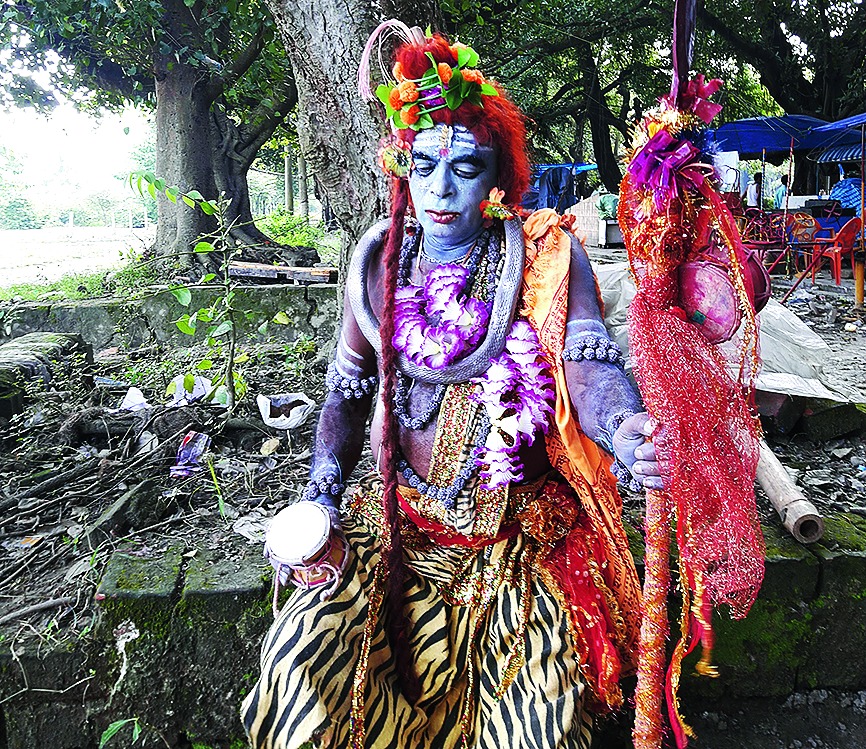

Gregor Samsa, the salesman in The Metamorphosis, had woken up to find himself transformed into a giant insect. I was reminded of Franz Kafka's novella as I watched Trilochon Das slowly change himself from man to, not a winged creature but, a god. Das, now in his 70s, has been dressing up as Mahadev, one of the popular deities in the Hindu pantheon, for over four decades. He is a member of the dwindling tribe of bohurupees, artists who disguise themselves as characters, divine and mortal, to entertain people and earn a living. Das had invited me to his dingy room in Kidderpore to talk about his life in the city where he works in a doshokormo bhandar (a store that sells merchandise for Hindu rituals). The room was spartan, but it contained a prized possession: a cloth bundle, which Das proudly calls his bag of tricks. Stashed in it were a make-up kit, body paint, wig, fake trident, plastic snake and a tiger-striped skirt. Das chatted while he applied make-up and paint to his face. He smeared ash on his forehead, placed the auburn wig carefully on his head, wrapped the serpent around his neck, and then declared that he was ready for the journey. Das and I had a plan: we would travel to his home in a village in West Midnapore with him dressed as the temperamental god.
During our conversation, I had noted Das's reluctance to describe himself as a bohurupee, or even an artist. He preferred the term, shong. Before meeting Das, eager to know the difference between these two figures in Bengali folk culture, I had read up Bireshwar Bandopadhyay's Bangladesher Sang Prasange. Shongs - costumed performers who took part in the Charak festivities and other processions - were usually supported by local patrons. Bandopadhyay writes of a certain Gangadhar Ghosh, who was employed in the municipal office, and was the chief sponsor of Serampore's famous shongs. A bohurupee, on the other hand, relies not on sponsorship but alms. Das said that he dressed up as gods (not just Shiva, but also Kali and the children of Parvati) to entertain guests in weddings, community pujas besides performing his version of the tandav nritya with 'band parties'. Bandopadhyay had also researched extensively on the repertoire of shongs that includes a diverse selection of satirical poems and songs. Das, however, relies solely on his appearance for effect. So why did he identify himself as a shong and not a bohurupee?
Perhaps the answer lies in an incident that took place as soon as Das and I stepped out of his home. We were accosted by a group of people who were chatting over tea and cigarettes in the neighbourhood. They accused Das of being a con man. In an impromptu trial, Das was found guilty of exploiting religion to make money, while I was reprimanded for encouraging corruption. I found the heated exchange between the irate jurors - some of them were still dressed in Puja finery - and the accused quite revealing. The hostility - Das later confided that he is bullied quite often in the city - explained his battered confidence as an artist. But it is the condemnation that Das faces that is illuminating. His vulnerability to scrutiny mirrors the undiminished antagonism between the classes, something that Bandopadhyay alluded to in his work. Das, an unlettered man, is unaware of the long and rich history of the pantomime tradition in Bengal. His preference for the term, shong - the clown, that harmless and ubiquitous public entertainer - is instinctive. In his mind, the identity of the jester renders him innocuous, enabling him to blend in. Das does not fully comprehend his need to remain inconspicuous. But that could be because the knowledge of an older fault line - the lingering tension that is the consequence of the subaltern performers' capacity to question all that is seemingly respectable - eludes the bohurupee. Das is tolerated in polite circles, but, as was apparent from the confrontation, he cannot hope for assimilation. The anger of those self-appointed jurors confirmed my suspicion that like their 19th-century brethren, the modern-day genteel Bengali remains discomfited, and not always amused, by a sensibility that questions as much as it entertains.
On our way to the station, Das and I decided to stop for tea. At the roadside stall, the bohurupee, who had regained his composure by then, held court. A group of tourists stood in a queue outside Victoria Memorial. On spotting Das, the women and the children ran across the road and prostrated themselves before him. (The taxi driver who had ferried us had sought Das's blessings before we alighted from the vehicle.) I asked Das whether he would charge a fee from his admirers. He declined, explaining that the spectators - we had been encircled, yet again, but this time by spell-bound people - had given him what he desired most: respect as a performer.
After sometime, the crowd began to disperse. But Das sat content, relishing the milky tea. I quizzed him on how it felt to play god. Did the power he seemed to hold over, say, the prostrating women please him? Is the line between such power and deception thin? In reply, Das sought to make a distinction. What looked like power to me, he said, was merely an ability. Das added that his art invested him not with authority but, simply, with a skill to make the divine accessible to people. His dexterity gave the gods not just a human appearance but also infused them with mortal frailties. What Das knew, but lacked the language to express, was that his art has the potential to subvert orthodoxy, and, in turn, the power relationships that feed on it. I was not surprised to hear that the bohurupee was frowned upon not just by the bhadralok but also by purohits (priests).
Das does not mind the censure. His borrowed divinity, he insisted, had set him free. For Das, freedom is synonymous with mobility, the liberty to move unhindered across diverse spaces - neighbourhoods in the city, obscure towns and forgotten villages. He said that he has been welcomed into Muslim homes in villages deeply conscious of, and divided by, faith. What he most remembers of his travels is the joy that people get on seeing the gods as one of their own.
Yet, the bohurupee was also fettered. On reaching the railway station, as Das and I made our way through the rush, I saw a familiar ritual repeating itself. Curious eyes followed Das's movements; commuters paused and bowed before him, some others gave him coins. But Das's metamorphosis had come at a price: the audience could no longer differentiate between man and god. Das, it appeared, had been eclipsed by his own creation.