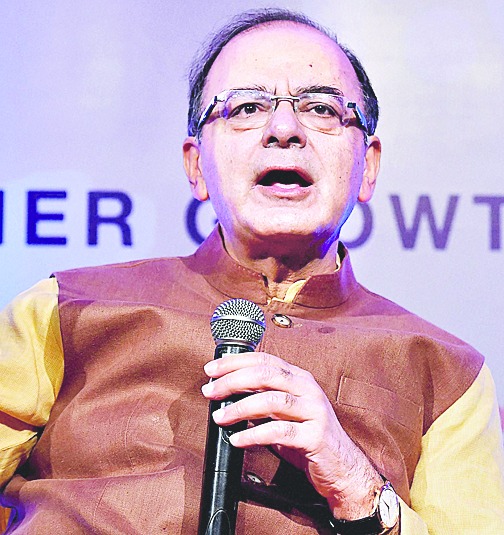

Taking his cue from Pranab Mukherjee, Arun Jaitley has also expanded the definition of being Indian. Thanks to the ingenuity of the two finance ministers, Vasudhaiva Kutumbakam may mean not only that the world is one family but that it's an Indian family that has triumphed over barriers of race, geography and law that less privileged mortals find insuperable.
Steeped in Rashtriya Swayamsevak Sangh bravado, Jaitley outshines Mukherjee in political assertiveness. Mukherjee's first budget in 1982 established that a desi remains a desi even if Queen Elizabeth drapes him in velvet and ermine and claps a peer's coronet on his head. Jaitley's quiet amendment to the Foreign Contribution (Regulation) Act of 2010 demonstrates two equally significant claims. First, a foreign company that funds one of India's political parties must be Indian for no one else would take the risk. Secondly, thieves don't have a monopoly of honour. There's honour among politicians too. Hence Jaitley's generous concession that a foreign company that gives money to the Congress (and not only to his Bharatiya Janata Party) is also Indian. He knows, of course, there isn't a business house in India or abroad that is so committed to one creed that it won't hedge its bets and keep all options open.
Mukherjee's interpretation of non-resident Indian to include people who had abandoned their nationality and flaunted foreign passports applied to exalted dignitaries like a governor-general of New Zealand, a Canadian cabinet minister, and a president of Singapore. In practice, it benefited only Swraj Paul, Baron Paul of Marylebone, who suddenly reverted to being an Indian. Jaitley's seemingly innocuous finance bill will also enable thousands of foreign companies in Britain, the United States of America, China or Singapore to invest in "activities of a political nature" that would earlier have been denounced as evidence of the ubiquitous Foreign Hand. In practice, the measure allows the BJP and Congress to escape punishment for pocketing illicit funds from Anil Agarwal's London-based metals and mining company, Vedanta, which was then regarded as foreign but has now been declared Indian.
On the eve of the 2014 Lok Sabha elections, Delhi High Court indicted both parties for accepting money from Vedanta and instructed the home ministry and Election Commission to "relook and reappraise" the matter and take action against the offenders within six months. According to the Association for Democratic Reforms, Vedanta and its subsidiaries gave Rs 8.7 crores to Congress and Rs 4.9 crores to the BJP. Revealingly, both parties argued that since Agarwal was Indian, so was his company. Money unites even ideological enemies.
Too much can be made of the foreigner question as if all money from abroad is tainted and all money at home is pure. It was part of Indira Gandhi's cynically xenophobic mythology that foreigners, especially Americans, were forever plotting against India. Daniel Patrick Moynihan gave the lie to that canard by disclosing that in those years the US twice funded an Indian political party. "Both times the money was given to the Congress party, which had asked for it," he wrote, "Once it was given to Mrs Gandhi herself, who was then a party official."
Given the persistent climate of suspicion, it's easy to understand the vehemence with which Pradeep Nandrajog, one of the two Delhi judges and author of the 33-page Vedanta verdict, expressed himself. "Political parties and pliant public functionaries were influenced by foreign powers to toe their lines and in return were handsomely rewarded in myriad forms, which included bribes, extending lavish hospitality, sponsorship of education of their relatives in reputed universities abroad and even securing attractive career opportunities in multi-national corporations," he declared. The abuse of financial power can't be condemned strongly enough, but what is most obnoxious is not a donor's nationality but his anonymity. Governments can, from time to time, legitimately impose restrictions on both source of funds and quantum. But there must always be transparency. Voters must know to whom their leaders are beholden.
The absence of transparency explains much that is rotten in India and accounts for tragedies like Calcutta's flyover collapse. The BJP and Congress should have remembered that Vedanta appears to have problems with authorities worldwide, including the Armenian government, the Church of England and Amnesty International. According to the New York Times, it is "known in some parts of the world for having left financial and environmental problems in their wake." The Delhi High Court's ruling was based on the law, which regarded as foreign a company with foreign investment of above 50 per cent. Jaitley's amendment ensures that so long as the foreign company's ownership of an Indian entity is within the officially prescribed foreign investment limit, the company will be treated as Indian for FCRA purposes. The simplest way of avoiding the writing on the wall is to demolish the wall.
When Mukherjee set the globalization ball rolling in 1982 by calling remittances a "manifestation of the close cultural and family ties" between Indians at home and abroad, he, too, ran into the paranoia about foreigners. All hell broke loose when Paul took advantage of Mukherjee's budget, which allowed ethnic Indians abroad to "purchase shares of companies quoted on the stock exchanges subject to specific limits" - 40 per cent of equity accompanied by full repatriation rights - to invest Rs 13 crore in Escorts and DCM. The two companies refused to register Paul's shares. Speaking darkly of the "danger of 'black' money going out of the country, laundered abroad, and brought back as 'white' money," J.R.D. Tata led protesting tycoons to the finance minister. The Federation of Indian Chambers of Commerce and Industry accused Mukherjee of giving away too much. Mrs Gandhi's warning that unless "our people are willing to face some competition we will get hopelessly left behind" added fuel to fire. The media thought it a ruse either to encourage foreign predators or enable the Gandhi family to repatriate their allegedly ill-gotten fortune or both. As the captains of industry clamoured for intervention by the government they had always reviled for intrusive practices, Mrs Gandhi commented wryly that India's supposedly free market industrialists demanded protection "just as bootleggers are said to favour prohibition".
Obstructed at every turn, Paul bitterly regretted the costly, protracted and ultimately fruitless adventure. After his mother's death in 1984, Rajiv Gandhi himself urged him to withdraw. Yet, even failure marked a psychological chink in the armour of India's ideologically-driven complacence. P.V. Narasimha Rao took up Mukherjee's scheme nine years later as part of a much more ambitious liberalization programme. The fiasco also revealed the corruption that riddled the pious rhetoric of India's crony capitalism. As Paul discovered, Indian industrialists "actually owned very small portions of their companies. Over the years, they had encashed their shareholdings, realised their monies, kept jobs for their families, and used government investment as their capital. Now, this free ride on public funds... was exposed."
Mukherjee and Jaitley have expanded the Indian family. The world is peopled by Indians - non-resident Indians, people of Indian origin, overseas citizens of India, American governors who look Indian but insist they are not, American Congresswomen who look Caucasian but insist they are Hindu, a Southeast Asian prime minister who called himself Malay and a distinguished British scientist who acquired Indian citizenship. Appearances are misleading. As the African mourner remarked on the death of a well-beloved English missionary, "His skin might be white but his heart is as black as ours." Now there are statutory Indians, individuals as well as corporations. It's like the courtship scene in Shakespeare's Henry V. When the French princess protested she couldn't love an enemy of France, Henry assured her that he loved France so much he would not part with a single French village. "I will have it all mine." That's the new age Vasudhaiva Kutumbakam.