|
|

Notes for an operatic play, working title: The Thirty-Four Year Circus/ The Cobra of Power; Bangla title: Choutrish Bochhorer Pala/ Khomotaar Keute.
The stage would need to be huge, even Rabindra Sadan would be too small, so perhaps two or three interlinked pandal-stages on the Maidan, each at least five storeys high, with the audience sitting in the centre as the action moves from stage to stage. The cast would run into a hundred-odd actors. The ‘opera’ would mix styles from all the different genres of theatre we’ve known in Bengal over the last half century: Tagorean verse-theatre, Sombhu Mitra’s proscenium realism, Utpal Dutta’s melodrama, Badal Sircar’s Third or Free Theatre, Grotowski via Khardah, the best elements of Arun Mukherjee’s cinematic Jagannath and so on, not excluding the traditional forms of jatra, bohurupi, khemta naach, chhau and putul khela nor the popular forms of the circus, P.C. Sorcar magic shows and the Bolly-Tolly dance shows.
One narrative thread would be the Bengal of recent months — say, from the massacre at Netai through the World Cup win to the election campaign. In and out of these scenes would run two contrapuntal themes of history: the CPI(M) and the Left Front from 1977 onwards and the Mamata-Trinamul from the late-1980s onwards with a small prequel from the 1970s. Occasionally, the rest of the world would make an appearance in stills and film on background screens: events such as major assassinations, the fall of the Berlin Wall and the collapse of the Soviet Union, the shifts in China, the rise of religious fundamentalisms, Babri Masjid, 9/11, Shining India and so on — everything, in short, that would be needed to provide the bass-line of the ‘bairey’ to the tivra ‘gharey’ of West Bengal.
Possible first scene, 1977 (the end of Emergency): on a dark, empty stage, a few men wearing rags fall out of jail gates and into the spotlight. We see the dirty white rags are imprinted with the repeated motif of the red hammer, sickle and star. As the men blink in the light, above and behind them an Ambassador-palki carries an old man who is waving at crowds. A young woman leaps on the bonnet of the Ambassador and begins to dance in protest but the noise of her stamping gets lost in chants of “Jaiprakash! Jaiprakash!” Every now and then, throughout the play, this girl dancing on the Amby bonnet will pass through, the noise of her taandav getting louder and louder till, at the end, the palki (always empty after its first entry), is itself on a long ‘Rajdhani train’ and the noise becomes deafening. In the meantime, the men in rags develop crisp dhuti-panjabis. But their white clothes are always patterned by the red hammer and sickle. Across the play, the dhuti-panjabi men grow in number. They develop absurdly long Brahmin chotis and outsize red-brown Stalin moustaches. They all wear thick, black-framed spectacles. They dance in a lock-step kirtan and always speak or sing in a chorus. So, for instance, when the Berlin Wall falls, their Stalin moustaches, too, fall off, but they pick up the moustaches and put them back on, strictly in unison.
In the storyline of 2011, the first scene would be a small group, in various white costumes but patterned with the hammer-sickle, cowering in a house as a surging mass of people surrounds them. The small group opens fire, shooting through the windows in panic and people in the crowd outside fall to the ground.
Next in the longer story would perhaps come Marichjhanpi in the winter of 1978-79, the shifting island of silt represented by a massive, unstable brown air-bag from which people tumble off as they are shot by police, the men in the hammer-sickle dhuti-kurtas dancing past, mouthing Marxist phrases. On a parallel stage, scenes of the positive things done by the Left, packets of soil passing from hand to hand as Operation Barga is launched, the first steps in panchayati raj, the army trucks rolling around Bhawanipur to protect Sikhs after Indira’s assassination, people not having to sleep on empty stomachs in village huts for the first time. But then would come the tableau of one of the dhuti- panjabis sitting drinking his Scotch as, behind him, a huge, three-storey-high blackboard with the English alphabet is erased by masked players swinging on trapezes. On another stage would be the huge crumbling walls of the old metropolis with ugly new blocks sprouting between cracks and beginning rapidly to crumble themselves. The grander action would be interspersed with intimate, realistic scenes from village, mofussil and crowded city, the family relationships changing, the anger and violence growing, the young leaving, the pada boys interfering and controlling daily lives, all this unfolding as the factories in the background come to a grinding halt, one by one. The chorus rises: “Bengal is lazy! Bengalis are lazy!” At one point, a huge tractor would be hauled on to one stage while a huge computer appears on the adjacent one. Showing huge energy, the dhuti-panjabis with help from others dismantle both tractor and computer, the first being reduced to a large, rusted sickle and the latter to a huge, battered hammer. The chorus continues: “Bengal is lazy! Bengalis are lazy!”
On one stage appears a large, papier-mâché Cong-I hand standing vertically. There is the sound of tearing as an older Mamata Banerjee rips open the palm and steps out, sloughing off tri-coloured confetti and presenting an unsmiling nomoshkar to the audience. Another actress playing Mamata is carried across the stage lying goddess-like on a large BJP lotus. Another group of actresses, say five of them, playing the current MB, lead simultaneous padayatras that criss-cross one another over all the stages, burying the small vans carrying the CPI(M) leaders. As the girl goes by jumping on the bonnet of the Ambassador, one or two of the Mamatas ignore her, while the other three turn and stare at her with annoyance. As the lotus passes by again, two of the Mamatas combine to tear it to pieces. As the ripped Cong-I hand passes, two MBs take large swathes of tape and stitch it back together again. The soundtrack is taken over by the slap of hawai chappals moving rapidly on asphalt. As the crowd churns around the five Mamatas, the massed bodies turn into a huge, human ‘helicopter’ that flings a Mamata out here and another one out there. We don’t hear any words as the Didis begin to speak; we just hear a shrill, angry whine of many voices that rises in volume as the different episodes of Left Rule are played out.
Women are stripped and made to walk naked through the lanes of places marked Bantala and Birati in vibrating neon. Other red neon signs mark out Nandigram and Singur. Peasants are killed by the cadre, women are raped, police open fire on people armed with sticks. The Stalin moustaches dance their unified kirtan, stringing along barbed wire made from shola pith that transforms into razor-wire as the opera progresses. At one pivotal point in the current election story, one of the Stalin-moustaches comes to the mike and makes comments about Sonagachhi and bhatars, lewdly thrusting his pelvis backwards and forwards. To which a group of actresses dressed as sex-workers also thrust their pelvises while chorusing, “We don’t know about bhatars, but Comrade Babu, you just lost a few lakh vhotaars!”
Towards the end of the play, a large see-saw becomes another device. On one end is a dhuti-panjabied, choti-bearing, black-choshma-wearing, red-brown Stalin moustached Comrade Babu, on the other is one of the actresses playing Mamata. At first, the Moustache Comrade is far heavier. Balancing on top of him are ‘goondas’ in T-shirts and pants and ‘businessmen’ in suits and safari suits, but all decked out in the hammer-sickle pattern, and Mamata goes flying. The heavier the red side gets, the higher flies the lone Mamata figure, but she always lands back on the see-saw. As the play nears the end, the balance changes — one by one, the goondas and businessmen leap over and balance on MB’s shoulders, gradually evening out the weight, revealing that their other side is patterned in green and orange clover-leaf.
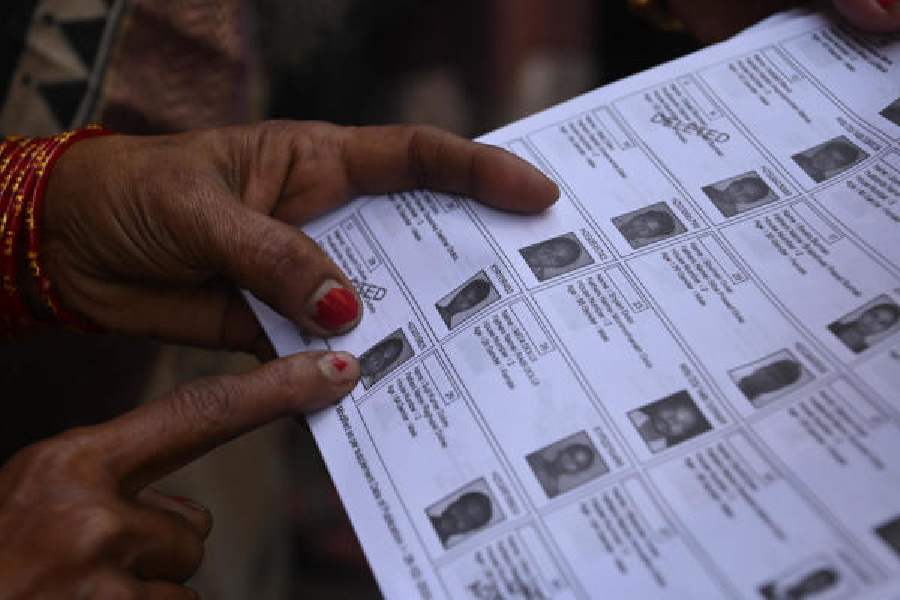
On one stage, large digital signboards appear among outsize banana trees, flicking words: Phase 1, Phase 2, Phase 3, Voter Turnout, and then corresponding numbers. The paramilitary troop up and down the stages as the campaign speeches rise in crescendo. OB vans wind through the audience. Voters rush from one leader to another, form queues, come out looking at their marked fingers. Through this frenzy, the chorus continues: “Bengal is lazy! Bengalis are lazy!” The Mamatas gather together and sit, one playing with her iPad, one with her mobile phone, one cooks, one paints, all are calm. The kirtan line of Dhuti-Panjabi Babus dance in attempted triumph but they are not convincing, all are holding on to their moustaches. As the results come in, one of them breaks from the line and says: “Was barely able to catch a grass snake, tried to grab a cobra! Hah!” A man, wearing a tattered hammer and sickle patterned kurta, stumbles on to stage wearing a heavy-looking Writers’ Building on his back. A kindly passer-by says, “Here, let me cut off this tumour that is debilitating you. You will feel much better.” He lops off the building from the tattered man’s back. The girl who’s been jumping on the Ambassador bonnet carries a snake basket to the gathering of five Mamatas. “Here, Didi! This is yours now!” she says, as a large cobra sways up from the basket. “What’s this?” They ask the girl. “Eita Khomotaar Keute! Shaamle raakhbey!” she replies. This is the Cobra of Power. Keep it carefully.