|
|

Works 88 at age 88 at Galerie 88. That’s a pretty large number for an art elder to have painted in less than two years. In fact, there are many more from this period; the number exhibited has been held down to 88, partly as an echo of the gallery, but probably more because it feels that viewers would have a tough time dealing with a greater abundance of exhibits.
And so here’s Paritosh Sen at 88. The only surviving member of the historic Calcutta Group, which had set out to dethrone the Bengal School in the early Forties, is still very active, still prolific, and still as articulate not only as an artist but also as a perceptive writer on art.
As is widely known, Sen’s learning circuitry plugged into multiple sources: Cubism, of course, and Picasso — whom he got to meet during his Paris years — Matisse and the trenchant caricature mode of artists like Ben Shahn and George Grosz. And the badinage and bold lines of Kalighat pat. Incidentally, many Western artists were then coming to terms with communism. Not surprising, therefore, that their art would tear into established notions during a critical era of flux that re-made Europe, claiming not only old power structures but also old ideas and values. Indeed, the subversive squint that seeks to upturn the accepted — Sen’s enduring signature over the years — reveals his temperament to be more European than Indian. When you’ve seen as many years as Sen has, or made the rare journey from Dhaka —where he was born — to Paris, life might tend to go beyond tragedy into dark satire or black humour.
The debunking smirk of the artist therefore breaks through the faux gaucherie of his satiric narrative that reduces violence and overheated emotions to cartoon stylization. His works have sometimes had suggestions of sound. Or noise, you may say. An old painting of his, for example (not on display), declares the dissonance of decibels as part of life. It has a man about to slice the neck of a chicken, held between two tight fists. The bird’s beaks are open in a stifled squawk, while in a corner hangs a transistor set, perhaps blaring some Bollywood hit. The dispassionate cruelty of a butcher is again seen in On the Way to the Market, which has screeching chickens, hogtied from the handle of a bicycle.
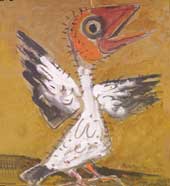
The reference to the ambient noises that intrude into our lives continues: the rich in idle chatter on the cellphone; an underclad singer singing passionately into a microphone; a Fledgling bird (picture), with its suggestion of beating wings and tentative squeaks. Indeed, many of the characters have their mouths open and teeth exposed. But not the artist himself who is present, like always, in several self-portraits.
The self-portraits again show Sen’s rather European temperament, for Indians are seldom comfortable with self-parody. Eyes shielded behind opaque glasses, lean contours exaggerated, lips pursed, he’s the malevolent observer. Or even, in Indecent Proposal, quite the satyr. Elsewhere, his acerbic vision penetrates appearances and turns a sitter into a skeleton. The hint is inescapable: the creative act is monstrous, inhuman, because it must destroy and resurrect the object of its attention as the latter comes into being in art.
But then, the amused look, the satiric comment has its limitations since the deepest chords tend to lie outside its scope. Perhaps that is why, although this pageant of life is largely re-invented as burlesque, you can yet see the artist’s concern for the besieged individual where the barbs are muted by empathy. Man in Anguish, with its assertive brevity of lines; Dialogue, whose nude has almost an absentminded melancholy in the eyes; Old Man Praying, which takes religious faith in earnest, are examples to cite.
As always, it is the brisk scaffolding of lines and their agile flow that hold the eye. Not only in the charcoal drawings but also in the paintings, which may seethe with acrylic patches sometimes dominated by textured blacks. That makes his Heads and Grimacing Faces some of the best works on view.
The show is on till October 15.