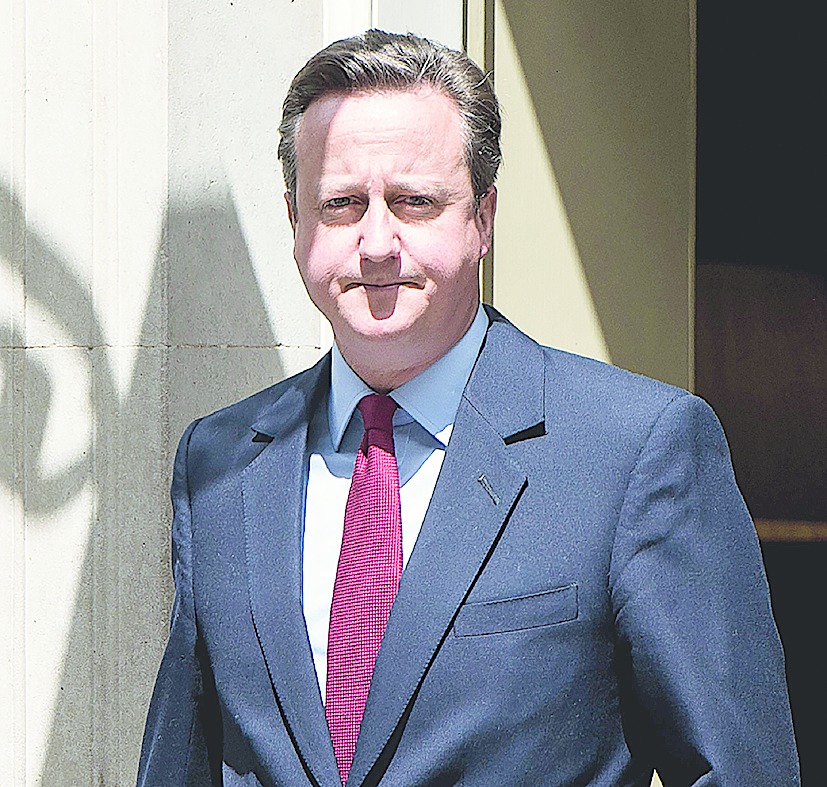

In the end, the British voters decided to ditch the European Union by around four percentage points but the ramifications of their decision will be far-reaching. British politics is in turmoil with David Cameron deciding to quit as prime minister after being defeated in a referendum that he had called hoping to win and silence the Tory euro-sceptics, perhaps forever. Now he is the one to go by suggesting that he would attempt to "steady the ship" over the coming weeks and months, but that it would be for the new prime minister to carry out negotiations with the EU and invoke Article 50 of the Lisbon treaty, which would give the United Kingdom two years to negotiate its withdrawal.
Cameron is right in this graceful acknowledgment of his failure. He had asked Britons to vote Remain but was defeated by 52 per cent to 48 per cent despite London, Scotland and Northern Ireland backing staying in. The Labour Party's leader, Jeremy Corbyn, is also coming under attack from all sides, with his critics accusing him of being half-hearted in calling for Labour voters to unite behind Remain. Senior Labour Party figures are suggesting that his position is now increasingly untenable. It were largely the Labour voters who were supposed to be the backbone of the Remain campaign but they, it seems, have stopped listening to the Labour Party.
The divisions within the UK are as stark as ever. London, Scotland and Northern Ireland voted to stay in the EU. Scotland voted in favour of the UK staying in the EU by 62 per cent to 38 per cent. Scotland's first minister now views a second independence referendum as "highly likely" after the UK voted to leave the EU by suggesting that it was "democratically unacceptable" that Scotland faced the prospect of being taken out of the EU against its will.
All this has had a significant impact on the markets already. Despite the governor of the Bank of England underlining the strength of British economy's fundamentals, the British pound has collapsed to its lowest level in over 30 years, suffering its biggest one-day fall in living memory. The London stock market also plunged, with the shares of major British banks facing a difficult time ahead. This was the last thing global economy needed at this critical juncture.
To prevent any more damage, European leaders have called for the UK "to give effect to this decision of the British people as soon as possible, however painful that process may be. Any delay would unnecessarily prolong uncertainty." Expressing "great regret" at the British decision, the German chancellor, Angela Merkel, said that Brexit was a "blow to Europe and to the European unification process." Brussels is in shock because while the polls had tightened in recent days, few were really expecting this divorce to come through. The post-World War II political and economic arrangement has been upended by the British voters and no one is quite sure what is to come next.
The remaining 27 members of the EU would now like to get over this shock as early as possible and not give the UK any more special privileges for fear of similar demands from other nationalist parties across the continent. But there are already calls for the need for significant changes in the EU. As the Czech prime minister, Bohuslav Sobotka, suggested,"Europe must be more operational, flexible, less bureaucratic and much more perceptive to the diversity that its member-states represent." And these calls are likely to grow louder with each passing day.
The British vote was a resounding rejection of the political elites and the establishment that went overboard in underscoring the negative economic consequences of a Brexit. The British public did not heed the experts because a large majority has not felt any real benefits from being a member of the EU. More significant was the issue of migration, which has already redefined British politics. Middle England has been feeling besieged by immigrants for some time now and the response of the mainstream political parties has been one of condescension. This referendum was an opportunity to reassert cultural and national identity of England and the English voters did it with all the power they had.
On the larger geopolitical front, the European project is facing a crisis today which it will find very difficult to tackle. The EU's democracy deficit is real and the rise of far-right political forces in various parts of the continent is a testament to the growing divide between the populace and the EU bureaucracy. As Merkel has rightly suggested, the British decision is a "turning point" for the European unification process. The EU will find it ever more difficult to reconcile competing demands in its management and the dream of an 'ever-closer union' will remain just that - a dream. The EU has entered a phase of glorious uncertainty as it negotiates with the UK and tackles numerous crises staring it in the face, from declining economic growth rates, migration crisis, lack of defence preparedness to an aggressive Russia. The departure of the second largest economy from the bloc will make it even more difficult to underscore the EU's credentials as a major power bloc at a time of great strategic flux in the international system.
All politics essentially is about who governs us and how. The British public has seized that power back with a vehemence few expected from them. And they have reminded the politicians that sovereignty is not merely an abstract concept but a living and breathing phenomenon that often drives people more than cold economic arguments. Britain and the world will never be the same again.
The author is professor of International Relations, Department of Defence Studies, King's College, London