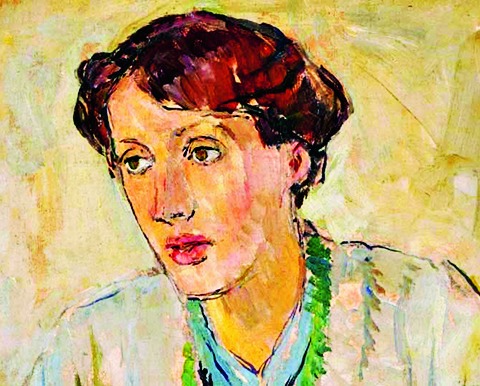

Is Virginia Woolf really 136? Is she old or ever young? Again, was she ever young or always too old in wisdom? These are questions readers and critics and scholars and commentators - among whom she only valued the reader - will have to decide for themselves, for she said, "[T]ake no advice... follow your own instincts... use your own reason... come to your own conclusions." Hemmed about with brilliant, feted, unconventional, artistic, loquacious men almost all of whom had been to university while she grew up part home-schooled, part educated in King's College, London, Woolf's creativity and intellect could only grow freely by rejecting canonical structures and conventions of perception and composition. The stream-of-consciousness technique in her novels such as Mrs Dalloway was the manifestation of the changes wrought by modernism on the perception of the relationship between the individual and what she experiences, in her body and outside it. Also, it was Woolf's own irresistible way of tunnelling into a woman's soul.
But all that is old hat. Discussions of the stream-of-consciousness technique can be relegated to the dusty pages of conference papers that Woolf may not have appreciated. At the centre of the iconoclastic Bloomsbury Group with her sister, Vanessa Bell, she yet appeared to lead a fairly conventional life - troubled but devoted daughter of Leslie Stephen and wife of Leonard Woolf. Her avant-garde quality, ahead of all the men who surrounded her, was subtle, as strong as steel yet fragile. It took the world a while to know her greatness, and that assessment has not been exhausted yet. Thinking for herself, which for her was the primary means of empowerment, keeps her ever young. And old in wisdom, as well. She knew that without a room of her own, without the economic independence that comes from education, no woman could write. Judith Shakespeare could only kill herself without writing a word; it did not matter that she was as gifted as her brother, William.
This is a dogged feminism - at a time there was no such thing. Or little of it. But that is not where she stops. Creativity, just another face of humanity, needs both men and women. It is only the androgynous heart, part man, part woman - maybe some unnamed third gender - that can grasp the world in its transient fullness. If her unconventionality still remains unfathomed that should not be surprising. Her maternal great-grandfather was "the biggest liar in India", an Anglo-Indian trader whose seven daughters were famous as the beautiful Pattle sisters. The mixture of Stephen and two generations distant Pattle - a man whose father-in-law was exiled to India from France for dallying too much with Marie Antoinette as her page boy - could only evolve an enigmatic genius. The writer of the incomparable novel, Orlando, a tribute to the indefinable relationship with Vita Sackville-West, for example. And also the writer who steps beyond modernism to contemporaneity - from Mrs Dalloway to Between the Acts.