
Visiting troupes from neighbouring states at Sudrak's Theatre Festival brought two productions new to us. The Bihari folk form of Bidesiya predominantly relies on the eponymously-titled play composed by Bhikhari Thakur in 1917, on urban migration to find employment. Bidesi leaves his newlywed village bride to go to - where else? - Calcutta, where he stays on and has children with another woman, ceasing all communication with his wife who, however, tracks him down and restores him to the path of virtue. Symbolically named Pyari Sundari, she even accepts her rival, Rakhel, and the kids.
This prototypical drama of roots and diaspora fed all Bidesiya performances ever since, no doubt because of its continuing relevance, even today. We had seen a variant of it previously in the Indian People's Theatre Association (Patna)'s Dur Desh ki Katha. But Nirman Kala Manch, also from Patna, presents an unalloyed version. I wondered about its open ending that surprisingly suggests things remain unresolved, given the seemingly patriarchal plot in which the pativrata forgives her straying husband and everyone lives as one big happy family. The director, Sanjay Upadhyay, answered my doubts regarding the conclusion by saying that he had kept it intact. In that case, we must credit Bhikhari Thakur with a modern perspective resisting reconciliatory closure.
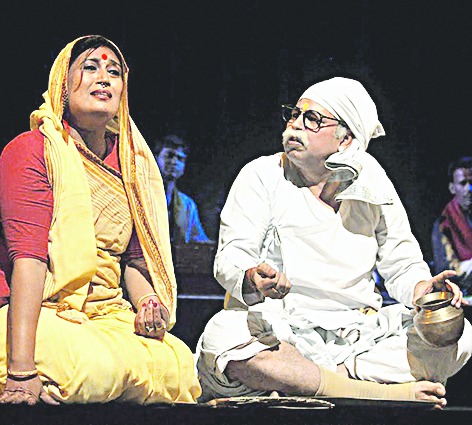
It is not difficult to understand why Bidesiya has become Nirman's big hit, notching up hundreds of shows. Upadhyay expresses the poignancy and humour, as well as high energy and live singing with authentic instrumentation (such as nal, sarangi and clarinet), providing full entertainment. And Sharda Singh as Pyari Sundari (picture) delineates the viraha rasa exquisitely, but also gives her a strong-as-steel personality.
For the first time, a group from remote Paradip (Odisha) came to town, with Chandrama ra Chudi, dramatized from Ramakanta Rath's poem by Sriman Narayan Mishra. Rath versified the life of a widow who has no option but to turn to prostitution for survival. Mishra's direction centres on Jayashree Mishra in the title role, who depicts her travails as a sad and lonely struggle, while a choric ensemble represents society's prejudiced attitude.
Correction: Gobardanga Naksha, mentioned in last week's column, did not draw on the Ministry of Culture scheme to build their studio theatre, but on their savings and local donors for the full funding. More power to them for setting this example.