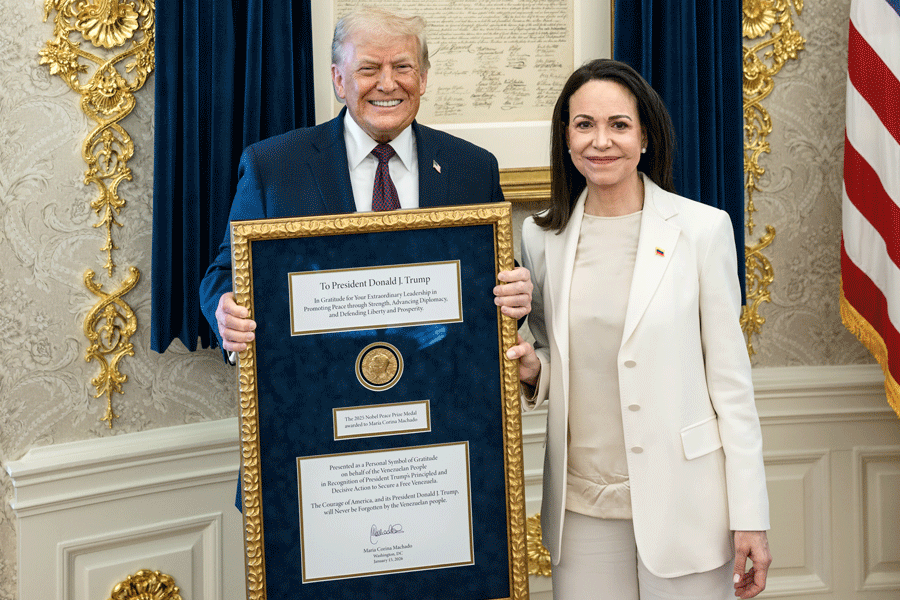
Comedy of errors
Sir — All that glitters is not gold and not everyone who holds a Nobel medal is a laureate. The Argentinian politician, María Corina Machado, received the 2025 Nobel Peace Prize and she has gifted the medal to the president of the United States of America, Donald Trump, whose craving for the prize is well-known. William Shakespeare may have written a ‘comedy of errors’ about this incident because both Machado and Trump trade in conflict, division, and political theatre. Neither figure is known for calming tensions or building trust across enemies and are thus equally undeserving of the prize.
Yashodhara Sen,
Calcutta
Powerful voice
Sir — Mahasweta Devi deserves renewed attention in her birth-centenary year (“Undiminished voice”, Jan 17). Her fiction and reportage focused on tribal communities, landless labourers, and survivors of violence. She wrote about forests, quarries, prisons, and courtrooms with sharp clarity. Stories like “Draupadi” and novels like Hajar Churashir Ma show how State power can harm ordinary lives. Her work helps readers understand inequality without slogans. Schools and libraries should make her writing easier to access in translation.
Sayantan Basu,
Calcutta
Sir — Many readers still treat activism and literature as separate worlds. Mahasweta Devi proved they could be linked through serious work. She edited Bortika, supported grassroots organisations, and helped marginalised communities fight for rights. Her writing did not romanticise poverty. It recorded humiliation, dispossession, and the pressures that lead to resistance. Rudali shows how grief can become a paid service under feudal control. Her example matters in an age when public debate often prefers comfort over truth.
Rai Sengupta,
Calcutta
Sir — Mahasweta Devi should be read as a political writer without being reduced to party labels. Her work asked hard questions about land, labour, gender violence, and the State. She wrote with a documentary style that refused easy endings. “Draupadi” shocks because it shows brutality without rescue. Aranyer Adhikar links history to resistance and dispossession. Such writing is uncomfortable, which is exactly the point. It forces attention towards people treated as invisible. That is valuable in any
democracy that claims equality.
Sumana Kabiraj,
Calcutta
Sir — The phrase, ‘urban Naxal’, is now used to dismiss dissent in India. Mahasweta Devi would likely face that label today. That says more about the current climate than about her work. She supported tribal communities, challenged injustice, and criticised State violence. Her writing offered evidence through stories rather than speeches. Hajar Churashir Ma shows how a mother’s loss connects to wider political repression. Healthy societies allow writers to question power without turning criticism into a crime.
Nibedita Das,
Calcutta
Heed the warning
Sir — Calls for 72- or 90-hour workweeks dress exploitation up as patriotism (“All work and no play”, Jan 17). India already works long hours, yet productivity remains low because management, training, and systems are weak. More hours will not fix those problems. China’s 996 culture led to burnout and public anger, and the courts declared it illegal. Even now, overwork persists there. India should learn from that warning.
Rohit Kulkarni,
Mumbai
Sir — China’s 996 work culture is a useful warning for India. It was sold as national sacrifice, then produced burnout, mental health problems, and even deaths.
Meenakshi Behera,
Baripada, Odisha