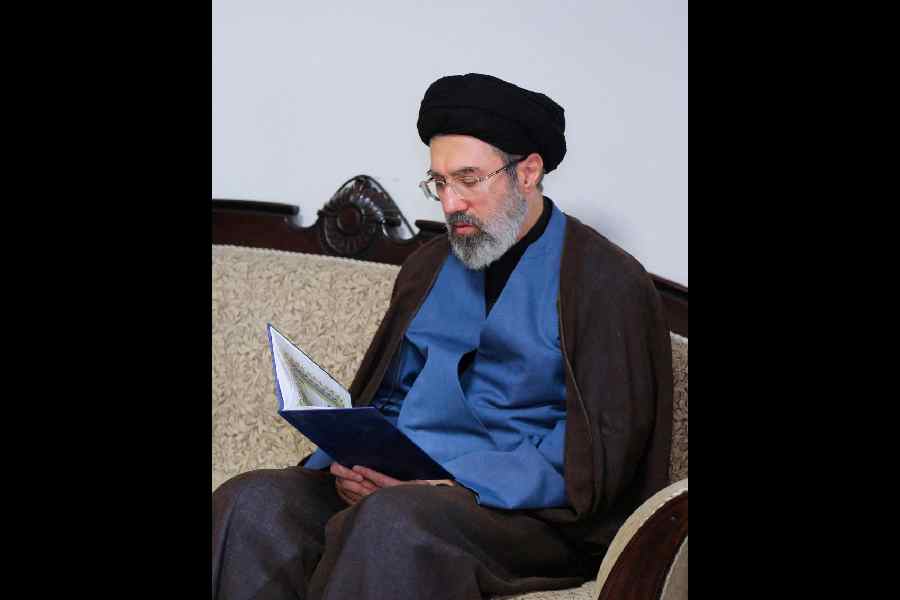
Mojtaba Khamenei had been a bit of a mysterious figure, even within Iran. Accredited with the scholarly and theological aptitude that is required to become the ayatollah, he has been known to coordinate military and intelligence operations from the shadows. But now, with his appointment as Supreme Leader after the assassination of his father, Ayatollah Ali Khamenei, during Iran’s continuing war with the United States of America and Israel, it may be time for Iran’s new apex leader to step out of the shadows. Mojtaba Khamenei’s elevation, of course, underlines some crucial tactical shifts on the part of Tehran’s leadership. The cartel that is now running Iran — senior clerics, the Revolutionary Guards as well as Ali Larijani, the head of the National Security Council — sees in Mojtaba Khamenei taking charge the value of continuity, even though Ali Khamenei had been against turning the office of the ayatollah into a hereditary one. Mojtaba Khamenei’s cause was also well served by the fact that he not only enjoys close ties with
Mr Larijani but he is also an influential figure among the armed forces. The former inherits a crown of thorns though. Tehran’s leadership is locked in an existential battle with two of its oldest foes and the outcome could well be tumultuous for Iran’s current leaders. It would be worth watching if and when Mojtba Khamenei prioritises peace. The domestic turf appears equally perilous. A sizeable segment of the Iranian population, especially the younger generation, is vehemently opposed to Supreme Leaders and their tyrannies. It would be interesting to see whether Mojtaba Khamenei makes cynical use of the ideas of reform and moderation to calm domestic tempers — for a while.
The office of the Supreme Leader has held Iran in an iron grasp ever since the Iranian revolution. One aspect about this post merits examination. Iran’s transition to Islamic theocracy was propelled by the post of the ayatollah. An expert in Islamic jurisprudence was deemed necessary for a State that would dispense its functions according to theological edicts. But since then, an office underpinned by theological imperatives had acquired distinct secular functions under its successive holders. So much so that the Iranian State, its values and functions were no longer distinct entities: they were subsumed by the Supreme Leader by carefully balancing, so to speak, the Church and the State. Yet, that sovereignty — impunity — has not made the ayatollah a figure receptive to democratic urges. Therein lies Iran’s dilemma and its inner conflict.