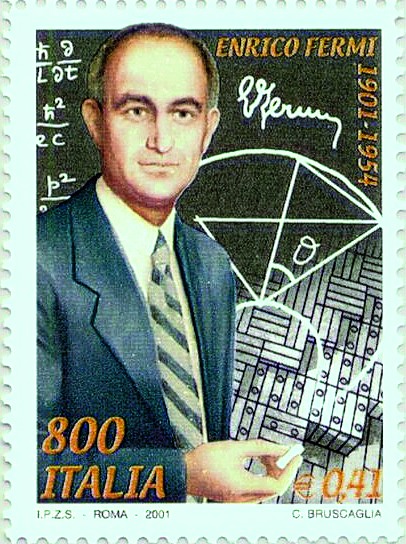

THE POPE OF PHYSICS: ENRICO FERMI AND THE BIRTH OF THE ATOMIC AGEBy Gino Segrè and Bettina Hoerlin, Henry Holt, $30
"The Italian Navigator has reached the New World." That was the coded message sent from Chicago to Washington on December 2, 1942. "And how did he find the Natives?" came the query from the US capital in response to the cable. The reply, again in code, was, "Very friendly."
The wording of the telegrams couldn't be more meaningful. It conveyed the success of a secret experiment that finally ushered science into a New World - the modern age of nuclear electricity and, of course, the bomb. The 'Navigator' in the message was Enrico Fermi, the most famous Italian scientist since Galileo Galilei. What he did was experimentally ensure that generating electricity or making bombs from atoms was feasible.
That both goals lay in the realm of possibility was anticipated by German scientists earlier, but they were nowhere near exploring that potential when Fermi did it. This, among other things, explains why the US, with the involvement of Fermi and his ilk, beat arch rival Germany in the race to build the atom bomb during World War II.
Fermi was among the retinue of physicists watching the first explosion of the bomb in a New Mexico desert at 5:29:45 am on July 16, 1945. As the mushroom cloud of fire sprang from Ground Zero, Fermi busied himself in deciding the bet that they had all joined in on regarding the yield of the blast. Immediately after the bomb exploded he took a sheet of paper, tore it to pieces, and dispersed them in the air. As the shock waves hit them they were blown a short distance away. Measuring the distance to where they landed, he calculated the yield. Turned out that his estimate was close to the mark.
That would establish Fermi as an experimenter par excellence, but that was only half of his persona. His calibre as a theorist also earned the envy of his peers. Scientists mostly display their talents either as experimentalists or as theorists. Ernest Rutherford belonged to the first category, while Albert Einstein fell in the second. Rarely there appears an Isaac Newton in whom both the traits combine to mesmerize humanity. Fermi can be bracketed with Newton, if not in class, then in category. Particles in this Universe come in two varieties; they are either bosons or fermions. Those that follow some rules discovered by Einstein and Satyendra Nath Bose are called bosons; the rest, governed by the norms discovered by Paul Adrien Maurice Dirac and Fermi, are known as fermions.
Written by the husband-wife duo, Gino Segrè and Bettina Hoerlin, The Pope of Physics is a page-turner of a biography. Hoerlin, a healthcare executive, is the daughter of one of the physicists who built the bomb. Segrè, a physics professor at Pennsylvania University, is the nephew of one of Fermi's colleagues, Emilio Segrè. He wrote Enrico Fermi: Physicist. Careful readers will also compare The Pope of Physics with the classic memoir, Atoms in the Family: My Life with Enrico Fermi, by Fermi's wife, Laura.
I think The Pope of Physics scores over the other titles for the sheer effort taken to put the story of a great physicist's life in perspective. During his lifespan (1901 to 1954), Fermi witnessed turbulent times in Europe; Segrè and Hoerlin work hard not only to depict the political backdrop, but also to show how Fermi's mentors pulled strings within the Fascist regime to prop up their prodigy's career. However, I found the authors' uncritical attitude towards some aspects of their subject's life (for example, his becoming a member of the National Fascist Party or his advocacy of dropping the atom bomb on populated areas in Japan) offputting.
Fermi's colleagues in Rome used to joke that he was infallible in scientific matters, giving him the nickname, 'Pope of Physics'. Segrè and Hoerlin show that even the 'Pope', before successfully flagging off the building of the atom bomb in the US, had erred in Italy in the splitting of the atom, politically the most significant of all scientific achievements.
It all began in 1932 with the discovery of the electrically neutral particle called neutron within the nucleus of an atom. It had mass like the proton, another constituent of the nucleus, but no charge, unlike the proton, which was electrically positive. These dual properties made the neutron an excellent projectile to hit an atom with, since a chargeless particle would not be repelled by the positively charged protons. Bombarding various atoms with neutrons spawned a whole new research as the target atoms, after absorbing the incoming neutron, became heavier, and in the process turned into new elements altogether. The exercise became a race very soon with physicists in France, Germany and Italy scrambling to outdo one another.
In 1935, Fermi, then the rising star of Italian research, succeeded in producing heavier elements one after the other. It was natural for him to choose uranium, the heaviest element known at the time, as the bombarding target and see if elements heavier than that could be produced. He believed that his mission was successful, and even suggested names for two such elements. The 'achievement' earned him the Nobel Prize in Physics in 1938. The award was wrongly given to him, for what Fermi achieved, but failed to realize, was that rather than producing elements heavier than uranium, he had broken apart the uranium atom into lighter fragments. The splitting of the atom - the mechanism that generates electricity or produces the bomb - was pointed out by physicists in Germany in 1939.
Fermi's failure is one of the quirkiest turn of events in world history. True, if Fermi had not misapprehended what he had done, atomic fission could have been discovered as early as 1935. Then Adolf Hitler would have had an atom bomb to use in World War II. Segrè and Hoerlin write, "Perhaps Fermi's not discovering fission is one of the world's greatest gifts of good fortune." The authors could not have been more correct.