|
|
| Reviving the grandeur |

Tamerlane
Sword of Islam, Conqueror of the World
By Justin Marozzi,
HarperCollins, £25
The old adage about history repeating itself seems true for the vast and varied region known to the West as central Asia or ?Tartary?. For centuries, nomadic armed horsemen have burst out of this region to devastate the surrounding regions ? from Attila the Hun in the 5th century, to Genghis Khan in the 13th to Amir Temur in the 14th. For most people, the dominant image of Temur has been the bloodthirsty ?Tamburlaine?, eponymous protagonist of Christopher Marlowe?s play. According to Justin Marozzi, it is ironic that ?a man who took such care to ensure his place in posterity by having his civil and military record meticulously chronicled should find his posthumous reputation in the hands of an Elizabethan playwright with a taste for the sensational?.
The facts of Temur?s life are no less sensational. From humble beginnings, he became a conqueror on the scale of Genghis; his cruelties as legendary to the unfortunate cities that fell to him. He conquered Persia, as well as the Ottoman Sultan Bayazid, the foremost warrior of his day. Indian history records with horror his massacre of Delhi. Just before his death, he was planning to invade China. The monuments of Samarkand and his patronage of artisans and scholars ? to be sure, for the greater glory of his capital Samarkand ? mark the difference with his predecessor. Yet, Temur has been relatively neglected by Western scholars. Marozzi sets out to remedy this gap in understanding. Whether he entirely succeeds is debatable, since no account of Temur?s life can avoid the grisly details of his various campaigns ? the cities razed, the towers of skulls, the plunder and rapine, as he cut a bloody swathe through Asia and the Middle East. After a point, the reader is relieved when the author leaves the trail of blood to provide accounts of Temur?s sojourns in Samarkand and his absorption in his grandiose building plans.
The title of the book ? ?Tamerlane? ? makes it clear that Marozzi intends a Western readership. To non-Western peoples ? generally those unfortunate to suffer his depredation, as well as in central Asia ? he was known as Amir Temur or ?Timur-e-lang? or ?Timur the Lame?, a derogatory reference to an old injury. In the Muslim world, according to Marozzi, Temur ?is a household name, usually revered as a great conqueror and propagator of the faith? ? which probably accounts for his choice of subtitle. Whether it is appropriate is another matter, and may only serve to reinforce stereotypes about Islamic fanaticism. In fact, as Marozzi himself points out, Temur was a shameless opportunist, who cared for little except power and conquest. He used Islam when he needed to justify his most horrific acts, and discarded it when it suited him. That the bulk of his victims were Muslims is obvious from some of the cities he sacked ? Bukhara, Baghdad and Damascus, for instance.
Even among contemporaries, Temur enjoyed almost mythic status. Marozzi quotes at length from the 15th century scribe Yazdi, who paints a glowing picture of his generosity and benevolence; but Marozzi also refers to a generally hostile chronicler Arabshah, whose hometown Damascus had been sacked by Temur. While reviling him as a viper and demon, Arabshah was forced to acknowledge the dignity and grandeur of Temur?s character. To compensate for Temur?s generally bad press among Europeans, Marozzi quotes from the account of one of the few Europeans to have lived at his court, Ruy Gonsalez de Clavijo, the Castilian ambassador, who has left an invaluable account of the magnificence of Samarkand. However, it can be argued that Marozzi has accepted Clavijo?s account uncritically, discounting the tendency in those days of poor communications, to fall prey to the ?Munchhausen complex? of exaggeration.
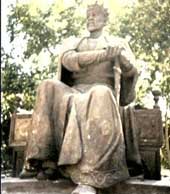
Perhaps the most telling indication of the awe Temur inspired is his present day use. In the republic of Uzbekistan, he has become an icon in the country?s efforts to carve out a post-Soviet identity. One of the more amusing incidents Marozzi describes is how newly-wed couples pose for an obligatory photograph under his statue. He is similarly scathing about the unsavoury attempts by President Karimov (a typical post-Soviet opportunist) to hijack Temur for his own purposes.
The book is an entertaining mixture of history and travelogue. Marozzi sets Temur in the context of his background: the land between the Amur Darya and Syr Darya (the Oxus and Jaxartes of antiquity), and the conflict between the old Mongol nomadic ways set out by Genghis, and the new, settled ways of the cities. What does come through is Temur?s relentless mythmaking: although a Barlas Turk, his marriage to a (captured) princess of the house of Genghis Khan allowed him to hitch his star to the earlier warlord and call himself ? ?gurgan? ? son-in-law of the Great Khan. This gave him both prestige and legitimacy in his campaigns. Like Genghis Khan, his military success was based on the horse and the composite bow.
An intrepid traveller in Islamic lands, Marozzi has travelled in the lands of Temur?s former empire, and we learn about post-Soviet central Asia ? its breathtaking landscape, but also its devastated economy, ruined by years of cash cropping and mono-culture. Some of the more enjoyable incidents are when he encounters the people ? whether his guides or simple bazaar folk. He is good on the monuments of Samarkand and Bukhara ? evoking their vanished splendour, to contrast with their present dilapidated condition.
The book is also an experiment in genres since it brings together historical research, reportage, and evocation of atmosphere and landscape. It may not always measure up to the high standards of biographical writing, but it provides entertaining read for armchair travellers and those who enjoy reading history.