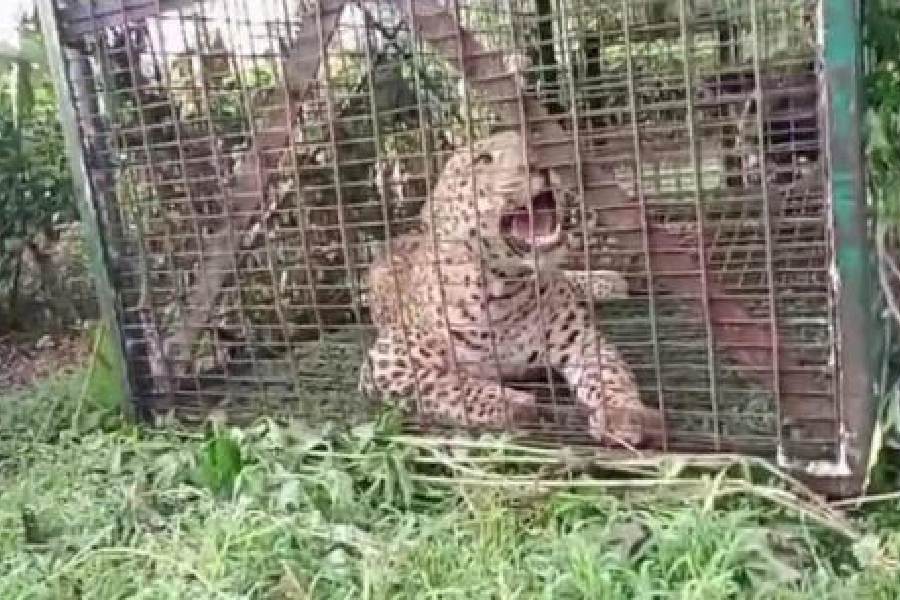
In the hills of Junnar, north of Pune, stands a row of cages at the overcrowded Manikdoh Leopard Rescue Centre filled with animals that once moved silently through sugarcane fields and village commons. This is not a zoo. The animals were captured after a series of leopard attacks on humans in nearby settlements. Now the Maharashtra government has decided to shift 50 of these captured animals to the Greens Zoological, Rescue and Rehabilitation Centre (Vantara) in Jamnagar, Gujarat, that is run by the Reliance Foundation. Reason: rescue centres are overcrowded and the conflict between people and wild leopards is intensifying. Yet, the decision raises an uncomfortable question: have governments run out of options? And was this the only way out of the human-animal conflict?
Junnar has been the epicentre of India’s human-leopard conflict. The mosaic of sugarcane fields and orchards is a hospitable habitat for the predator. Dense cane provides cover for raising cubs, while stray dogs and livestock form their prey base. The result is a paradox: leopards have adapted to the human-dominated landscape and learnt to live alongside humans. Within this fragile coexistence, a two-decade-old problem has worsened in recent times. Forest officials estimate that as many as 56 people, many of them children, have died and over 150 have been injured in leopard attacks in the area since 2002. Every incident deepens fear and anger in villages where children walk to schools along farm paths and farmers start working before dawn.
Under pressure, the forest department often resorts to the most visible response available: capturing the leopard by setting up cages in fields and shifting it to a rescue centre. This never solves the problem. Leopards are territorial animals. Remove one individual and another often moves in to fill the vacant territory. The conflict returns.
Meanwhile, the captured animals accumulate in holding facilities that were never designed to keep wild predators permanently. Once the cages fill up, officials relocate them elsewhere, and the problem starts in a new place. Enter Vantara, a privately run facility spread across thousands of acres which is the largest of its kind in the world.
Governments across India are increasingly transferring rescued or captive wild animals to Vantara. Gujarat’s Sakkarbaug Zoo has reportedly sent more than 100 leopards to the complex in recent years. Seized exotic animals from Assam and elephants from the Northeast and other states have been relocated there for alleged long-term care.
While this writer does not know how much space it has and how many more animals Vantara can accommodate, what we do know is that the human-wild animal conflict is not ebbing any time soon. And it needs a deeper, more profound response, one that involves communities living within these landscapes. There have been some durable civil society responses to this problem. We ought to study those.
India’s wildlife laws are designed to protect animals inside national parks and sanctuaries. But many species — especially leopards, even tigers — live largely outside these protected areas, in vast landscapes shared with millions of people, who also rely on forests for their livelihoods.
When those unmanaged landscapes become too crowded or contested, the State has limited choices. Coexistence requires careful land-use planning, livestock protection, and deeper engagement with local communities. Capturing animals may be easier but the danger is that captivity then becomes the default solution. Leopards or tigers survived for centuries because they adapted to our expanding world. If every difficult animal eventually ends up in a cage far away from its habitat, the future of India’s wildlife may no longer lie in the forests or fields where it evolved.