|
|
| From the margins |

Brass Baja Stories from the World of Indian Wedding Bands
By Gregory D. Booth,
Oxford, Rs 595
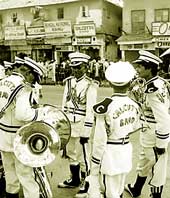
The Bollywood Brass Band has earned quite a name for itself. It attends important street-music festivals all over the world, and plays to hysterical crowds that sway to its renditions of Hindi film songs. Like the cast of Bombay Dreams, the members of the band are multi-racial, but they all speak English because they are drawn from the London milieu. The band, in fact, has never been to Bombay, and its repertoire is largely borrowed from bands which come visiting from India. In other words, they are a far cry from the sorry men in stained uniforms ? bending under the weight of their brass instruments ? who follow around wildly gyrating men forming the barat or wedding procession for hours on the streets of India to earn their daily bread. But the Bollywood Band, and Gregory Booth would possibly agree, is the result of another mutation in the south Asian musical culture.
This book, however, is not about the ?syncretic musical outcome? of the Indian presence in Britain, but the other way round. Booth thinks the widespread adoption of bugles, fifes, bagpipes and drums in processional music in the subcontinent from the beginning of the 19th century can be attributed, in large measure, to the colonial presence in the region, more precisely to the appearance of British military bands. For a century from the 1860s, the rapid changes in the accompaniments and the accompanists in processions were also catalysed by British rule. The doubling of the population, the fast-paced industrialization and urbanization that undid traditional socio-economic bonds, the successive political traumas that destroyed the known worlds of people and led to mass migrations ? all facilitated this change.
As with most colonial inheritances (Booth mentions cricket), the gift of brass did not go unmediated and unaltered. Having started off by praising the queen, bagpipes, trumpets and clarionets sang the paeans of the native maharajas and zamindars, and eventually of anyone who could hire them ? be it the merchant Marwari community of Calcutta, a prospective father-in-law in rural Bihar or the cronies of a politician just released from jail. Despite the commercialization of relations, between the bandsman and his malik (band-owner) or between bandsmen and their audience, Booth still finds traces of the ancient jajmani system in the dan (tip) that is given to the low-caste musicians by families who hire them. There are also the insuperable caste linkages and kinship ties that regularly bring unemployed caste members to bands and keep the bands staffed even in the busiest of wedding seasons.
But above all these associations, what Booth regards as the most important determinant of the fate of brass bands are the musicians themselves, who ?acting as individuals and in groups, in response to their own economic needs and the demands of the societies around them, effect the renovation or refashioning of social content: musical instruments, uniforms, musical repertoire, and processional performance practice?. It was their innovative skills that allowed the families of Jea Lal Thadani and Abdul Rahim to develop their respective Jea Bands and Mumtaz Band into successful family enterprises. It was his business acumen that led Ishwari Prasad to arrange for the recording of his Shyam Band?s performance by Tips, and subsequently took him to street-music festivals in Britain.
But this is the more congenial face of the brass band?s history. Booth?s twelve years of travel with the bands reveal the other side too. Among the many anecdotal accounts that flesh out his theorizations is that of his journey to village Homnabad in Karnataka with the Prabhat Band. In the two days that he was with the band, it had attended six processions and undergone two back-breaking journeys, to and from Homnabad, 150 kms away from Hyderabad.
The hard work, however, is not all that there is to complain about. Traditionally a low-caste occupation, the processional musicians continue to be marginalized because of their social identity and ritually impure status ? and this is true as much of Hindu as of Muslim bandsmen in India (they have better status in Pakistan). They are part of the show, but their presence is never acknowledged, much less their music.
Since the caste-linked status is more of a palpable reality to Hindus or Sikhs, they have tried to dissociate themselves from the profession, in some instances after the first generation itself. Their bands are professionally managed, but they no longer play in it. It is a bit different for Muslim bandsmen, who are seen to remain hands-on managers and musicians for generations. The association is so strong that the trade is often perceived as a Muslim monopoly. It is to this perception that we owe the picturization of Anwar bandmaster in Hum Saath Saath Hai, and not so much to the symbol of the ?marginal acceptability of Muslims?, as Booth alleges.
Booth has undoubtedly done a stupendous amount of work in an uncharted territory where he has had to depend entirely on oral history and his own observations in order to arrive at his conclusions. But his resulting, and certainly overwhelming, sympathy for the subaltern bandwallah sometimes gets the better of Booth, as in his discussion of the bands and the Hindi film music industry. He neither blames the bands ? given their lack of finances, time and skill ? nor the audience for the obsession with film music as the predominant feature in the band?s repertoire. He perhaps could also have mulled over the growing urban preference for child-bands to the all-male bands. The catalyst for the subsequent mutation of south Asia?s musical culture probably lies in this changing preference.