
The loud and merry beat of the Indian drums, dhak and dhol, played to the clanging accompaniment of the kansar - the heavy hand-held bell metal disc that would be swung as it would be struck by a solid wedge of wood at regular intervals - is so closely associated with Hindu temples and pujas in Bengal that even Bollywood has appropriated it, and a rather distorted version of this boisterous music is included in every film that has a remotely Bengali association. While dhak and dhol are meant for only special, festive occasions, the daily pujas in temples and household shrines are unthinkable without the metallic gong of the kansar and the tinkle of the bell. Non-believers may pronounce this cacophony, but it is sweet music to the ears of most Hindus.
But the music, like the times, is changing. And those blessed with a good ear will have noticed it already. The pitches and the timbre are different. And so are the musical instruments. I had noticed this change while I was doing my usual rounds of the stately homes of Calcutta a few Durga Pujas ago. I was in Pataldanga adjacent to College Square at one of the two Basu Mallik pujas. The thakurdalan was splendid, but the moment the priest began the aarati or special worship of the goddess, it took me a moment to realize that the music was offbeat. The drum beat and the heavy metal were deafening enough, but the tempo was far too fast, and it sounded far too belligerent. The merriment was missing.
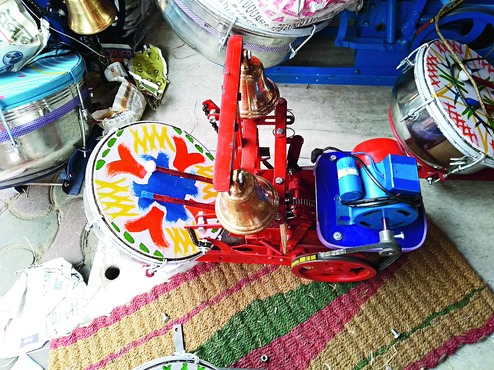
And of course, the dhaki or drummer with his large, plumed dhak and his accompanists were not to be seen. A moment later I identified the single source of the clangour. It was a small instrument on the floor fitted with a small drum and a set of two bells, and these were playing incessantly without any sign of human agency. It was a simple device, with a kada-nakada - nagara in Hindi, and closely related to the kettledrum - complete with a pair of drumsticks, and a pair of bells, and driven by a minuscule motor. But the row it kicked up was quite an earful.
Then again I heard the same aggressive beat in Ahmedabad from the 14th floor of an apartment block. Was this a call to arms, I wondered. On making inquiries, I discovered that here, too, the mechanized drum had replaced drummers.
About two years later, I heard the same war-like (to my imagination) music emanating from the Firinghi Kali temple in Bowbazar. The mechanized drum was affixed to the ceiling of the temple's portico. The priest said they were available in the music shops behind Lalbazar police headquarters.
Sure enough, the music shops opposite Poddar Court did stock them. I had a word with Madan Mohan Khatua, who owned the biggest of these establishments. He explained that the mechanized drum-and-bells set were first manufactured in Ahmedabad way back in 2000. There was an increasing demand for these in the Calcutta market not only during major festivals but throughout the year. Those with household deities needed them badly, because most joint families had broken up, and only aged people were left behind in big houses. The mechanized drum-and-bells set had come as a godsend for them. Moreover, the traditional drummers or dhakis charge extortionate rates nowadays. So why not the mechanized substitute? Khatua sells about a hundred such sets every month. The demand increases before Kali Puja and Shibaratri. So this is the music we shall have to face today.