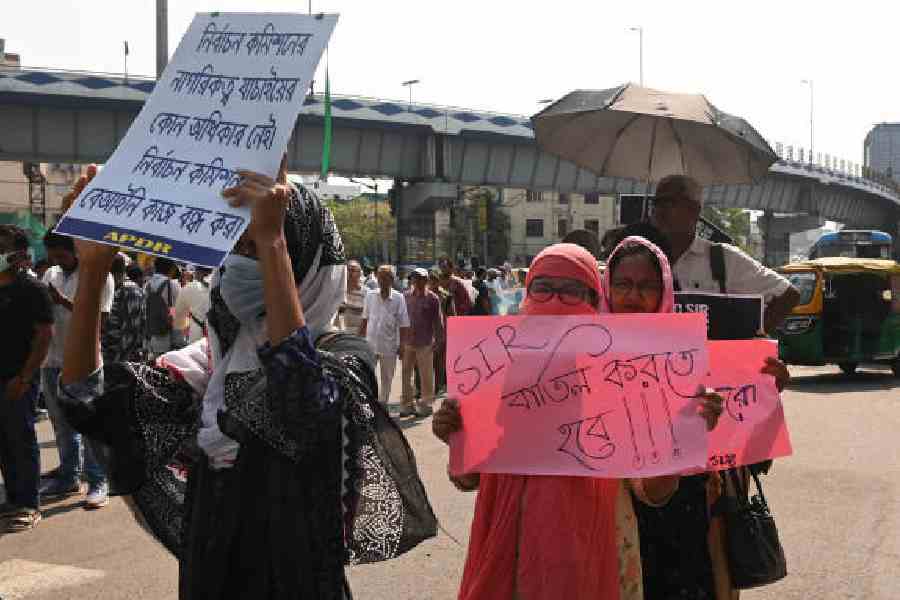
The accusation that the Special Intensive Revision of electoral polls — it has taken place under the hawkish eyes of the Election Commission of India — has been exclusionary in nature is getting difficult to dispel. Even official data suggest that certain constituencies are undoubtedly disappearing through the cracks. For instance, the Centre revealed in the Lok Sabha recently that the number of women voters in Bengal has fallen to its lowest in over a decade in the aftermath of the SIR. Before this supposedly neutral exercise, there were 969 women for every 1000 male voters: the figure dropped to 964 after the publication of rolls on February 28 — a first in 14 years. Worse, even this figure may change — deteriorate. This is because the fourth supplementary voters' list post-SIR was published on Sunday, bringing the total number of adjudicated cases to 26 lakh, out of which, unofficial estimates suggest, 42% may not have made it to the electoral list. This means that the number of women voters in Bengal may fall further.
Bengal, incidentally, is not an outlier in this case. This is because an analysis by a national daily had revealed falling gender ratios across several states that have undergone the SIR. For instance, in Bihar, the gender ratio has shrunk from 907 women per 1000 men to 892 women after the SIR. A similar worrying trend was evident in other states such as Gujarat, Rajasthan, Kerala, Madhya Pradesh, Goa and Chhattisgarh. This implies that the EC has not been receptive to some of the structural challenges faced by women; these include change in residence after marriage, migration, change in surnames on account of marriage and so on. What makes the EC’s obtuseness revealing is that in some states, such as Bengal, women constitute a crucial vote bank for the incumbent government. There is, of course, a greater irony that must not go unnoticed. Historically, the EC has played a pivotal role in encouraging women’s participation as voters in elections. Are the wise men manning this august institution today hell-bent on reversing these gains? Political parties, too, have been mindful of this change in electoral demographics. The modern political manifesto, cutting across party lines, thus has something for the woman voter in nearly every state. Yet, the SIR, central to electoral inclusion, appears to have been vengeful towards women voters, especially those from the margins. This exclusionary push must be redressed at the earliest.