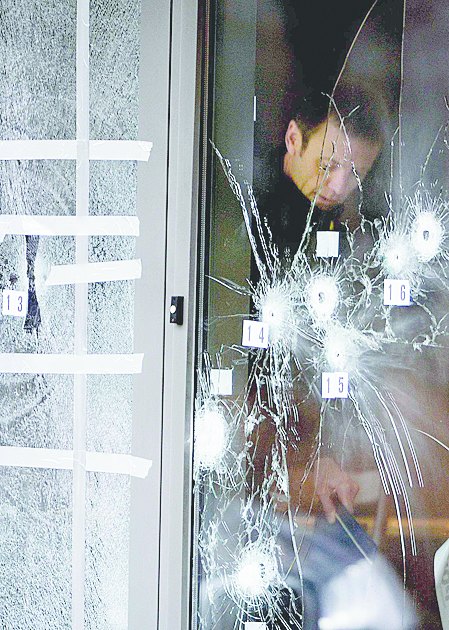

Just over a month after the Charlie Hebdo attack in Paris, a hail of bullets hit the Krudttoenden café in Copenhagen (picture) on February 14, as it hosted a seminar called 'Art, blasphemy and the freedom of expression'. Swedish cartoonist, Lars Vilks - who has stoked controversy by drawing caricatures of Prophet Mohammed - is thought to have been the main target of Omar Abdel Hamid El-Hussein's initial shooting that took place on a Saturday at the Copenhagen café. Finn Norgaard, a documentary film-maker was killed during the attack. Hours later, the gunman turned his weapons on Copenhagen's main synagogue, killing a voluntary security guard as he guarded the building during a Bat Mitzvah ceremony.
The attack came after 17 people were killed by three Islamist terrorists in the offices of Charlie Hebdo magazine and at a supermarket in Paris in January. Two of the attackers then went on the run, sparking a lengthy manhunt that ended when they were cornered and shot dead. The French ambassador to Denmark, François Zimeray, who was also present at the café in Copenhagen, said on Twitter shortly afterwards that he was 'still alive in the room'.
The Danish intelligence service later confirmed that it had been alerted last year that the gunman believed to be responsible for the deadly attacks on a synagogue and a free-speech event in Copenhagen was at risk of being radicalized. Details about the gunman, El-Hussein, that emerged showed that he had spent time in prison and had been affiliated with gangs. While incarcerated, he had drawn the attention of the authorities by saying that he wanted to travel to Syria to fight with the Islamic State of Iraq and al-Sham. The Danish authorities believe that El-Hussein was part of a network - a criminal gang called the Brothas - that has traditionally traded in drugs and theft but whose members have lately been lured by radical Islam.
Tens of thousands of people rallied in Copenhagen following the shootings, with many vowing to defend free speech in the face of threats, echoing a similar moment years ago when a newspaper stirred outrage with its caricatures of the prophet. At a time of heightened sensitivities in the region, Europe's response to terrorism is evolving as the threat from home-grown radicals is magnifying. While the French authorities are starting to weigh the value of surveillance, in Sweden, police are now out in full force, guarding possible terrorist targets with automatic weapons. Last month, it also carried out an operation that netted four men described as financiers for the ISIS.
Ill-prepared and seemingly surprised at the proliferation of potential threats, the whole of Europe is now confronting difficult trade-offs in deciding how and whether to monitor hundreds or thousands of their citizens who are travelling in and out of conflict zones, or making contact with radicals or being inspired by assaults like the one on Charlie Hebdo. The French authorities have identified prisons as a catalyst for radicalism. Two of the three gunmen responsible for the Paris attacks spent time in French prisons, coming into contact with jihadi militants who turned the men's previously tepid faith in Islam into radical zealotry. Yet there is no easy way out for the region as a whole.
The Barack Obama administration too is revamping its effort to counter the ISIS's propaganda machine, acknowledging that the terrorist group has been far more effective in attracting new recruits, financing and global notoriety than the United States of America and its allies have been in thwarting it. The terror group moved across Iraq and Syria with ease. But after drawing heat for beheading Egyptians, the path to take Libya is much more difficult. The ISIS's success in Iraq and Syria was fuelled in part by its control of some of the region's richest oil fields, but the group will be hard-pressed to turn Libya's oil reserves into a steady source of financing. However, that is no consolation for a strategy-deficient West.
Officials from some 60 nations met in Washington DC late last month for the long-postponed three-day summit by President Barack Obama on combating violent extremism. Ahead of the meeting, the key players in Obama's administration were unable to get on the same page. Some even took issue with the conference name, arguing that the only kind of extremism that threatens America grows out of radical strains of Islam. However, the hurdle for the White House was not merely over how much to focus on Islam. The internal politics of the summit proved to be as heated as the external politics. And it did not help that the state department had been kept away from the management of the event till early January.
Obama's response to the turmoil in the Middle East is also evolving. One key to the White House strategy against the ISIS is to train moderate Syrian rebels to fight the group. The US has decided to provide pickup trucks equipped with machine guns and radios for calling in US air strikes to some moderate Syrian rebels. But the scope of any bombing has not been worked out - a reflection of the complexities of the battlefield in Syria.
It is far from clear if the West can come up with a coherent, united strategy to tackle the rising tide of radicalism in the Middle East which is upending the social harmony in Western societies. At the moment, there is no unity in sight and it looks like a long road ahead.
The author is Professor of International Relations, Department of Defence Studies, King's College, London