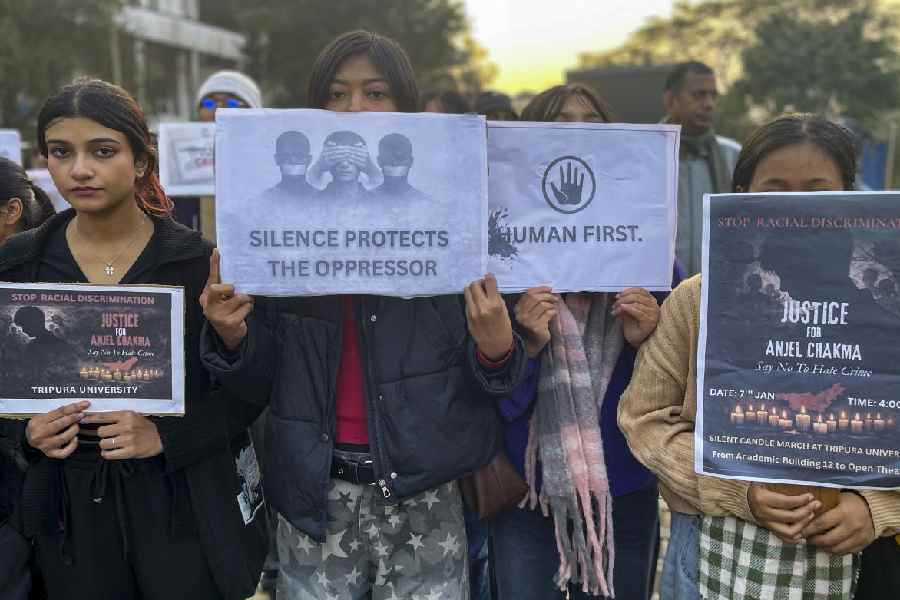
Last month, last year, a young man from Tripura was beaten and stabbed by a gang of thugs in Dehradun who abused him and his brother with the ‘usual’ racist epithets used for people from the region that is often called the Northeast.
Anjel Chakma, just 24, succumbed to his injuries; his brother suffered head and other wounds but lived to tell the tale. A few arrests were made, demonstrations and outrage followed, a media company not recently known for rights advocacy took up the issue and interviewed a bunch of us with the anchor asking with genuine naivete: “What should we do now to make sure that such incidents don’t happen again?”
The answer to that question is not easy. It would be facile to say that such horrible hate or racist crimes are unpredictable and are triggered by a whole host of factors. It would be easy to say that the police need to be fiercer in tackling such viciousness (they seem to be fierce in handing other issues, anyway). Leaders from across the political spectrum need to speak out strongly and tell their followers to keep an eye on such incidents. The media need eyes and ears which are constantly looking out for such incidents or the roots of such events.
There are some points which are often overlooked: those listed above come largely in the framework of ad hoc measures. Even the official inquiry which was announced at the time of the last major murder of a child of the region, Nido Tania of Arunachal Pradesh, was an ad hoc measure — it was set up to calm the furious outcry at the time across the country. The Government of India accepted the recommendations of the group headed by the former IAS officer, M.P. Bezbaruah, but did not take up the issue of an anti-racism law, saying that strengthening existing systems and legislation was the way forward.
Committees and laws have a role in framing public conduct. But the following have a greater say: political processes and positioning on representation of India and Indians, behaviour steeped in conservative approaches and teachings, false narratives and the role of a new player on the block — extensive dissemination through accessible digital platforms driven by the hype and the hysteria of so-called ‘public influencers’.
Over the past weeks, there have been a surge of reels and stories on social/digital and traditional media where people who ‘look’ different are asked, “Which country are you from?” Some of it may be just curiosity fuelled by genuine interest or ignorance (a thin line separates the two) or a tactic to harass those who don’t fit into a particular definition or image of an ‘Indian’.
After all, what an ‘Indian’ is supposed to look like is a question worth thinking about as we cast our mental eye from Jammu and Kashmir to Tamil Nadu and Mumbai to Kohima. This approach cuts across class and political boundaries: even as senior a political figure as Lalthanhawla, the former Mizoram chief minister, has spoken of being once asked for his passport when checking into a five-star hotel in the country.
The incident involving Anjel Chakma shows clearly that racial bias is alive and kicking in India. It impacts those of different colour from other countries as well as those from this region who live in metros where they have migrated for livelihoods, education or even to settle down.
This is not to say that much has not improved — it has, with or without the recommendations of the Bezbaruah Committee report. Delhi now has a police unit dedicated to tackling problems faced by members from the region in the national capital; more migrants are moving to urban centres for jobs in academia and other professional avenues, such as tech and hospitality industries, as well as in music, sports and writing. In fact, there are more than 100 university teachers and faculty in Delhi’s universities and colleges from the Northeast, apart from tens of thousands of students. Films based there are being streamed and screened on digital platforms as well as in cinema halls with actors, screenplay writers and directors from the area. A new generation of fiction and non-fiction writers from east of Calcutta in English and in translation is being picked up by publishers and celebrated at literature festivals and by readers across the country.
But some realities cannot be ignored — and the ugly incidents of Nido Tania over a decade back and now Anjel Chakma show that discrimination does not know the boundaries of time or geography. That is why issues related to representation and mutual respect have to be taught seriously and methodically in schools and universities so that the youth filter, process and better understand these critical connections. Whether it is school or university curricula, these issues need to be part of all foundational courses and also be placed in the training of all officers who go into the many services that run this country, not just the IAS and the IPS but also revenue, banking, economic and information services.
These are the factors that make an approach or policy sustainable and become part of what is known as behavioural change. This is a long-term approach, which is based on exposure to better information, education, experience and peer example. It is not the ad hoc way reflected on earlier in this column.
The challenges are formidable. A senior police official in Delhi says that many young people who come to the metros after doing some basic skill training at private institutes funded and approved by the government have no understanding of the kind of social pressures that exist. Perhaps a monitoring cell in the ministry of development of north eastern region under Jyotiraditya Scindia needs to be set up with area specialists and stakeholders to review the quality of training and output. Interactions at the community level with new migrant groups across the states are needed. This could be initiated by chief secretaries and DGPs of migrant-receiving states. At the local level, district commissioners and municipalities can initiate the process. Senior retired government and army officials from the region have settled in Dehradun as have some well-known writers. They could take the lead there.
What’s needed is not just an advertising campaign but continuous teaching of the need for mutual respect at homes, schools and colleges, offices and industries as well as respect for the law. As for those upholding the law, they should go fiercely after those who abuse the right to equality.
Permit me a little cynicism: I’d be surprised if this happens. I hope it does but public memory, driven by a controlled media and political narratives, is fickle. With the surge in deaths as a result of contaminated water in Indore and the US’s capture of the Venezuelan president, the Anjel Chakma incident has vanished from the headlines.
Sanjoy Hazarika is a writer who specialises on the Northeast and travels extensively in the region