
On September 3, four days after the full moon, academics will travel to the University of Hertfordshire in the United Kingdom to participate in the world's only werewolf conference. The three-day event not only involves serious deliberations among experts on werewolves but the organizers - aptly called The Company of Wolves - have also taken care to arrange for 'wolf walks' as well as a picnic near a churchyard where Peter the Wildboy lies buried. Peter, a feral child, was discovered in the woods in Germany in 1725 and then brought over to England by its queen.
Wolves, and their spectral cousin, mean serious business in Europe, and not just for innovative event management firms. That a conference is being held shows that the animal, which stoked fear and fascination in cultures of the ancient world, continues to enthral modern societies. Social conditions, especially persistent inequality, are a rich source of myths. The demonization of the wolf, which, in turn, led to the creation of the myth of werewolves, has its roots in the Middle Ages because predators and humans were competitors in the food chain. Wolves preyed on livestock, thereby posing a serious threat to pre-modern societies that lacked sufficient resources to replenish their meagre food stocks. Significantly, the concept of lycanthropy - the ability to change shape from a human being to a wolf - which features prominently in the conference, predates the Middle Ages. Both Ovid and Pausanias, a Greek geographer, referred to Lycaon who was transformed to a wolf because he had served human flesh, that of a child, to Zeus.
Legends bring with them their share of virulence. In medieval societies, werewolf trials, like witch-hunts, were not unheard of. There are recorded instances of the guilty being hanged in France and Germany. One example is that of a Rhenish farmer, who, on being stretched on a rack, confessed to being a werewolf. It was not a prudent choice: the antipathy towards werewolves was such that the farmer, poor and of inferior social status, was tortured further.
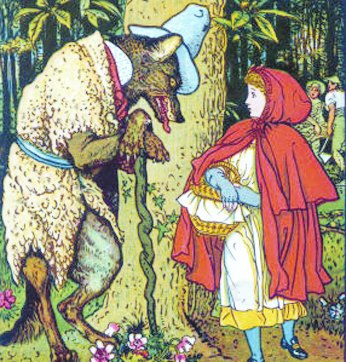
Kipling's benign wolf is a creature of the wilderness. But the wolf also inhabits the recesses of the mind, permeating such spheres as desire and sexuality. Little Red Riding Hood was warned against the charming wolf, the quintessential predatory male, who lay waiting on her path. Was the disapproval an expression of the collective anxiety regarding unconventional relationships triumphing over the norms that regulate human desire?
The importance of the conference that will be taking place in Hertfordshire is two-fold. First, such gatherings have the potential to generate an interest in decoding the hidden cultural connotations of surviving myths. Second, and more important, is the challenge to utilize the existing body of knowledge, including myths and legends, to create a new ecological ethic to help conserve the endangered species. The purging of the stigma associated with the werewolf can help ensure the survival of wolves in the wild.
Conservation efforts must look at popular culture as well as at research on old texts to save the wolf. For instance, what binds the Twilight series to Guillaume de Palerne, a 12th-century French romance, is, after all, the presence of a benevolent werewolf.