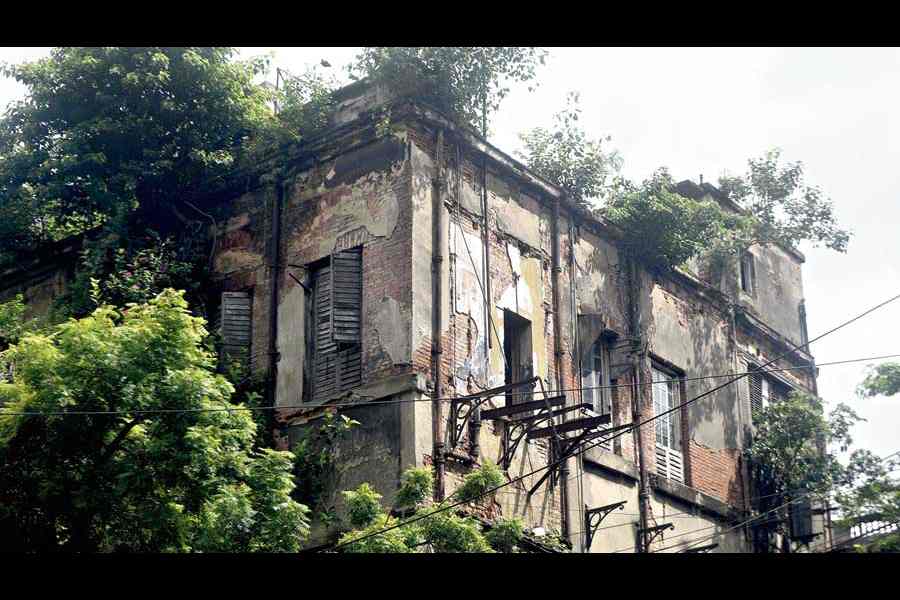
Across the post-pandemic world, cities are rethinking their centres. When a city’s centre fails, it signals systemic breakdown, not cosmetic neglect. Chowringhee — Calcutta’s centre — is not a peripheral street. It is a transit corridor, a commercial spine, a ceremonial address, and a crucial node in Calcutta’s reputational image. And yet, today, Chowringhee is a contradiction the city has chosen to normalise.
What should have been Calcutta’s ceremonial hub has become a space of congestion, visual hostility, and civic fatigue. Pavements dissolve into kiosks and cables; crossings turn unpredictable; structures rise without dialogue or restraint, with informal occupation proliferating in the absence of regulation.
In most metropolitan cities, the core is where regulation tightens and responsibility sharpens. London guards its West End, Whitehall, and Mayfair with near-ritual discipline. Paris protects sightlines and façades along its Grands Boulevards with an almost moral insistence on coherence. Mumbai continues to assert intent across its historic core: Fort, D.N. Road, Churchgate, Marine Drive. Even younger cities such as Singapore recognise that a city centre is symbolic of reputation, discipline, and dignity.
Calcutta’s failure, by contrast, is not one of scale or resources but of attention and intention. That Chowringhee has been allowed to drift into disorder is not an accident of history, but a sustained abdication of civic will.
But Chowringhee was not conceived in disorder. Two centuries ago, she was imagined as one of the most deliberate urban statements the city could make. By the early nineteenth century, Chowringhee functioned as a regulated residential axis. Her scale was understood, uses negotiated, and social life carefully staged.
That order was documented.
When Samuel Smith’s The Bengal Directory and Annual Register, or its variants, first appeared in 1825, it did not offer a modern street-by-street listing. Instead, it assembled the city through sections: official appointments, commercial houses, shipping, ecclesiastical establishments, military and medical services, and bazaars. Between 1825 and 1858, Smith’s directories recorded a Chowringhee that still functioned as a composed social corridor rather than a traffic funnel.
That confidence collapsed with the Great Revolt of 1857-58. What followed was recalibration.
When Thacker’s The Bengal Directory appeared in 1864, Chowringhee shifted from a residential axis to a mixed-use spine. The bungalow world survived,
but now alongside clubs, offices, hotels, and public buildings. By 1885, Thacker’s Indian Directory replaced the Bengal-focused volumes and continued until 1960, documenting Calcutta not as a regional capital but as an imperial administrative hub, charting Chowringhee’s passage from domestic order to institutional dominance. What follows after Independence is a different story altogether, one shaped not by documentation and discipline but by political turbulence and civic drift.
After 1960, the documentary record thins, but Chowringhee does not fall silent. What changes is intent. Planning yields to expediency; regulation to accommodation; traffic intensifies without redesign; pavements are surrendered piecemeal. Even the 1977 CMDA plan acknowledged severe deficits. What the city lacks today is not history, but attention. The disorder that now defines Chowringhee is not the result of organic growth but of forgetting how deliberately this street once evolved, and how carefully its changes were once recorded.
Chowringhee does not need restoration to a colonial past, nor preservation as a museum street. But it does need to be taken seriously again. History shows that order here was never accidental: it was planned, negotiated, and sustained. That knowledge matters, not as nostalgia but as evidence that disorder is not destiny.
The question is whether the city still believes its centre is worth governing with care, imagination, and dignity.
Devasis Chattopadhyay is a narrative history writer and columnist