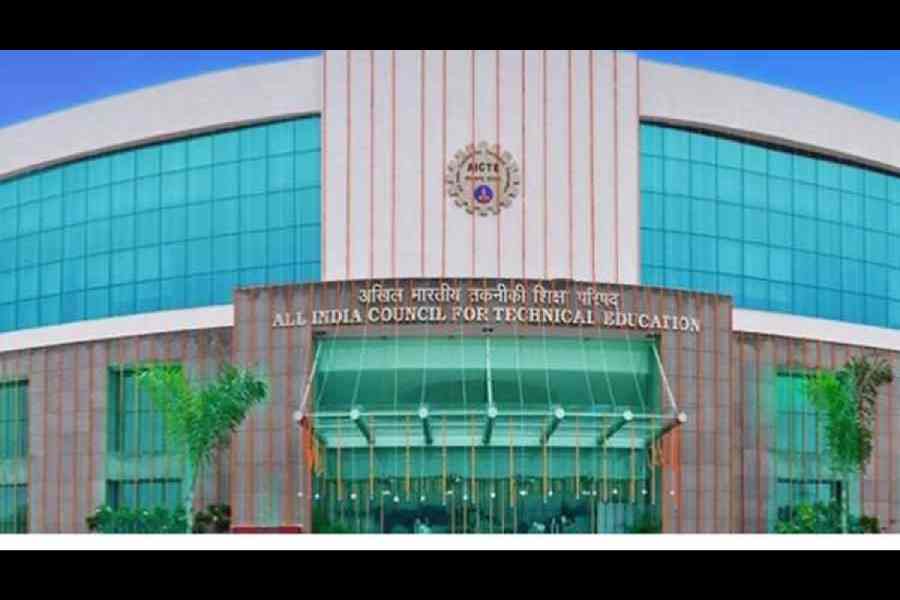
The All India Council for Technical Education (AICTE) wants all its approved colleges to treat students from the Vedic education system on a par with their peers from regular school boards for admission to engineering courses.
Many academics wondered whether students from the Vedic education system, whose learning is focused on memorising ancient scriptures and texts, would be able to cope with the rigours of engineering courses. The academics also feared a dilution in the overall standard of technical education because of what they believed was a tendency among private engineering colleges to
pass as many students as possible.
Technical education regulator AICTE has written to the vice-chancellors of technical universities, state governments and the heads of nearly 9,000 approved institutions.
The AICTE has asked to treat the Veda Bhushan and Veda Vibhushan certificates of the Maharshi Sandipani Rashtriya Veda Sanskrit Shiksha Board (MSRVSSB) as the equivalent of the Class X and Class XII pass certificates, respectively, of conventional boards.
Students of the MSRVSSB, started by the Maharshi Sandipani Rashtriya Ved Vidya Pratisthan, were so far not eligible to study engineering.
The syllabi for Veda Bhushan and Veda Vibhushan are loaded with content from the Vedas while integrating some elements of English, mathematics, science, social science and computer.
The eligibility criteria prescribed by the AICTE for admission to BTech courses include clearing Class XII with science subjects like physics, chemistry and mathematics.
The directive issued by AICTE adviser N.H. Siddalinga Swamy on January 28 says: “Higher Educational Institutions are advised to ensure that students who successfully pass examinations conducted by the MSRVSSB and meet the eligibility criteria are considered at par with students of other recognised boards for the purpose of admission to higher education programmes.”
The letter said the Association of Indian Universities (AIU), empowered by the government till last year to grant equivalence to various boards and varsities, had recognised Grade 10and Grade 12 qualifications under the MSRVSSB as equivalent to those of the regular boards.
“In view of the above, the Ministry of Education, Government of India, recognises the Maharshi Sandipani Rashtriya Veda Sanskrit Shiksha Board (MSRVSSB) as a Regular School Board. Accordingly, the Certificates awarded by the MSRVSSB are equivalent to certificates issued by other Central/ State School Boards of India for the purpose of admission in higher education institutions and employment in Central/ State Government organisations/ bodies,” the letter said.
According to the website of the MSRVSSB, Vedic education is distinctly different from the conventional education system.
“In modern system, the emphasis is on conceptual clarity and understanding and memorisation is viewed negatively; whereas in Vedic education, complete memorisation and knowing the meaning is celebrated with excellence in merit. Vedic education primarily involves memorisation of the entire Samhita of a particular Veda Shakha, its recitation and perfect intonation of each Swara. It’s called Vedic oral tradition, Veda recitation, wherein direct face-to-face learning is emphasised, with hours of continuous practice,” the website says.
Prof. Onkar Singh, former VC of Uttarakhand Technical University, said students with inadequate knowledge of science subjects would find it difficult to cope with engineering studies. “They will face several challenges in conceptual understanding. The medium of instruction will be an issue, too,” he said.
Singh also feared a dilution in standards. “The syllabi of middle and secondary classes in school boards aim to maintain a particular standard. But the Vedic school boards are focused on Vedic education. The AICTE should have examined the syllabus, delivery of course content and the learning outcome of children from the Vedic boards before issuing orders to consider these pupils on a par with the students of other boards for admission to engineering colleges,” he said.
He said colleges would start admitting students from the Vedic stream of education now as many seats remained vacant.
“Nearly 30 to 40 per cent of seats remain vacant in engineering colleges every year. Many engineering colleges will admit these Vedic board students. As the examination system is also compromised in many colleges, these students will complete the courses. Quite likely, a few of them will become facultymembers and institutional leaders. Prima facie, it is a huge compromise with the standard of eligibility for engineering and technical education,” Singh said.
A government official said the AICTE had issued similar instructions to its approved colleges earlier, too, but the response had been cold.
“The letter has been sent again to popularise the Vedic boards,” the official said.
The Telegraph sent an email to AICTE chairman Yogesh Singh asking about the criticism of the decision. His response is awaited.