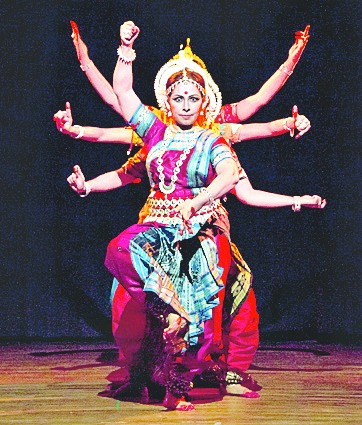

Kakali Bose, an Odishi dancer and a disciple of Kelucharan Mohapatra, presented Naman, an evening of Odishi dance, along with her group at the Satyajit Ray Auditorium, ICCR, in its Horizon series recently. Traditional items from the Odishi repertoire were presented in solo as well as in group choreography. The evening began with mangalacharan, an invocatory number, through bhoomi pranam, followed by ishtadeva vandana and trikhandi pranam, where the dancer offered salutation to the almighty, her guru and the audience.
This particular mangalacharan was chosen from Jayadev's Geetgovind. It had wonderful choreography by Kelucharan Mohapatra. The music was composed by Bhubaneshwar Mishra. The dancers were Sayoni Roy, Bidisha Saha and Chirasri Roy. Kakali selected " Jata juta", a Durgastuti based on ragamalika and talamalika for her solo recital, which was again choreographed by Mohapatra. Kakali showed her mettle in her precise chauk and tribhangi postures, neat bhramaris and sense of rhythm.
Pallavi, a pure dance number from the Odishi repertoire, was the next item of the evening. It was based on Raga Kirwani. The three dancers explored the multi-layered dimensions of rhythm and speed through their graceful movements and complex patterns of dance. Another Pallavi based on Raga Bilahari and taal Ektali was performed by Kakali in an elegant manner.
It was nice to get a chance to see Kelucharan Mohapatra's brilliant compositions this evening. Ashtapadi from Geetgovind is always a favourite choice for classical dancers. Kakali too chose " Sakhi hey", an ashtapadi, for her abhinaya number. Based on Raga Pahari and tala Jyoti, this number described the sambhoga shringara of Radha's fascination with her first love encounter with Krishna in a convincing manner. Kakali's lasya expressions were praiseworthy. Following the ritualistic practice, the programme came to an end with moksha, where the dancers seek salvation in and through their dance.
Vaishnav Padavali left an immense influence on Bengali music and literature. Starting from Jayadev's Geetgovind, followed by works by Bidyapati, Chandidas, Jnanadas and Govindadas, Vaishnav geeti-kabita continued to be popular in Bengal through various styles like baul songs and kirtan. Rabindranath Tagore was deeply moved by this tradition and by Brajabuli.
The thematic depth of Vaishnav geetikabita, the journey of finite beings towards an infinite supreme power, were reflected in various poems and songs of Tagore. Keeping in mind this philosophy, Brati presented Paran Bodhua Sone, a musical evening, at Rabindra Sadan recently. Conceived and directed by Apala Basu (Sen), a brilliant Tagore song singer, the entire programme was well conceived and enjoyable.