
Bhubaneswar, May 5: The Public Health Engineering Organisation (Pheo) will appoint a consultant to assess the city's water loss caused by leaked pipelines and various other factors and prepare an effective strategy to address the problem.
The Pheo supplies to the city about 295.30 million litres of water every day against its daily water requirement of 120.62 million litres.
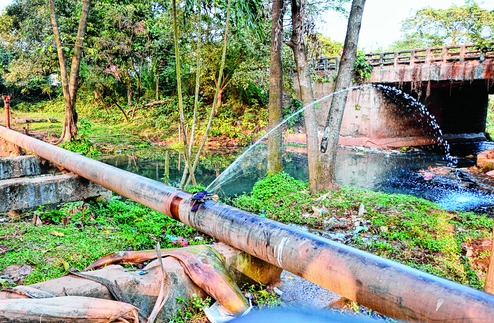
The Pheo estimates that about 50 per cent of the supplied water goes to waste because of leakages in the supply lines, water theft by private tankers and unauthorised connections.
"We made an assessment two years ago when we estimated that about 147 million litres of water was getting wasted every day," said Pheo superintending engineer C.R. Jena.
He said that the manual monitoring system was not enough to reduce water was-tage and that there was a need for a comprehensive strategy.
At present, the Pheo acts only when it gets a complaint about leakage or water theft. But according to the new plan, the Pheo will expect the consultant to do periodic checks with high-end equipment to detect such occurrences.
"We have decided to hire a consultant to help us formulate a strategy. The agency will be selected through tender and the process is likely to be completed by August," said Jena.
In April last year, the Pheo had planned to appoint a specialist team to check water supply lines on a regular basis and detect leakages. However, the plan didn't work out as the Pheo had no experts specialising in this particular area, said an official.
The Pheo had planned to send some of its officials for special training in the field. But that did not materialise as the organisation was already reeling from staff shortage.
While contributing to loss of water, the leakages also pose a risk of contamination of drinking water, which often results in the outbreak of deadly water-borne diseases, such as hepatitis. Water contamination due to faulty supply lines was blamed in almost all hepatitis outbreaks in and around Bhubaneswar.
In July last year, hepatitis outbreak due to faecal contamination of drinking water was reported from a slum not far from the chief minister's residence. About 50 persons were diagnosed hepatitis positive within one month and the government had to address the issue on a war footing to ensure that it did not spread to other areas.
"Many of the pipelines pass along the drains. So, drinking water gets contaminated with sewage easily if there are leaks in the supply lines. It causes many deadly diseases," said physician Gyanendra Tripathy, a Satya Nagar resident.
Apart from plugging the leakages, the administration is also planning to conduct surprise checks on households to detect unauthorised connections.