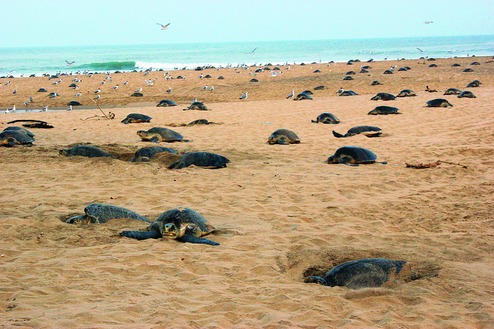

Paradip: A natural phenomenon that has increased the territory of the outer Wheelers' Island has made wildlife experts hopeful that the beach would prove congenial for mass nesting of olive ridley turtles.
Thanks to natural accretion (the process of growth or enlargement by a gradual build-up), the 1,000-metre-long beach now stretches up to 1,500 metres. The profile of the idyllic beach is perfect for turtles to crawl on and dig pits to lay eggs.
Sea erosion had wreaked havoc on the nesting ground in the past with the marauding sea eating up a sizable portion of the boundary.
However, it has come out as a pleasant surprise that the beach has got longer this year. "According to measurements conducted by wildlife personnel on Sunday, the beach now stretches up to 1,500 metres. We are optimistic that there would be more convergence of marine animals for en masse nesting," said forest official.
"Despite regular erosions, the Gahirmatha beach continues to be a favourite nesting ground for the turtles. Over six lakh female turtles had turned up to lay eggs last year," said Rajnagar mangrove (divisional) forest officer Bimal Prasanna Acharya.
"However, the nesting ground still lacks uniformity in its shape. Its form had become unbalanced with seawater inundating patches. Still, we are hopeful of a large congregation of turtles for mass nesting," the official said.
In some patches, the edge of the beach facing the sea has become too steep for the turtles to scale, said Gahirmatha forest range officer Subrat Patra. Strong southern winds and atmospheric temperature ranging from 32 to 38°C are conducive for mass nesting of turtles. The turtles are scheduled to turn up en masse shortly as the beach and weather are conducive to their annual ritual, said Patra.
Female turtles almost invade the beaches usually at the dead of the night to lay eggs, the phenomenon otherwise described as arribada. They then leave the nesting ground to return to the deep sea. The hatchlings emerge after 45-60 days.
It is a rare natural phenomenon where the babies grow without their mother, said the forest officials.