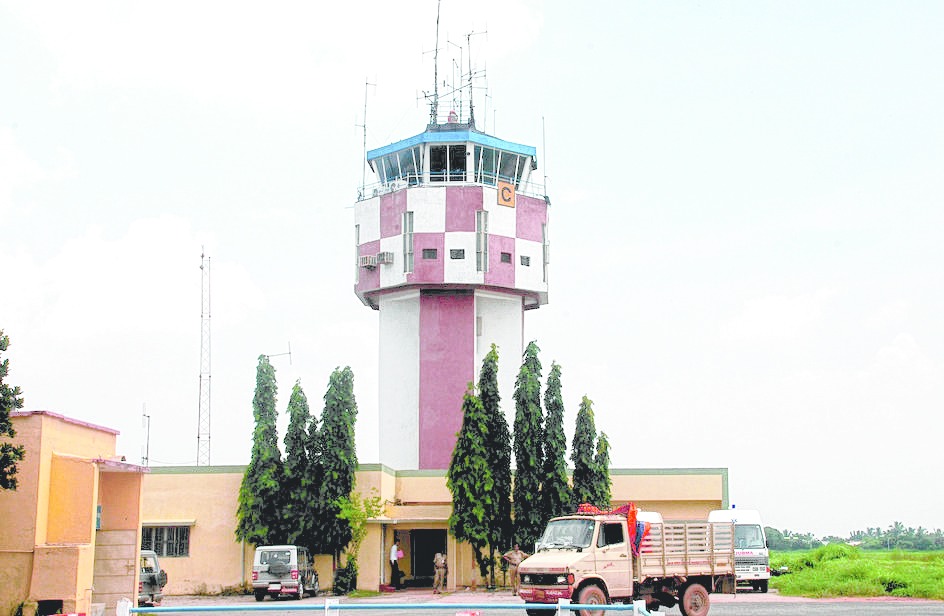

Bhubaneswar, Nov. 27: A digital weather forecasting system installed at Biju Patnaik International Airport will provide accurate data on wind, temperature and air pressure to the air traffic control (ATC) to ensure safe flying.
The Wi-Fi-based system has the capability of sending its observation automatically to the recipient (as set in its memory), so that the recipient can act according to the requirement warranted in the aviation sector.
According to the Indian Meteorology Department (IMD), the device is called the current weather instrument system (CWIS), which has been installed near the main runway of the airport.
Local director of the IMD Sarat Chandra Sahu said: "Earlier, the manual system was to be studied by a person for collecting data. But now, the new system can work automatically irrespective of weather conditions. It takes data from the runway area, so that the pilots can get real-time inputs. Earlier, the data used to be generated from weather observation equipment placed nearly 1km from the runway."
Airport director (in-charge) S.K. Siddha said: "The CWIS is extremely helpful for pilots as it detects the exact weather conditions over the runway. As weather conditions are vulnerable to local climate, the pilot after getting the data can feed into the computers in the cockpit to take decision on landing. The pilots always have automatic computer-aided mechanism to process weather data."
"The raw data received by the IMD officials is being processed through special systems and then referred to the ATC and even to the pilots. We send the data through e-mail to pilots of domestic carriers when they are already on air. This helps the ATCs have a better control over the aircraft and guide the pilots in taking decisions on landing," said Sahu.
The digital weather forecasting system was installed jointly by the IMD and the Airports Authority of India (AAI). In India, there are 21 airports (including those in Bhubaneswar, Patna, Gaya, Raipur and Goa), where the CWIS is in place to provide weather data.
Regarding the functioning of the machine, Sahu said: "The ordinary weather-reading tools are manually operated, but this one has highly sensitive sensors, which can trap the data to deliver the exact observation - which was not possible earlier."
However, he also said an automated weather observing system (AWOS) had already been installed in seven major airports across India such as New Delhi, Mumbai, Chennai, Calcutta, Hyderabad, Bangalore and Lucknow. The IMD local director said: "The AWOS can predict more parameters such as visibility range on the runway - which is very important for the landing and takeoff operations. It can also provide data on cloud amount and their formations."
Saying that the plan to upgrade the CWIS to the AWOS at the city airport is also on the IMD radar, Sahu said: "The process, however, has to be initiated by the AAI. Their local officials can apprise those in Delhi of this. Once the decision is taken, the system can be upgraded. Even we can now install additional sensors in the existing CWIS to get additional data on weather."
Regarding cost of the equipment, he said: "While the indigenously manufactured CWIS costs around Rs 4 lakh, the AWOS costs around Rs 60 lakh to Rs 70 lakh. The CWIS sends weather data continuously every half-an-hour to the ATC and the IMD office near the airport."
In another development, the Aviation Safety Week is being observed on the airport premises to sensitise stakeholders on airlines and airport safety aspects. The AAI organised a workshop, in which officials from various state government departments and quality assessment institutes took part.
Joint general manager (air traffic management) Yudhisthir Sahoo said: "Air safety is a collective responsibility and all stakeholders have to act in an integrated manner for it."
The airport director said: "The safety issue involving the bird-hit cases are happening in almost every airports, and it is not an alarming thing here. Agencies of the state government are also taking action as well as we are conducting grass cutting activities after the rainy season."