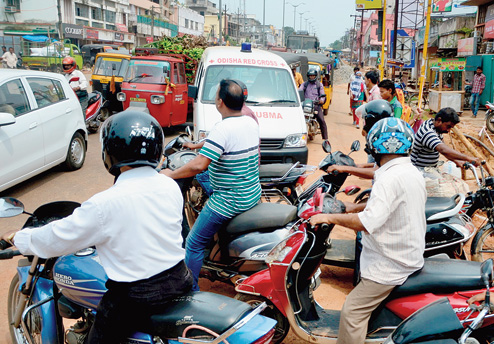

Picture by Ashwinee Pati
Bhubaneswar, Nov. 3: Bangalore, Chennai and Gurgaon have done it, but cops here want to ensure that unhindered movement of ambulances doesn't remain a one-off event.
After the initial push from chief minister Naveen Patnaik in September, the first step was taken here today with the police deciding to install global positioning system (GPS) devices on ambulances of private hospitals to provide them hassle-free movement on city roads.
Naveen had asked the police to develop a dedicated "ambulance corridor" in the state. He has also asked the police not to detain ambulances during VVIP movement.
The police today convened a meeting with representatives of private hospitals seeking suggestions regarding a dedicated corridor for ambulances. To take the process forward, a sub-committee comprising representatives of private hospitals, police, IT experts and 108 ambulance service was committee to taken the green corridor plan off the drawing board.
The panel will conduct a study to identify a suitable control room that would be integrated with GPS devices to be installed in the ambulances.
"While the police have a modern control room, the 108 ambulance service, which has expertise in managing such vehicles, also has one. The sub-committee would decide on possible ways to ensure hassle-free movement of ambulances. The sub-committee would submit its report in two weeks," said police commissioner R.P. Sharma.
The police have decided to equip traffic personnel with walkie-talkies so that the route of ambulances is cleared. "The control room will be integrated with the office of the assistant commissioner of police, traffic, and the movement of the ambulance would be tracked through GPS. Subsequently, the traffic personnel deployed at various intersections would be informed and they would give clear passage to the ambulances," said a police officer.
The police had earlier formed a committee comprising officials of National Highways Authority of India, works department, police and Bhubaneswar Municipal Corporation to discuss modalities of the service.
The police had asked the works department to widen roads in some areas so that an ambulance lane could be earmarked.
Speaking about the effort, security officer of Apollo Hospital Radha Shyam Mishra said: "We will lend our full support to the police as a dedicated ambulance corridor would help save the lives of patients who very often get stuck in the busy city traffic."
The critical need to give free passage to ambulances grab-bed national headlines in May when a burn injury patient died in Bihar's Hajipur town as the vehicle taking the victim to the hospital was caught in a massive traffic jam that was spurred by an agitation.
The cops also want to involve the people in implementing its plan. To do that, the traffic wing of the police has decided to conduct a massive awareness drive to educate commuters on the need to give clear passage to ambulances.
"We find many drivers not letting ambulances pass due to lack of discipline. We will carry out an awareness drive for drivers," said assistant commissioner of police (traffic), Jatindra Kumar Panda.
♦ In August last year, Chennai created history by becoming the first Indian city to create a green corridor to transport a harvested heart in less than 14 minutes from a government hospital to a facility 12 km away
♦ A month later, a similar green corridor was created between Bangalore and Chennai to transport a heart from a
hospital in Bangalore to a health care facility in Chennai. The 350km journey was over in less than 2 hours. In the first case of inter-state cadaver transfer, the heart travelled 55km within Bangalore before it was flown to the Chennai
airport and from there to the hospital
♦ In January this year, cops of Delhi and Gurgaon joined hands to facilitate a green corridor to transport a harvested heart 32km away in 29 minutes. The heart was transplanted into a 16-year-old boy