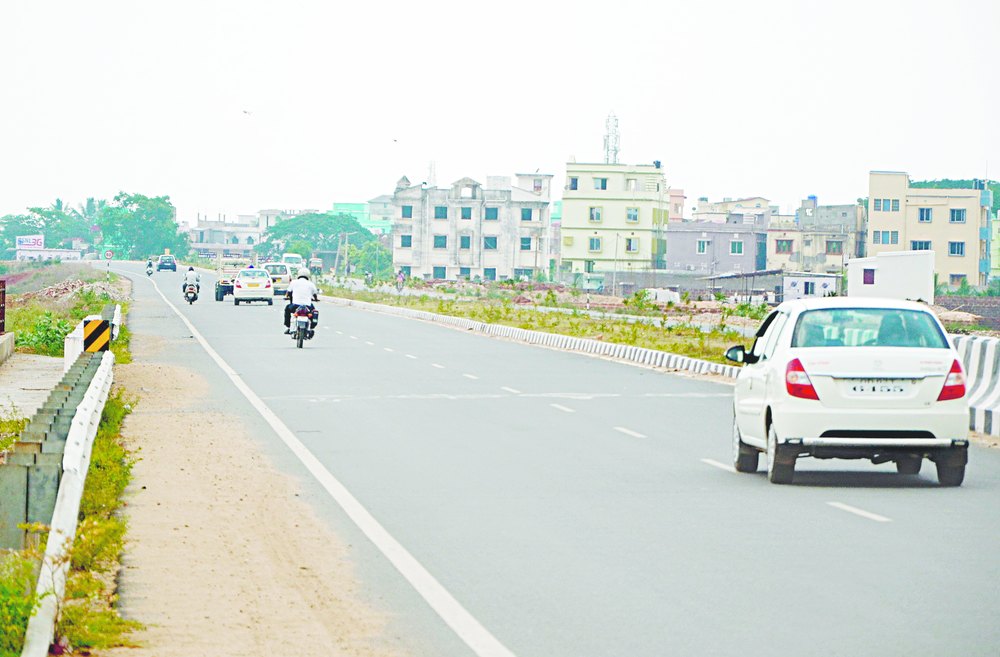

Bhubaneswar, May 31: Illegal constructions continue to come up along the National Highway (NH) 203 between Pandra and the Daya bridge, while the development authority and the National Highways Authority of India (NHAI) indulge in blame game.
The stretch along the NH-203 between Pandra and the Daya bridge has seen a real estate boom in the past three years.
While the Bhubaneswar Development Authority regulations stipulate that no multi-storey building can be permitted to come up within 100 metres from the centre of a national highway, the reality is something different. Numerous structures have come up on either side of the highway within the restricted zone. Moreover, it is a low-lying area and suffers from waterlogging during heavy rainfall. The illegal houses are also affecting the locality's drainage system.
NHAI project director Anil Dixit said: "There should not be any construction within 30 metres from the centre of the highway. The unplanned growth will create problem for the drainage system. Also, if the number of houses keep increasing here, one day the major stretch will end up like a district-level road."
On this, planning member of the authority Sudhiranjan Mohanty said: "While the mandatory restriction is for 30 metres, the authority has increased it to 100 metres to keep a buffer zone. All other government agencies that also have areas under them should take action to remove illegal structures."
Architect Akshaya Beuria said: "According to the authority's building regulation, the 100-metre restriction on construction of multi-storey structures near the highways is in force to facilitate proper drainage of rainwater."
To a question why the authority did not take any action while the houses were being built, Mohanty said: "Nearly four months ago, the enforcement wing carried out a demolition drive along the stretch, where buildings had been built without plan approval. We will take up such drives in future as well."
An official of the enforcement wing clarified that though there was a mechanism to stop construction of illegal structures through issuing a stop-construction notice by informing police, in practice, the landowners continued to build houses as there were options to appeal against the notice in the Odisha Development Authority court as well.
"Already the police are over-burdened with law and order situation. The development authority is also having inadequate number of field employees to monitor the building construction activities in the low-lying, flood and restricted zones," he said.
Dixit said habitation close to a major road such as a national highway always triggered traffic problem. The NHAI, he said, had written to the development authority to restrict the growth of unauthorised structures along it.
Mohanty, however, said: "The NHAI acquired land on both sides of the highway by paying a huge compensation. They have to protect it from encroachment. As the development authority has no dedicated mechanism to act on the NHAI's own land, they should come forward to evict the squatters."
"The diversion of the NH-203 from Pandra to the bridge and beyond was done to facilitate better traffic movement from Bhubaneswar to Puri, but the way the houses are being built, the plan may not be successful at all," said Lipu Jagaddeb, a resident of nearby GGP Colony.
A senior highways authority official admitted that there were instances where even after receiving compensation, people were yet to vacate the land. The state government must come forward to remove them from the area, he said.
Besides, environmentalist Bijay Mishra said the flood zones along the NH-203 bypass between Pandra and the bridge was an eco-sensitive locality. "The area is low. If illegal constructions near the major road is not controlled, it may complicate the situation in rains and especially when water from the Kuakhai river floods the area," he said.