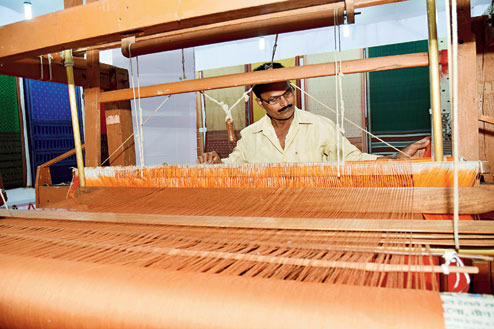

File picture of a weaver working on a loom at a handloom exhibition in Bhubaneswar
Bhubaneswar, Sept. 2: The state government will set up a handicraft and handloom development board to promote the industry and ensure welfare of artisans.
Chief minister Naveen Patnaik made the announcement yesterday after a meeting with a delegation from the Kalinga Shipi Mahasangh, a federation of handicraft artisans and weavers.
The delegation had handed over a memorandum to the chief minister with the signatures of around 50,000 artisans and weavers from across the state.
The Mahasangh had staged a demonstration in front of the Assembly to demand special attention to the sector, which earns foreign exchange for the state.
'If a separate board is set up, it can look after the problems faced by the handicraft artisans and handloom weavers,' said Priya Ranjan Kar, general secretary of the Kalinga Shilpi Mahasangh.
Odisha is known for production of handloom and handicraft products. More than 3.5 lakh weaver and artisan families earn their livelihood from this diverse production base.
The Mahasangh had, in the past, drawn the government's attention to the scarcity of raw materials, lack of state patronage and unhealthy competition from the companies duplicating the design of Odissi handloom saris and selling them at cheaper rates in the market.
Recently, the implementation of the Goods and Services Tax (GST) that has put handloom and handicraft products in the 5 and 18 per cent slab has also hit the state's artisans and weavers. 'We have been hit hard by this development,' members of the delegation told the chief minister.
Naveen said the state government had already taken up the matter with the Centre. He also wrote to Prime Minister Narendra Modi yesterday and urged him to waive GST on these indigenous products.
'The issue needs urgent reconsideration in the GST council for extending GST exemption on these products in the interest of the weavers and artisans,' Naveen said.
The chief minister said prior to the introduction of the GST, the state government had always exempted these products from value added tax (VAT) and there was also excise duty on most of these products.
But now handloom fabric and handloom apparels have been made taxable with the GST rates of 5 and 12 per cent respectively while handicrafts have been levied a GST rate of 12 or 18 percent depending on the type of handicraft, he said.
'Although my finance minister had strongly argued in the GST council that handloom and handicrafts should be kept in the exemption list, it was not agreed to. This will likely lead to increase in prices of these products, which will adversely affect the livelihoods of the poor families depending upon the products of these goods,' said the chief minister.
That apart, artisans faced severe difficulties following the Centre's announcement to scrap all high-value currency notes last November.
The handloom sector in the state has been struggling for survival for years. It lags behind in popularising the indigenous patterns and fabrics of Odisha whereas private players are managing to do roaring business.
The plight of weavers, many of who cater to government textile organisations, have quit their hereditary profession in the past few years because of financial pressures. The weavers, who are not covered under co-operative societies, find it hard to run the profession because of inadequate wages, rise in price of yarn and absence of an organised market.
In 2015, the Union ministry of textiles announced that an incubation centre to encourage budding designers and weavers would be constructed near the National Institute of Fashion Technology here.