 |
Assamese poetry recitation albums are not new in Assam. Saptarshi — the album launched during late 1970s, containing enchanting recitations by Bhupen Hazarika, Ishan Barua, Amarjyoti Choudhury and others of Assamese poems by Rupkonwar Jyotiprasad, Nilmoni Phukan, Navakanta Barua, Keshav Mahanta and Hiren Bhattacharyya, was probably the first to create the tradition in this particular field of performing arts in Assam.
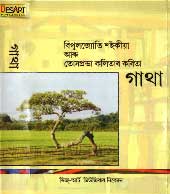
Since then there have been numerous albums of Assamese poetry recitation and thus a rich trend has come into existence. The latest of the same genre, Gantha is undoubtedly a noteworthy contribution to this trend. Produced by DesArt music, the album Gantha presents recitation of 24 modern Assamese poems by Toshaprabha Kalita and Bipuljyoti Saikia. The recitations have been rendered by Kamal (Rana) Sarma, Bibhuranjan Choudhury, Santwana Bordoloi, Aboni Bora, Shrutimala Dowera and Toshaprabha Kalita.
Of the poems by Bipuljyoti Saikia, the recitations of Edin Hothat and Pahoronir Noi by Kamal (Rana) Sarma deserve to be mentioned first.
While in the first number the elocutionist strikes the mood of a mysterious future and a quest for the beginning of life, the second number depicts the pathos and whispers of the poet about his lost childhood with ariver as the metaphor. The music in these two numbers, composed mainly with violin and santoor, complements the recitation.
Bibhuranjan Choudhury also excels in three numbers: Geetapaath, Prithivi Naatghar Howa Hole and Matribhumi. Choudhury’s heavy voice seems to be an asset in these. Aboni Bora marks his skill in Tumi Mor Utsa.
But he fails to reach the expectation in the number Swapna-Smriti-Bishador Gantha, although the use of the sitar in raga megha is superb here, besides the rare intensity in the poem itself.
Santwana Bordoloi and Shrutimala Dowera present an average performance.
Toshaprabha Kalita’s poems narrate a sublime story and hence the recitation of such poems deserves ability to maintain two simultaneous tracks. Aboni Bora scores here in two numbers, Karnabishadyog and Nagina Basforor Mrityut. His rendition brings the visual dimensions to the forefront.
Kamal (Rana) Sarma proves his class in Guwahati 1982 but he disappoints in Bartajivi. Bibhuranjan Choudhury’s two numbers — Mahabharatar Kotha 2002 and Punaragamanaya, are real treat for all those who lovepoetry.
Similarly, enchanting are Santwana Bordoloi’s Sita and Shrutimala Dowera’s Anya Ek Sita. But the pleasant surprise of the album is Toshaprabha Kalita’s recitation of her poem Deiza.
The music of the album has been directed by Manoj Sharma, who leaves no stone unturned to take the recitations to rare heights.
So do the musicians — Hem Hazarika, Dipak Sarma, Pankaj Sarma, Manoj Barua and Amarjyoti Deka.
Rong Sarmah