
Guwahati, March 15: The rhinos in Laokhowa-Burachapori wildlife sanctuary in central Assam will meet the same fate like those in Manas National Park if the poaching threat is not eliminated, an expert group has warned.
The only difference is that rhinos are already present in Manas whereas in Laokhowa-Burachapori wildlife sanctuary, rhinos will be brought from Kaziranga.
A specialist group of IUCN-Conservation Breeding Specialist Group (CBSG), an expert group under International Union for Conservation of Nature (IUCN), in its draft population viability analysis report of Laokhowa-Burachapori wildlife sanctuary, has suggested that loss of one to two animals a year because of poaching hugely increases the probability of failure of a translocation programme.
Population viability analysis is an extremely useful tool for investigating current and future demographic dynamics of greater one-horned rhino populations distributed across Assam, the CBSG says.
Vortex, a simulation software package, was used to carry out the population viability analysis.
In the early 80s, the Laokhowa-Burachapori wildlife sanctuary had more than 70 rhinos.
The population gradually decreased because of natural deaths and poaching especially hard-hit during the period of civil unrest from 1980-1991, until it was extirpated in 1991.
Laokhowa wildlife sanctuary is spread over 70.01 sq km in Nagaon district and Burachapori wildlife sanctuary over 44.06 sq km in Sonitpur district. The Laokhowa-Burhachapori area plays a critical role as a corridor for rhinos between Kaziranga and Rajiv Gandhi Orang national parks.
Ten rhinos (four this year) are being planned to be translocated from Kaziranga in two years. The report says if poaching can be largely eliminated as a threat to this emerging population, the translocation of just six to nine adult animals each year for just three years may be sufficient to create the demographic conditions necessary for sustained positive population growth.
"This optimistic prediction is critically dependent on minimising the rate of loss of animals through poaching," it said.
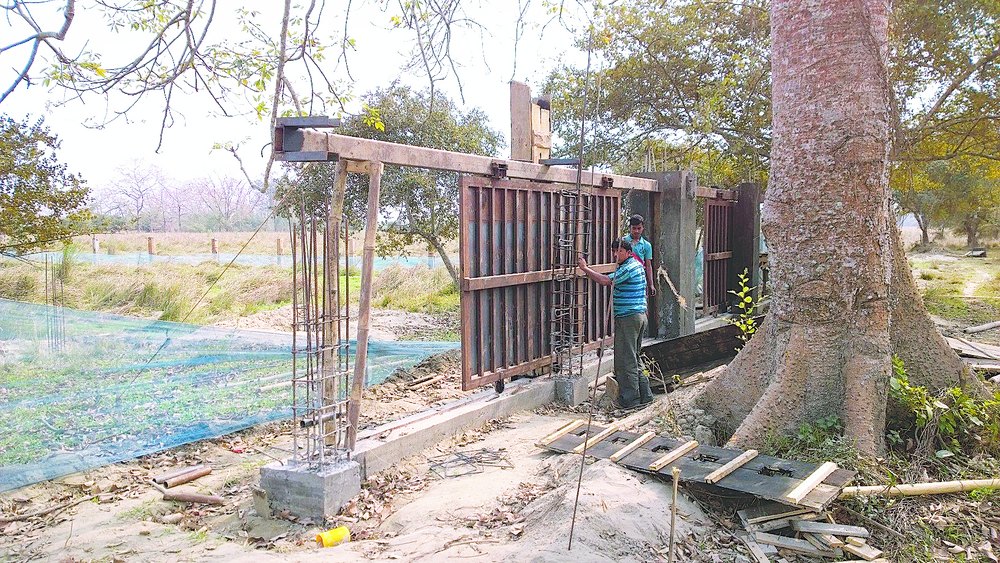
A senior forest department official said this time, the rhinos will be contained in a very large boma (enclosure) prior to their release into the sanctuary to help them in acclimatisation.
"The boma will have five security layers to make it totally impregnable," the official said, adding this will be the one-of-its kind in the state.
The enclosure for housing the translocated rhinos has been divided into two basic parts - the holding-cum-training boma and the main boma. Since rhinos would be translocated straight from the wild, it was decided to build a holding boma first and keep them there for 30-60 days before releasing them into the main boma.
"This would get the rhinos oriented to an electric fence situation and contain them within the permissible perimeter of the electric fence as far as possible. The translocated rhinos would be released into the main boma once they are seen to be adapted to the desired levels of response to an electric fence," the official said.