 |
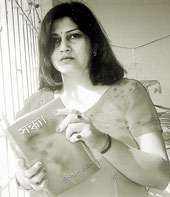
Loneliness feeds her creativity, life plays her muse and silence is her best pal when she picks up her pen. Monikuntala Bhattacharyja, the new face of Assamese literature, is also the face of the new-age woman, juggling her career, passion and familial responsibility with equal elan.
So, while she prefers to have complete silence when she sits in her study, she is also the heart of any party, a dash of sunlight among her friends and admirers.
Though her creativity draws sustenance from loneliness, Bhattacharyja?s personal life is a picture of happy domesticity.
In her flat at Chandmari where she lives with her husband and daughter, she plays the role of a perfect homemaker.
Bhattacharyja skilfully manages time to cook her husband?s favourite dishes and play computer games with her teenaged daughter. Yet, she always feels a sense of despondency for which she herself has no answer at all.
?Maybe my sense of loneliness gives me an impetus to write and writing helps me get over it,? she says.
The winner of prestigious Munin Barkataky award for 2004, Bhattacharyja confesses that she spends most of her time writing. The award was given for her short story collection Prastar Kanya. ?Winning the award is like fulfilment of a long cherished dream,? says the author with childlike enthusiasm.
?Nothing is more satisfying than winning the hearts of my readers.?
To talk of her fan following, the author in her mid-thirties, her admirers range from a young school going kid to a man in his late seventies. ?To be honest I don?t follow a strategy to win admiration from different sections of the society, perhaps my readers are touched by my honesty to portray life without any pretensions,? she says.
?Along with writing about society, my emphasis always lies in highlighting women-related issues, since I am a woman portraying female protagonists with their deep and unattended emotions is an easier task for me.?
Daughter of a government employee, Bhattacharyja was blessed with a destiny to visit different places since childhood.
?Seeing my immense interest in reading, my father Bhobani Sharma is always generous enough to bring me books from different parts of the country,? she says.
?Although he never asked me to write, I can still remember the mythological anecdotes he narrated on a regular basis.?
She wrote her first couplet as a young girl of four years old, tremendously touched by the plight of two disabled persons. By the time she was in the ninth standard, she used to write poems on a regular basis. During that time she maintained notebooks on her poetry.
However, this young poet went into a long hibernation after she got married at 18, when she was still pursuing her graduation at Nagaon Girls College.
?I myself is short of answers when ones ask me why I stopped writing for 12 years,? she confesses. ?In spite of having a loving husband and a very caring family, I went through a period of great despondency, supplemented with a sense of bereavement.?
She went through a phase of bereavement as her father died after she got married. ?Even after two years of his death, I could not shed a drop of tear as the shock was so severe and I could not react instantly,? she says.
But when her husband, Paran Kumar Phukan, was posted in Goalpara in 1999, their house at the top of a hillock, surrounded by picturesque hills, fired her imagination. She wrote her first poem after a gap of 12 years.
Titled Jooban, the poet sent a copy to Aamar Asom, then edited by Homen Borgohain. The poem earned her immense admiration from a large section of readers, but also from the editor himself, who wrote a letter of appreciation for the poet?s creative instinct.
Thereafter, every Sunday, three poems by the poet were published in different magazines and newspapers of Assam for quite a long time.
Though poetry is her favourite genre, the author is yet to publish her book of poetry.
Her first book, Prastar Kanya, was published in 2002. This was followed by her novel Sandhya, on AIDS.
Till date she has written 13 novelettes, published in various Assamese magazines.
However, the author is most associated with the novel Arundhuti, the story of a woman and her two marriages. The depiction of the protagonists experiences were so realistic that the author?s admirers took it to be her own story.
?Letters and phone calls flooded my place, enquiring how far the story was based on my life,? she remembers. ?Many readers think that writers write stories based on their own life, which in many cases is not true.?
But with success and admiration she encountered criticism. ?A novelette of mine Swapna Sambhab was taken off midway from a vernacular magazine, as the story was based on AIDS, which demanded me to write on sex and the preventive measures one should adopt for the prevention of the killer disease.?
Accused of depicting moments of man-woman relationship which are too intimate for the readers? comfort, the writer answers, ?If they are disturbed that I write truth in its truest colour, then I demand that let us come out from the shackle of traditional writings, where we always depict of household chores and very often the desires and despondency remain hidden.?
The author has just finished the script of a 13-episode serial titled The Gateway for renowned theatre and film personality Kulada Kumar Bhattacharyya.
?The freedom of expression given to me by Bhattacharyya sir is really hard to find,? she says.
?I have been given full freedom as a writer to paint my characters the way I perceive and there is no censorship in my thoughts and creative urge while writing the script.?
She is also planning to turn The Gateway into a full-fledged novel in the near future.
She is also writing three novelettes for the Bihu edition of three Assamese magazines. Simultaneously, she is also writing her magnum opus, presently she has finished eight episodes of the novel.
While she shares a good rapport with Nabhakanta Barua and Niloprabha Bordoloi, she is reticent about speaking on women writers, ?I am too small to comment on the subject, but we have seen several brilliant women writers in Assamese.?
?But the present situation demands us to change and highlight issues which remained shrouded in obscurity for being considered taboo in our society.?
For an author who converts her despondency into lyrical verse, life is bliss as long as she finds plots and characters that excite her enough to nourish them with life.