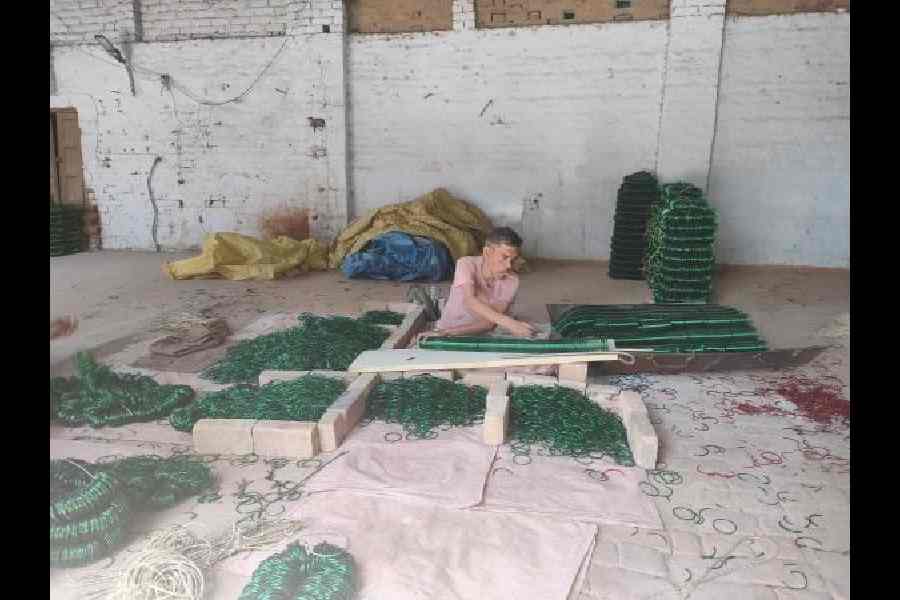
The shortage of natural gas in the wake of the West Asia war, combined with strict environmental restrictions in the Taj Trapezium Zone (TTZ), has plunged the Firozabad glass industry into a crisis that has impacted the livelihoods of many daily wage workers.
TTZ is a 10,400sqkm protected ecological area around the Taj Mahal spanning parts of Uttar Pradesh and Rajasthan. It is meant to shield the monument from pollution by banning coal use in local industries and mandating a switch to natural gas.
Unable to shift to alternative fuels, production by the glass industry in Uttar Pradesh’s Firozabad has declined by nearly 40 per cent.
“We have no alternative fuel options left. Since Firozabad falls within TTZ, the use of fuels like wood or coal is strictly prohibited,” said Lalitesh Jain, president of the Glass Industrial Syndicate, Firozabad. “This has led to a 40 per cent drop in production.”
Often called the “Bangle City” or “City of Glassware”, Firozabad is famous for its centuries-old tradition of glass-making.
Around three lakh people are employed by nearly 150 factories manufacturing bangles and 30-40 units producing glassware.
Now, the city is starved of fuel, bringing the glass units to a near standstill.
Gas Authority of India Ltd (GAIL) manages the supply of regasified liquefied natural gas (RLNG), which is essential for running the furnaces. Mostly, the RLNG comes from imports through the Strait of Hormuz.
Many factory owners welcomed the government’s recent decision to extend a 70 per cent commercial LPG allocation to glass industries, but said it would not meet their requirements.
“Gas supply disruption has prompted some to scale down machinery and others to reduce capacity and cut production,” Jain said. “This has led to losses worth crores, as reduced output has impacted our earnings.”
Jain said he had not sacked any permanent employees in his glass factory and had not heard of others doing so either.
However, many daily wage labourers have seen reduced work, making it difficult for them to sustain their livelihood.
“We are not getting jobs, and earning is becoming difficult day by day,” said a daily wage worker, who was seen roaming outside a factory.
Some distance away, a few others were sitting in a group and waiting for work.
“We are no longer getting regular work. The situation is worrisome,” one of the workers said.
In a bid to avoid the punishing heat, these jobless workers are often seen resting under trees or makeshift sheds around the kilns, passing time talking with one another or scrolling their mobile phones.
“Where do we go? I am not able to earn enough to even afford food. We are not getting LPG either. Inflation has made things worse. No one cares for the poor. This crisis has made life miserable,” said Madhav, a daily wage worker.
“We get ₹530 per day, which comes to around ₹15,000 monthly. But now some factories are operating only for 12-15 days, which means we can only earn around ₹6,000-7,000,” Pankaj, standing next to Madhav, weighed in. Many fear the factories might shut down.
A worker complained that he was having trouble procuring a domestic LPG cylinder and is using kerosene and wood stoves to cook food.
Sanjay Kumar Jain, who runs a glass factory, said: “We are able to manufacture very little, so we need less workforce. We are not earning enough. We don’t have money. How will we pay the daily wage workers?”
The factories are fully dependent on gas to operate high-temperature furnaces that need to run constantly at above 1,000°C to keep the glass molten and prevent any defects.
Many small and medium units are either shutting down for a few days or reducing their furnace capacity. A factory watchman said some units were operating irregularly.
A few factories are planning to switch to smaller bhattis (furnaces) that consume less gas.
The production of glass bangles is a multi-stage, labour-intensive process that involves melting glass, shaping it into tubes, cutting and joining them into circles and then decorating and polishing them. Furnace workers, glass shapers, cutters, joiners, designers, polishers and traders, along with many daily wage labourers, contribute at each stage.
Shamim Khan, 60, who designs and polishes bangles, said the crisis had led to a spike in the cost of raw materials such as sulphuric acid.
“The price of sulphuric acid, which is used to clean glass components, has increased sharply, from ₹8 to ₹55 per kg. Prices of everything are rising, but wages remain unchanged. The chemicals used in designing have also become more expensive. Overall, the cost of everything is going up,” Khan said.
Ali, who sells bangles from a cart, complained of a decline in sales. Many shopkeepers said they were not able to stock new items because of production cuts.