 |
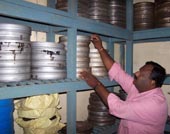
| The rudimentary film archive at Jyoti Chitraban Film Studio Society. Picture by UB Photos |
Film is a teller of history. With every foot of film that is lost, we lose a link to our culture, to the world around us, to each other, and to ourselves,? said filmmaker Martin Scorsese.
With the disappearance of the original print of Joymoti, the first Assamese feature film by Rupkonwar Jyotiprasad Agarwalla, a slice of history has indeed been lost forever. Proper scientific storage and preservation of films in archives is still at a nascent stage in Assam. Assamese film industry?s lackadaisical approach towards its own history is appalling.
Celluloid decays within years if not properly stored. The loss is already great. ?Very few Assamese feature films survive in their complete form in film archives. The handful include the national award winning films, which are preserved in the National Film Archive of India in Pune. For shorts, documentaries, and independently-produced works, we have no way of knowing how much has been lost,? Film critic Chandan Sarmah says. Still at risk are documentaries, silent-era films, avant-garde works, ethnic films, newsreels, home movies, and independent works.
The Northeast Film and Television Producers and Directors? Association is planning to urge the government to set up a film library and an archive in Assam. Filmmaker Gautam Bora, the president of the association says, ?We will take steps to assess the loss and condition of the films. A lot depends on the initiative of the producers to store the films and its negatives. As directors, we are very helpless.?
At present, a film archive is at a rudimentary stage in the Jyoti Chitraban Film Studio Society in Guwahati. It?s one of its kind in the entire Northeast. Nabajyoti Das, its librarian-cum-archive officer, says, ?We have no modern infrastructure. We have an air-conditioned room where film cans are stacked in a scientific manner.?
?We have urged the Union government to provide us with modern tools like a humidifier control and an anti-fungus plant to protect fungal infection,? he added. Das, who has a library science background, says they store only the reels in print form and audio sound negatives. ?The producers have to apply to the authorities and pay a minimum fees. We have an auditorium for 35 mm (big screen) and 16 mm films. The producers deposit the films and we don?t have prints of our own. We provide these films to NGOs and individuals who want to see them.? The archive, however, has only about seven to eight films and around 15 documentaries.
Doordarshan Kendra, Guwahati, too, preserves films in betacam format in its air-conditioned library. ?Earlier, it was preserved in the umatic format and later transferred to betacam. We preserve our own productions, commissioned programmes and feature films approved by Doordarshan,? said an official of Doordarshan Kendra, Guwahati.
?For approval, a producer has to apply and experts of an independent committee watch the film and grade the film according to quality. The producers are paid according to the grade of the film. Generally, producers do not prefer to give new films to us,? he adds.
Film preservation is expensive. ?Film deterioration can be combated through an integrated, three-pronged strategy. This involves printing old film into new, more stable film stock, storing film materials under cool-and-dry conditions, and providing access through modern copies,? says veteran filmmaker Kulada Kumar Bhattacharya. ?By integrating these processes, the public can study and enjoy access copies on film and video and archives can conserve the original source material and preservation master so that they will be available for years to come.?
A film consists of a clear plastic base, a much thinner layer of gelatine emulsion, and an image composed of either colour dyes or, in the case of black-and-white film, very small particles of silver. The goal of preservation is to avoid deterioration in any of these components.
In order to protect films, they should be kept in a cool place, which is neither too damp nor too dry. Major Hollywood studios and other large film archives have built specially designed, humidity-controlled cold storage vaults to preserve their films. However, understanding the nature of the film decay and taking a few simple precautions can help everyone achieve the longest life possible from a film collection.
The National Film Archive of India (NFAI) was established in February1964 in Pune, as a media unit of the ministry of information and broadcasting. Its objective is to acquire, preserve and restore the rich heritage of national cinema, and the best of international cinema. The archive has made significant progress in the preservation of films, audio and video material, documentation, research and dissemination of film culture in India.
With its headquarters at Pune, NFAI has at present three regional offices, at Bangalore, Calcutta and Thiruvananthapuram. Regular joint screening programmes at important centres like Bangalore, Calcutta, Mumbai, Hyderabad and Thiruvananthapuram expose audiences to the fascinating history of Indian and world cinema. The NFAI, in collaboration with the Film and Television Institute of India, Pune, conducts an annual film appreciation course.
?Films document life even when they deal with fiction. Historians are continuously expanding their range of source materials and films are one of them. Its natural that a historian would welcome setting up of a film archive,? says noted historian Amalendu Guha.
?There should be the widest possible public access to all preserved materials. Usually, selected film archive material is made available for research in the form of viewing copies on VHS, DVD or film. Many of the archives also offer screening facilities for larger groups and may provide teaching resources to institutions within their region,? he adds.
?Users should also bear in mind that copyright and other usage restrictions may apply if you are seeking to copy or re-use moving images from the collections. Users should discuss their requirements with the respective archive,? cautions Guha.
Veteran actor Nipon Goswami, who played the lead romantic role in the Brajen Barua blockbuster Dr Bezbaruah (1968) laments that the film?s negatives are lost forever. ?The film was a trendsetter, which set the course for commercial films in the Assamese film industry.?
He says, ?There were plans of setting up a film archive in Srimanta Sankardev Kalakshetra. It?s long overdue and our future generations will have to miss out on some valuable pieces of history. By saving and sharing these motion pictures, we can illuminate our common heritage with a power and immediacy unique to films.?