 |
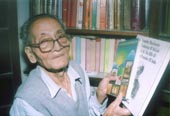
Interacting with Suryyakanta Barpujari the historian is akin to reading the pages of history. Each of his words, laced with expression, is analytical, enriching and, at times, proves to be prophetic. His vast corpus of knowledge in the field buttresses his approach to consider the subject as social science.
?How can one define history? In simple words, history is culture, tradition, values and a lifestyle adopted by the people of a nation or a place,? he muses.
?And with the flow of time, history goes through changes and that needs to be recorded, studied and understood. Losing even a single episode of history is an irreparable loss.?
The octogenarian scholar, after surviving a severe accident a few years back, prefers to spend his time at home and work and bring out the lesser-known histories of the Northeast to the forefront.
At present, he is planning to write the history of his illustrious family. Son of Padmakanta Barpujari, teacher of Golaghat Government Bezbarua High School, his brother is the revered Assamese historian, H.K. Barpujari.
?A scholarly atmosphere prevailed in our home and most of the erudite scholars of that time frequented our place,? he recalls.
?During my college and university days, World War II was at its peak, which had a lasting impression on my mind. And from that time onwards, I wanted to become a student and observer of events and history.?
After obtaining his graduation degree in history from Cotton College, Guwahati, Barpujari took his Master?s degree from Dacca University, now in Bangladesh.
?My brother was posted at M.C. College of Sylhet. Since we lost our father when I was only eight months old, my mother and I stayed with my brother. Dacca University was not only close to Sylhet but was also the most prestigious institute of the time,? he recalls.
During his university days, he became a member of the pacifist Progressive Union. Barpujari vividly remembers the days of the Quit India movement in which he participated with full vigour.
?I am an eyewitness to the movement. From freedom fighters and students to children and even housewives, all were out on the streets demanding the withdrawal of British colonialism from India,? he remembers nostalgically.
He was first posted as an assistant lecturer in history at Cotton College in 1945. He also taught history in B. Borooah College and Pragjyotish College, Guwahati.
He has also served as principal of Haflong College in North Cachar Hills district. Later on he joined Gauhati University as a Reader in Modern History, retiring in 1981.
Owing to his experience and expertise in writing history, he was also appointed an editor-cum-co-ordinator in the department of political history of the Assam government at Dispur on deputation from Gauhati University.
After retirement, Suryyakanta Barpujari worked as a research fellow in the Indian Council of Historical Research. He presided over the fourth session of the North East India History Association at Meghalaya and the history session of the Asam Sahitya Sabha, at Goreswar, Assam. But his active involvement in founding the Assam College Teachers? Association contributed a lot to the betterment of the teaching fraternity.
Even 25 years after his retirement as a teacher, young and enthusiastic historians flock to his Rajgarh flat in Guwahati to gain from his vast store of experience and knowledge.
?Though I am suffering from several old age ailments (and after a recent accident I find it difficult to even walk), I cannot say no to anybody who is ardent enough to know more about the history of the region. So, I welcome all of them,? he said.
The historian has even donated valuable books from his personal collection to several public libraries and study centres in the city and gifted some to a few of his favourite students.
?For the past 60 years, I have been buying books on different topics of history. Most of them are now considered rare books,? he says. To that he adds, ?Instead of keeping them with me, I want more and more readers to know and read about these books.?
The historian is generous not only with his erudition, but also treats guests to tea and his favourite chocolate cake, which he himself prepares when he is at home. ?I do bake a cake at times,? he smiles.
After the death of his wife some years back, Barpujari stays with his daughter Indrani, who is conducting research in anthropology. The father-daughter duo not only looks after one another but also shares their knowledge in the fields of history and anthropology.
Apart from being a reputed and respected teacher, Barpujari has written important historically relevant materials for research journals and newspapers of the country and abroad.
Till date, he has published three books. One is The History of the Dimasas (From Earliest Times to 1896 AD), published in 1997 by the Autonomous Council of North Cachar Hills, Haflong, Assam. The Nagas: Evolution of Their History and Administration (1832 to 1939) is a documentary study published jointly by the North Eastern Hill University, Shillong, and Spectrum Publications, Guwahati, in 2003.
Alexander Mackenzie and Evolution of British Policy in the Hills of Northeast Frontier of India was published by Spectrum Publications, Guwahati, in 2003. His second book is a must for obtaining a complete picture about the history of the Nagas, the most talked-about tribe of the region.
I know the Nagas from very close quarters. From a village headmen in the interior of Nagaland where development is yet to have an impact to the modern-day man well-versed with current trends, everyone is proud of their long and cherished history,? he says.
To that he adds, ?Their ardent love for their place, language, tradition and culture inspired me to write a book on them and I feel good whenever someone comes and talk about the book.?
The book contains a valuable collection of documents that forms the basis of an extended analytical study of the long and nuanced relationship between the British and the Nagas.
The set of letters by British administrators is also important, not only as documentary evidence, but also in conveying the drama that lies behind the law governing the common man and the bureaucratic policies.
?My last wish is to write a worthy book on the history of my motherland since the time of the British,? he says, sighing, ?Hopefully my health will permit me to accomplish my work.?