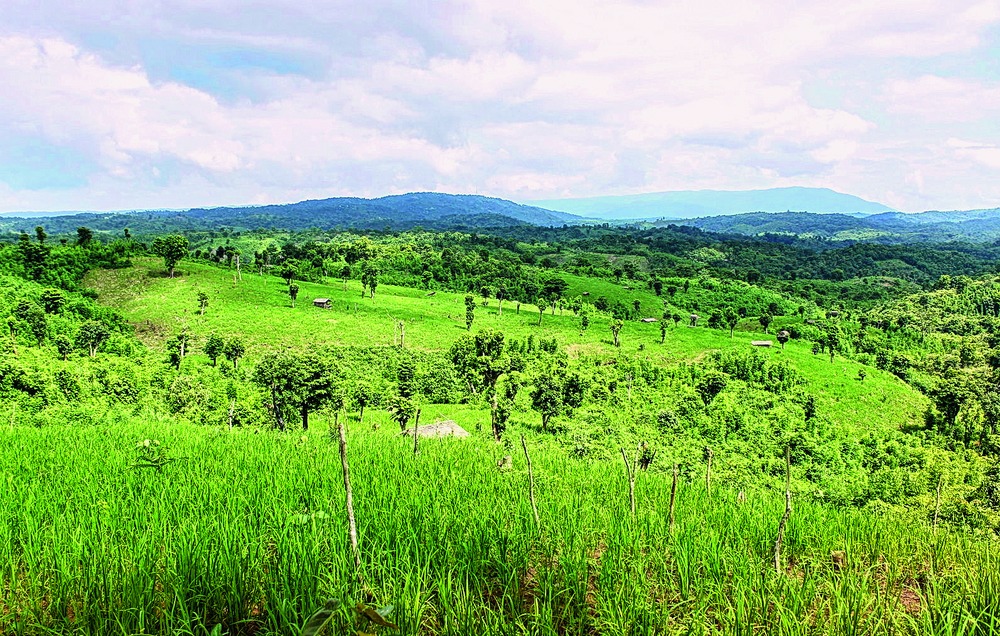

Tura, Feb. 16: It is the time of the year when vast forest areas are being cleared for jhum or shifting cultivation in Meghalaya's Garo hills.
Though efforts to convince the indigenous people through different programmes are under way, they have failed to yield much result.
Environmentalists say jhum is associated with the culture of the people and hence has become difficult to ban or regulate it. However, the concern many raise is that if the government has to promote its ambitious sustainable agriculture practice, it has to pull up its socks and find ways to regulate jhum.
Jhum has had a cascading impact on the fragile ecosystem of Meghalaya.
In the past, the jhum cycle in Garo hills was between 12 and 20 years, which has now been reduced to two to three years, resulting in largescale deforestation and soil nutrient loss. The impact of shifting cultivation is devastating and far-reaching. The scientific community has termed the practice environmentally destructive and economically unfeasible.
In the old days, a cultivated area was left to fallow for about 20-30 years allowing it to replenish. But this has reduced drastically, as with increasing population farmers have been returning to the same site within two to three years. This time period is insufficient for the soil to regain its fertility and for forest to grow, resulting in reduced yield and a vast barren area.
"When the cycle lasted for 20 to 30 years, it was alright. The rise in human population has put an enormous pressure on the jhum cycle. This has lead to land degradation, posing a threat to ecology," said Samgar Sangma of the Centre for Environment Protection and Rural Development (Cepard), an NGO based in Garo hills.
Official data available states that about 350 square km area is under jhum in Meghalaya, of which about 250 square km is in Garo hills.
The government and pro-government organisations are seeking ways to replace shifting cultivation.
"The lackadaisical attitude of the officers and stakeholders has failed to yield much result. There is practically no awareness amongst the rural population in Garo hills, who still practise jhum, " Sangma said.
He said frequent shifting from one land to the other has affected the ecology adversely. "Area under natural forest has declined; fragmentation of habitat is one of the ecological consequences of jhum. "
Sangma said repeated short-cycle jhum has created forest canopy gaps, which are evident from the barren hills, adding that various government programmes, including the integrated basin development and livelihood promotion, aimed at reducing jhum, has not percolated to the grassroots.
seem to be penetrating to thethat madeas jhum has led to large scale deforestationplantationconvinced with
"There is a need to blend traditional approaches of the farmers with modern science. We cannot do away with jhum but we have to definitely find out ways for alternative solution", said Gino A. Sangma, assistant professor from the department of Agri Business Management at North Eastern Hill University.