 |
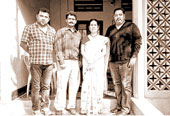
| Director Rajib Hari Kaushik (second from left) with Ruprekha Saikia Bora. Telegraph picture |
March 31: The six-decade-long eventful journey of the Latasil Bihu Sanmilani, which brought Bihu from the courtyards to the stage, will now be documented for the times to come.
Documentary filmmaker Rajib Hari Kaushik is making Oitiyamondito Latasil Bihutali 1952-2012 Khristabdo (The historic Latasil Bihutali from 1952 to 2012) to showcase the evolution of the sanmilani.
The documentary is being made under the banner of Luit Gist Communication, in association with Guwahati Bihu Sanmilani, which celebrated its diamond jubilee last year.
According to Kaushik, the Latasil Bihu Sanmilani has a huge contribution towards promoting Bihu onstage.
It has also been trying to provide a platform to the folk culture of the state and attract the younger generations towards Bihu. The documentary will be released on April 14 at Latasil playground and will also be available online.
Kaushik said around 80 per cent of shooting has been completed till today. “Within next week, I hope, it will be ready for the audience,” said Kaushik.
Through interviews of the first Bihu-rani Madhurima Choudhury, first Bihu Konwari Ruprekha Saikia Bora and first Bihu Xamragyi Rupa Deka Pator, the documentary will take the audience back to the days when the Latasil Bihu Sanmilani set an example for other organisers to popularise the folk dance.
The documentary will feature the interviews of almost 20 people who either performed or were closely associated with organising activities at the sanmilani.
Kaushik said he was happy that Guwahati Bihu Sanmilani has extended its support for the endeavour.
“I started the project in 2009. It was slightly difficult to amass all data and documents of 60 years for a documentary of less than one hour. But I am trying my best to make it a successful one,” said Kaushik.
The bilingual documentary, in English and Assamese, will be of 45 minutes duration.
Kaushik said an important aspect of the documentary would be the inclusion of parts of a gramophone record made by cultural icon Bishnu Rabha in 1937. “Rabha made a gramophone record on the nuances of Bihu performance at a time when it was looked down upon by a section of people in the state. A few segments of the recording will be used in the documentary to throw light on what Rabha thought about the dance,” Kaushik said.
The filmmaker added that earlier he had made a documentary on the state anthem of Assam on the occasion of its centenary celebration.
Singer Bhupen Hazarika was also a regular performer at Latasil Bihu. Last year, it organised a tribute to the singer.