 |
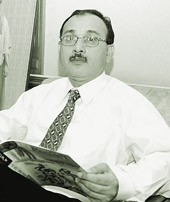
| Picture by Biju Boro |
Bhupati kumar das
Managing a new refinery is no mean task and building a platform for launching it to greater heights is a commendable one. Bhupati Kumar Das, managing director of Numaligarh Refinery Ltd (NRL), drinks 17 to 18 cups of tea everyday to keep himself awake and focussed on the deadlines. However, 53-year-old Das still squeezes out a few hours to write a book, May I. In conversation with Roopak Goswami over a piping hot cup of tea, Das reveals that a book of poems is also on the anvil.
Excerpts from the interview:
Q. Was it feasible to set up a refinery like NRL, considering its size and the market in the Northeast?
A. The Numaligarh refinery was conceived as a development project. It was set up to fulfil the commitment made by the Centre in the Assam Accord signed on August 15, 1985. The refinery was set up to provide the thrust required for industrial and economic development in the state.
The refinery suffers from certain inherent limitations like the sub-economic capacity of 3 MMTPA, poor location in terms of logistics and environment, and limited demand in the state for its products.
Over 75 per cent of NRL’s products have to be marketed outside the Northeast that incurs additional transportation cost. To obviate these limitations, the Centre and the state government have provided full support as well as incentives to make the refinery economically viable. The company has been able to sustain its viability and register profits consistently every year since it started commercial operation in October 2000.
Q. What are the problems faced during transportation of products to places outside the region?
A. Most of the NRL products have to be transported by rail. As a result, we are facing a problem of inadequate transportation of surplus products due to non-availability of sufficient number of BTPN railway rakes.
We have tried to increase the road transportation, though its impact is not significant.
For a long-term solution, the NRL has planned to move its products through a pipeline from Numaligarh to Siliguri, which would be set up by Oil India Limited. The pipeline, approximately 660 km long, will make movement of white oils safer, efficient and cost effective. According to the MoU signed with OIL, we would set up despatch facilities at Numaligarh and receiving terminals at Siliguri, while OIL would construct and operate the pipeline.
Q. What are your plans for selling products in Bangladesh and Myanmar?
A. These two geographically contiguous countries with the Northeast can open a huge market for NRL products.
We have been exploring possibilities of exporting products like diesel, kerosene and LPG to these countries.
Q. What if politics and insurgency come in the way?
A. Economic imperatives of a country would override factors that have the potential to retard development. I am an eternal optimist. The key is to make export proposals economically and logistically attractive to the host country.
Q. Has your experiment in transporting products through waterways succeeded?
A. The NRL had undertaken a trial run on barges navigating the river systems from here through Bangladesh to Budge Budge and Haldia to explore an alternative mode of transportation. However, there are some inherent limitations in waterways like inadequate infrastructure and poor night navigation. These will improve in the future.
Q. When will you enter the retail market with petrol and diesel?
A. As a matter of fact, we have very recently entered the retail market segment. The first four NRL retail outlets in the Northeast were commissioned in March. At least 50 more outlets will be commissioned during the 2004-05 fiscal.
The NRL has a roadmap for setting up a total of 510 retail outlets in a phased manner in various parts of the country. The outlets would strengthen our marketing network for auto fuels and generate ancillary business and employment.
Q. The refinery has been given the permission to produce motor spirit, which conforms to the Euro-III specifications.
A. The project for producing Euro-III motor spirit is being implemented. Construction of infrastructure is progressing and the project is expected to be commissioned by March 2006 within the approved cost of Rs 296.86 crore.
Q. What are the environmental safeguards employed by refinery?
A. NRL is one of the most environment-friendly refineries in the country. Right from its inception, efforts have been made at every stage to preserve the environment. Normal pollution control measures have been taken to ensure that there is no adverse impact on the nearby Kaziranga National Park.
In spite of processing low sulphur Assam crude, a sulphur recovery unit has been established. Our effluent treatment plant with tertiary treatment facilities along with provision for reuse of treated effluents, is considered one of the most modern. Installation of non- illuminating ground flare in the refinery is another first in the country.
We continuously monitor the furnace stacks, while five stations constantly check the ambient air quality in the refinery as well as Kaziranga. A modern sewage treatment facility and an incinerator in the hospital are provided to take care of hygiene in the locality.
Moreover, we have created a 100-metre green belt around the refinery.
Q. What kind of technology is in operation in the refinery to improve its efficiency?
A. Ours is one of the most modern and energy-efficient refineries in the country. It is designed to process three million metric tonnes of crude per annum. The refinery configuration minimises generation of heavy ends and fuel oil in favour of high value products.
The hydrocracker technology from Chevron, USA, was incorporated for upgrading product quality and maximizing middle distillates yield.
The refinery is fully automated with the latest microprocessor-based instrumentation for optimum monitoring, control and yield.
The Distributed Control System (DCS) of plant operation is interfaced with Enterprise Resource Planning (ERP) for on-line monitoring and desktop information on vital parameters. The Marketing Terminal is equipped with Terminal Automation System (TAS), which provides quicker and efficient product loading apart from other utilities.
The TAS is also integrated with the ERP package.