|
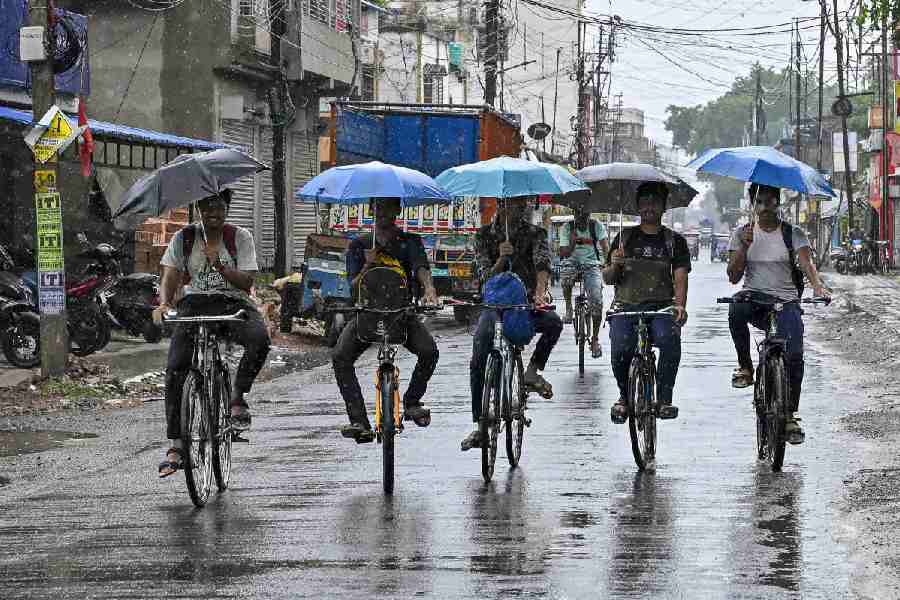
| On the road to Tripura. Picture by Eastern Projections |
Many a myth and misconception dominate any discourse on socio-political developments in Tripura over the past three decades. Scarred almost regularly by ethnic violence and blood-spilling by tribal militants, Tripura is invariably projected as a killing in field in the national media. The demographic imbalance entailed by the disastrous partition of India in 1947, marginalisation of indigenous tribals by settlers and the “ethnic explosion” over the past three decades, are inevitably cited to oversimplify the interplay of complex socio-political developments and the state’s history.
Nestled in the northeastern extremity of India, tiny Tripura escaped notice of the government of India till the eventful year of 1971, even though too much history had been happening in too short a time, with events overlapping each other in quick succession till then. The military crackdown in erstwhile East Pakistan in March 1971 and the influx of 1.5 million refugees into the tiny state, which had a total population of the same size, pitchforked Tripura into national and international media.
It is an axiom that tribals do not remain tribals for eternity; they also become full-fledged assertive nationalities in time, through a process of natural evolution. The physical features and appearances have little to do with a people’s status as tribals and nationalities. All major communities of the world, including Bengalis, Punjabis, Tamils and countless others, had been tribals before they achieved the status of a nationality group. Exactly when and how a tribal society graduates to a full-fledged nationality is still a matter of debate. But we have it on the authority of Anthony D. Smith, eminent sociologist, that there are certain preconditions to be fulfilled before a tribal society can be said to have graduated to that of a nationality.
In his celebrated work, Ethnic Origin of Nations, Smith has enumerated the preconditions quite perceptively: a stable group of people sharing similar social existence, folklore, culture, legends and myths in the course of settled existence on a particular geographical area must speak a common language. But in addition, they should develop social stratification, class formation, consciousness of property and its accumulation and a distinctive identity along with the growth of capital, to earn the sobriquet of nationality. To my mind, this, most of the tribal clans of Tripura, barring the extremely backward Reang shifting cultivators, identified as the sole “primitive group” in the state, have fulfilled the preconditions. The climax of the evolutionary process, exacerbated by sectarian political interests, brought them into a conflict with the non-tribal neighbours and the militancy in the state is only a bizarre manifestation of self-assertion.
However, the old order, which ensured absolutely peaceful and idyllic co-existence of tribals and non-tribals of Tripura for centuries, could have died more peacefully. Many scholars and intellectuals may differ with me on the issue of co-existence but we have it on the authority of Francis Fukuyama that the “question of national sovereignty is uncompromisable”. The tribals and non-tribals of Tripura will definitely co-exist, but only on the basis of equal and shared interests and ideals. It is also significant that the non-tribals — Bengalis in the present context of Tripura — had contributed to the development of the state and its indigenous tribal people. The historians and anthropologists continue to split hairs over the exact time when Bodo sub-group of Tibeto-Burman tribals made their way to Tripura in remote antiquity — 13th century, according to one school of historians or earlier as claimed by others. The fact, however, remains that Tripura’s proximity to the vast water resources and plains of East Bengal inhabited by a people possessing a relatively developed Sanskritised culture did exert a strong influence on the indigenous tribals.
Monarchy, an unmistakably advanced political institution, is not generally associated with a primitive tribal society living on shifting cultivation and leading a nomadic existence. That the institution of monarchy had been formed among Tripura’s tribals as early as in the fifteenth century is proof enough of the close contact and interaction between the tribals and non-tribals. According to Rajmala, princely Tripura’s court chronicle and source of history, King Ratna Manikya (1464) had invited hundreds of Bengali farmers, Brahmins and professionals to settle in Tripura with the permission of the then Nawab of Bengal Rukunuddin Barbak Shah. The process continued and, in fact, gained momentum during the rule of subsequent kings, as large tracts of land in East Bengal (present Bangladesh) passed into the sovereign domain of Triura’s Manikya dynasty rulers since the conquests of Dhanya Manikya (1490-1520). The domain of the Maharajas expanded and contracted depending on the individual military might of the rulers but the close contact with the plainlands of Bengal remained. In fact, tax given by non-tribal farmers of the plainlands turned out to be the major source of princely Tripura’s revenue.
There were other correlated developments, which also influenced life and thoughts of the tribals. The royal administration used to be run by many Bengali officials and Bengali became the court language once Muslim nawabi rule in Bengal yielded place to British rule. In fact, late King Radhakishore Manikya (1897-1909), issued a series of circulars, directing officials at the lower level to keep up and increase the use of Bengali in official works. The kings aimed at augmenting revenue by encouraging settlement of Bengali farmers in Tripura because the tribals, who depended on shifting cultivation for survival, could hardly contribute to the royal coffer. What, however, acted as positive impediment to tribal development was the failure of successive kings to initiate efforts to spread the light of education or develop the tribal language Kokborok. This had its inevitable fallout in the form of a popular literacy movement called Jana Shiksha Andolan (mass literacy movement) and the subsequent “armed struggle” launched by the undivided Communist Party during the last days of monarchical rule and the opening chapter of Tripura’s history after partition.
The delicate demographic balance in the state till 1951 was permanently tilted in the wake of influx of refugees from riot-torn East Pakistan. This avalanche and steady marginalisation of the tribals in the uneven economic competition inevitably led to ethnic polarisation with the formation of the first ethno-centric party, the TUJS. Subsequent scars on Tripura’s politics and history, such as two successive ethnic riots in 1979 and 1980 and the problems of insurgency followed, as tribals started coming into their own. But in the entire process, the non-tribals played a part right from developing plainland cultivation in Tripura to devising a script for Kokborok language — and further to growth of political and socio-economic consciousness. After initial reservations fomented by sectarian organisations, the non-tribals also actively took part in the agitation for Autonomous District Council (ADC) for tribals encompassing 68.10 per cent of the state’s geographical area.
Even in the matter of political culture and preservation of distinctive tribal tradition and heritage, it was the non-tribals who gave the lead. Yet, this process of alienation between the two communities may have resulted from the inexorable interplay of dialectical forces. Unless the tribals, accustomed to a peaceful, idyllic existence in the lap of hill, had come forward to claim their legitimate rights and positions, the process of nationality formation would have remained incomplete. The mindless violence, seemingly bordering on vengeance for a retrospective hostility, is a passing phase of Tripura’s history which will usher in a new era of co-existence on equal and honourable terms.