
 |
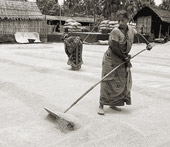
| A woman spreads paddy for drying at Jirania near Agartala. Picture by UB Photos |
The youths of the Northeast have time and again attempted to redress the grievances of the region as well as their own. Youth organisations like the North East Students’ Organisation (NESO) have made several attempts to make the Centre as well as the state government aware of the problems of the region and particularly of the youths.
The issues raised by the youths mainly deal with education, problems of infiltration of illegal migrants, foreigners or refugees, repeal of draconian laws, economic development and unemployment.
The first regional party that was formed by the indigenous tribal youths was the Tripura Upajati Yuba Samiti, in 1967. The main demands of the party were creation of an Autonomous District Council under the Sixth Schedule of the Constitution in the tribal areas, restoration of Kokborok language and adoption of the Roman script instead of Bengali for Kokborok language.
The indigenous tribal students also formed the Tribal Students’ Federation (now Twipra Students’ Federation) in 1968. In the early Seventies, both parties had similar demands — renaissance for the Kokborok language, which is spoken by the majority of the indigenous and tribal population.
Various indigenous tribal groups and tribal-based political organisations also raised their voice for the reorganisation and development of the language by the state government. It was after a long struggle by the political parties and students’ literary organisations that Kokborok was recognised by the government of Tripura in 1979 and became the second state language, Bengali being the first. So, in a way, it took 30 years for the Kokborok language to be recognised by the Tripura state government.
Recognition alone was not enough as no steps were taken for the development of the language by the government. After being recognised as the second state language and introduced in schools, particularly at the primary level, the controversy over the script began to roll. The state government was controlled by Bengalis and thus the Bengali script was accepted for Kokborok textbooks. However, a majority of the indigenous educated youth was in favour of the Roman script.
The present ruling party of the Tripura Tribal Areas Autonomous District Council has adopted the Roman script for primary schools. The issue of script was politicised and has taken a political turn. As in other parts of the Northeast, the youth unrest can be broadly of two kinds — armed and unarmed.
Independence and Partition of the country left a deep wound in the hearts of the tribal population. Tripura, an independent princely state, signed the merger agreement and became part of the Union of India on October 15, 1949. Partition was followed by communal riots and influx of refugees into Tripura. The influx continued over a long period of time and ultimately the indigenous tribal people of the state were outnumbered by migrants.
The situation can be gauged from the 1951 census which recorded 1,01,000 displaced (refugees) from East Pakistan (now Bangladesh); in 1961 the number of migrants was 3,95,883 and in 1971 the number was 4,20,847. However, these excluded those refugees settled in Tripura without being registered and the illegal migrants.
A large number of refugees were rehabilitated in the tiny state against the wishes of the indigenous people. These refugees were rehabilitated, given land and cash and they later acquired Indian citizenship. This brought about abrupt changes in the demographic scenario of the state. According to the government census of 2001, the indigenous people are only 34 per cent of the total population. The attitude of the government was to marginalise the tribal people in their own homeland.
It is pertinent to mention here that at the primary level, after having been educated in Kokborok, the language for the next class is Bengali. From Class VI the students have to learn Bengali, English, Sanskrit/Hindi. Thus the tribal students spend more time in learning of languages than other lessons. This is in sharp contrast to people whose mother language is Hindi. As Hindi is also the national language, the students can devote enough time to master English, the international language. The problems faced by the tribal students leads to dropout, the rate at the primary level of education in the tribal areas being as high as 75-80 per cent.
Another factor is that due to the promulgation of the Armed Forces Special Powers Act 1958 and the Disturbed Areas Act, covering 22 police stations which are exclusively within the tribal areas, many of the schools or some parts of the premises are occupied by the armed forces. Because of this, many girl students are reluctant to attend school. As the dropout rate is alarmingly high and no concrete steps are taken by the government, few acquire higher education.
The tribal people’s attempts to grab resources continues but in a systematic manner. Most of the camps and headquarters of the security forces are deliberately selected in the areas occupied by the tribal people.
The Gumati or Dumbur hydropower project is one of the most glaring cases of how the indigenous tribal people were forcibly relocated against their wishes. The valley was very fertile, watered by two rivers, Raima and Saima. These two rivers are considered sisters and many folk tales have been woven around them. The hydropower project was established in the early Seventies as the state needed electricity to light up the towns.
The valley’s catchment area, being fertile, produced surplus foodgrain for more than 24,472 families. The valley was also rich in flora and fauna. The tribal people resisted the construction of dams tooth and nail. But the government turned a deaf ear and did not consider any other factor other than the generation of electricity.
The tribal people tried their best to retain their land where their forefathers had lived. But the government machinery had no sympathy for the tribals and evicted them. The people were given only a week’s time to evacuate the valley and thereafter the security forces went on a rampage and threatened and assaulted all those who tried to resist the action of the government.
In the name of indigenous tribal development, crores of rupees have been spent but the net result has been almost zero. Almost all the funds embarked for the development of the tribals is diverted to other schemes.
Right from the merger days, the indigenous people have shown a preference for national political parties like the Congress, the CPM and many regional political parties like Bir Bikram Tipur Sangha, Adibasi Samity, Adibasi Sangha, Tripura Gana Mukti Parishad, Eastern Indian Tribal Union (Branch), Tripura Upajati Juba Samity (TUJS), Tripura National Volunteers (TNV), Tripura Tribal National Conference (TTNC), Indigenous People Front of Tripura/Twipra Nationalist Socialist Party of Tripura/Twipra (NSPT).
Right from its inception, the student youth organisation, Twipra Students’ Federation (TSF) has been involved in movements for the uplift of the tribal people of Tripura. The demands of the organisation have been always in keeping with the situations of the tribal people.