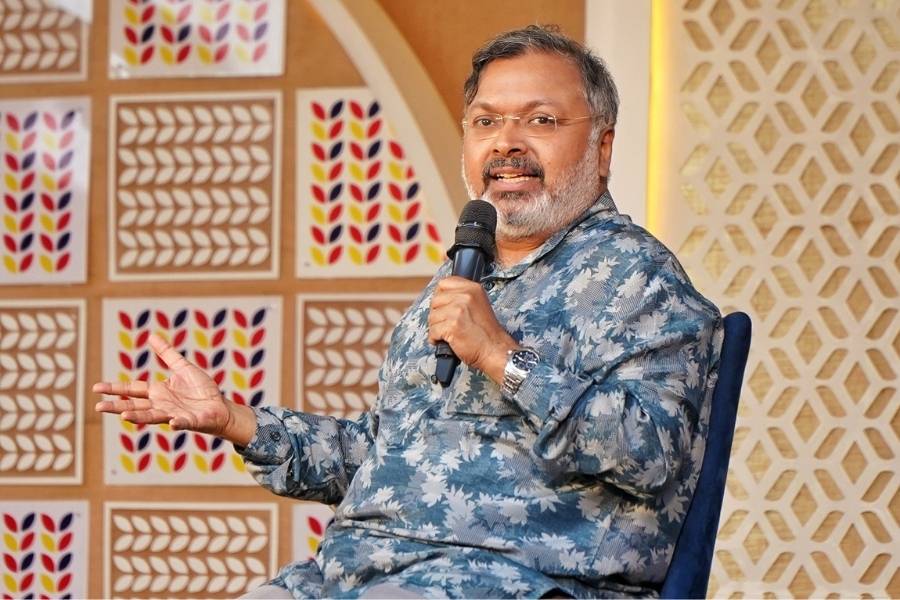
“Let’s learn from the stories and not hide from the truth,” said author Devdutt Pattanaik at the Kolkata Literary Meet 2026, where he discussed his book Sati Savitri, offering fresh perspectives on mythological beliefs and the stories of Sati, Savitri, and Shikhandi.
Sati Savitri explores the evolution of womanhood and feminism across different yugas, providing insights into the lives of women in mythology and what power, freedom, and agency meant for them in their times.
Known for explaining Indian and world mythology in contemporary terms, Pattanaik spoke candidly on Day 3 of the fest at Alipore Museum, on Saturday, about how the Vedas and Puranas addressed issues such as sex, desire, and fidelity.
The session was moderated by Milee Ashwarya, publisher of the Adult Publishing Group at Penguin Random House India.
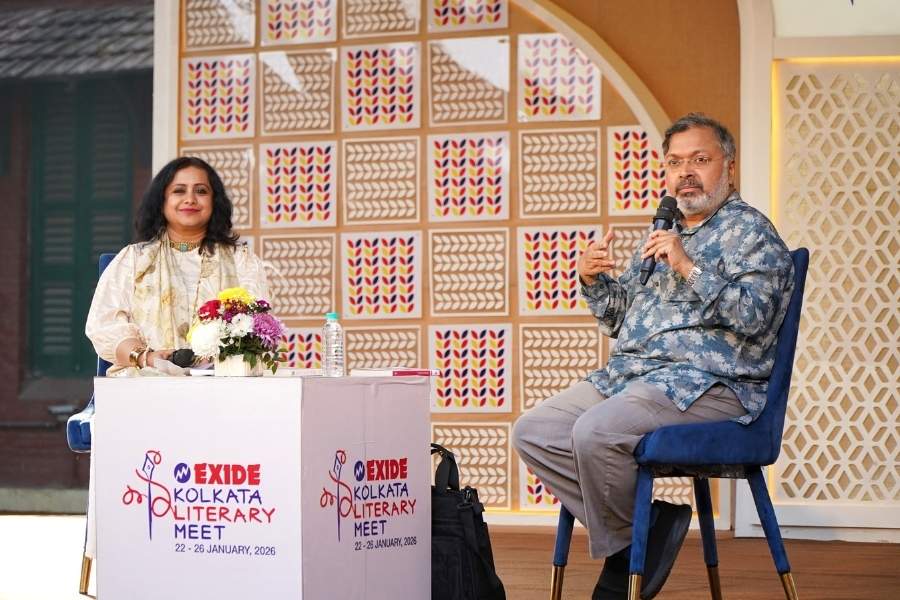
Pattanaik was in conversation with Milee Ashwarya
Reflecting on how myths shape social imagination, gender roles, and moral frameworks, Pattanaik, discussing the characters from his book Sati Savitri, said, “Sati and Savitri are not defined by patriarchal constraints. They assert their agency, make their own choices, and challenge societal expectations, showing that women in mythology often shaped their own destinies long before modern feminism emerged.”
Elaborating on the “Sati Savitri type”, Pattanaik said modern interpretations often misread these characters as obedient figures shaped by patriarchy.
Drawing a parallel with the iconic Dilwale Dulhania Le Jayenge scene where Simran seeks her father’s approval, he noted that Sati and Savitri chart their own paths, making choices independently and asserting their agency in ways rarely acknowledged in popular retellings.
Pattanaik also addressed gender identity through the story of Shikhandi, highlighting how ancient myths recognised gender fluidity long before modern discourse.
When asked whether Amba’s anger in the Mahabharata shaped Shikhandi’s destiny, Pattanaik explained that Shikhandi, though born female, was raised as a man due to her father’s desire for a son.
He noted that it was at the point of marriage that Shikhandi asserted her identity, choosing how she wished to be recognised. She ultimately became a man through a sex exchange with a yaksha — a narrative that, he said, shows how ideas often seen as modern were explored in mythology over 2,000 years ago.
Pattanaik also spoke about the character Sukanya, narrating how she chose a mortal husband to the immortal gods.
The author also referred to the story of Nala and Damayanti, a classic tale from the Mahabharata, to address themes of mental health in his chapters. After losing his kingdom, Nala sank into despair, but Damayanti recognised his true worth and chose him for his qualities rather than his looks or status, showing courage, discernment, and women’s agency in mythology.
“What is the role of a woman? What defines her identity — is it only her biology?” Pattanaik said, noting that the Mahabharata raises such questions.
Throughout the session, Pattanaik emphasised how his retelling of stories in Sati Savitri showcased women’s assertion and independence, challenging the notion of the “damsel in distress.”
He illustrated how these characters, from Sati and Savitri to Shikhandi and Sukanya, actively made their own choices, demonstrating that women in mythology were often far more decisive and empowered than popular retellings suggest.
Pattanaik’s insights demonstrated that women in mythology were often far more decisive, empowered, and self-determining than popular retellings suggest.
Responding to a question about the relevance of a female character from the Mahabharata in today’s world, Pattanaik said, “The most relevant character is my reader.”