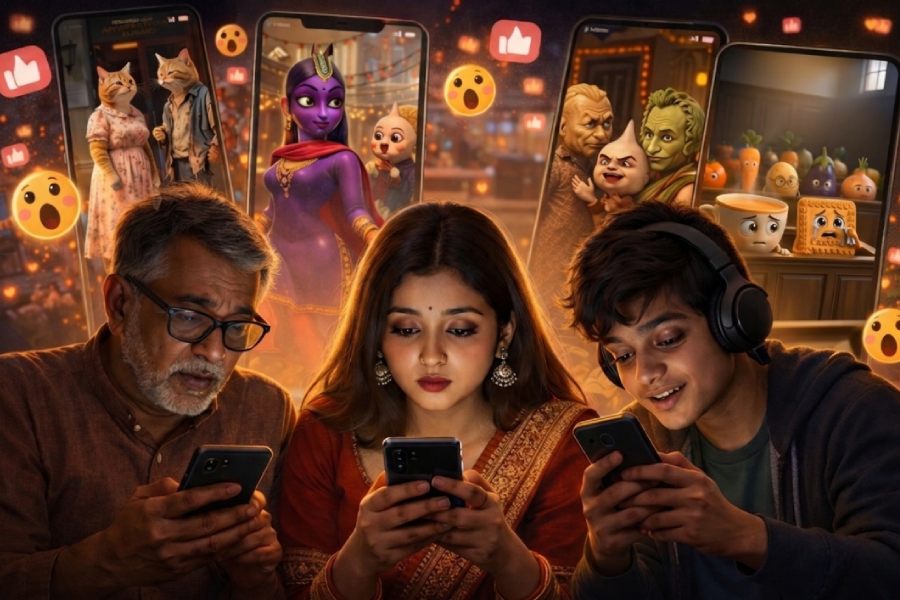
With the advent of artificial intelligence, the internet is evolving every day. One moment, you can draft an important work email within seconds; the next, you can reimagine yourself as an apple or your pet dog.
And if you have scrolled enough on social media, you might have come across videos — hideous and bizarre — of a gory zombie football, bickering humanised cats, babies flying aeroplanes, howling onion motor vehicles, and even a shrimp Jesus offering life lessons.
Such videos are created with AI. And AI slop is now a ubiquitous term for subpar stuff churned out by artificial intelligence models.
When the internet gets weird: Enter AI slop
They often exist in a surreal, eccentric space—mimicking reality while defying logic, physics, and human emotion—wrapped in a dreamlike haze of inconsistent details and oversaturated colours.
And these low-effort, mass-produced AI videos are busy clogging your YouTube and Instagram feeds… and still pulling in over a million likes like they’ve unlocked a cheat code the rest of us are still struggling to crack.
But watch a couple of these reels, and it’s not exactly hard to see the pattern — zero substance, zero educational value, and a generous drizzle of misogyny.
They thrive on pure ragebait, feeding off your doomscrolling fatigue, hovering on your feed like a glitch you can’t fix… and somehow, you still end up watching them, without a pause.
“There are no proper ways to stop this spread,” said Jaspreet Bandra, AI expert and co-founder of AI&Beyond. “There is a huge gap in the creator’s accountability space. Because of the ‘AI made it’ tag, some creators get away with their responsibility.”
So, have you ever thought of reporting on these videos, or maybe just restricting them on your social media handle?
Most people don’t; they aren’t political, nor are they explicit enough to threaten our society.
Bandra explained that most platforms prioritise engagement over quality, with algorithms rewarding watch time, interaction, and scroll-stopping novelty.
But there is a catch beneath the so-called unharming outer core. It gradually obscures legitimate, human-made information, experts say.
The psychology of ‘morbid curiosity’
Doomscrolling through these videos for hours can trigger anxiety, stress and restlessness among social media users, those in the know warn.
“Disturbing or bizarre content creates a mix of curiosity and discomfort, which activates attention more strongly than neutral content,” said clinical psychologist Rimpa Sarkar.
“There is also something called a 'morbid curiosity' effect, where people feel the urge to look at things that feel strange, shocking, or slightly unsettling.”
Prolonged exposure to such content can start to blur the line between what’s meaningful and what’s not — slowly dulling the brain’s ability to focus, process, and engage with anything that actually demands depth.
“The brain releases dopamine not necessarily because the content is enjoyable, but because it is novel and surprising,” said Sarkar.
Misogyny becomes formula
Most of these videos bank on misogyny, portraying women in hyper-sexualised clips, often described as fantasy bait or soft-porn material.
On social media, such specific “coded AI characters” — mostly anthropomorphised objects, animals, or vegetables depicted as women with exaggerated curves and large eyes — are used in narratives where they pass lewd remarks, flirt, cheat, and are subsequently punished for their actions.
Such videos draw maximum engagement online.
“Misogyny sells, unfortunately, and that is the reality,” said Kolkata-based women’s rights activist Panchali Kar.
“It is not a one-off phenomenon that these videos are showing or portraying women in a misogynistic way. It is just a reflection of how women are portrayed in popular culture on a wider level.
“It’s about hierarchy. It’s about power; about who gets to shape the narrative,” she said.
“Misogyny isn’t just political; it’s structural. And in today’s India and across the world, we’re seeing a steady push to curtail the rights of women and also queer people — so it’s no surprise that the content gaining traction increasingly reflects and reinforces those very biases.”
Hooked across generations
AI slop videos are quietly hooking viewers across all age groups.
“I have tried not to watch these videos, but somehow couldn’t stop myself from watching them once they appeared on my feed,” said Sreya Mukherji, a 30-year-old corporate professional from Ballygunge. “Surely, I could have avoided them, but I never found them threatening enough,”
Parents are also worried about their children.
“Being worried about our kids' digital indulgence was a constant task for us,” said said Shraboni Biswas, 45, who lives in Dumdum. “But lately, my son has got hooked on such weird clips that don't make any sense at least to me, yet he remains glued to them for questionable hours,”
It seemed that none of the social media users deliberately invited such content on their feed. Then, are creators exploiting AI or algorithm loopholes to go viral?
Jaspreet Bandra agreed.
“It’s a system: mass-producing trend-based variants, dodging moderation with subtle tweaks, using shock cuts to boost retention, and flooding multiple accounts to see what sticks,” he said.