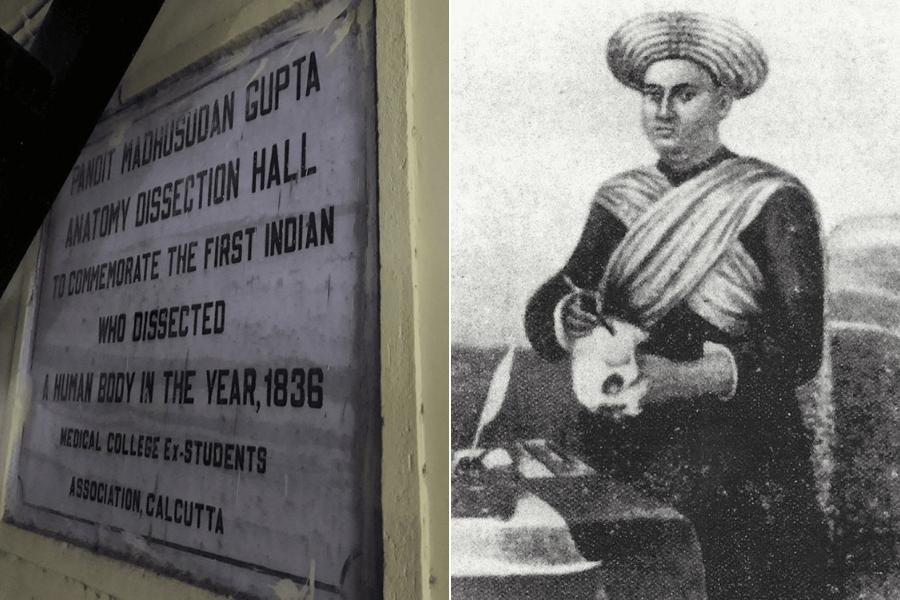
On January 10, 1836, a radical act took place inside Calcutta Medical College, creating history that changed the face of Indian medicine and healthcare. Madhusudan Gupta performed the first recorded human cadaveric dissection in Asia, challenging deep-rooted religious taboos and fierce social resistance.
At the time, orthodox beliefs considered touching a dead body a transgression, and dissection was viewed as sacrilege. Gupta’s decision marked a decisive shift from theoretical learning to hands-on medical education and laid the foundation of modern anatomy teaching in India, according to records documented by the National Library of Medicine.
Historians note that the resistance was not merely religious. but cultural and political, with colonial medicine itself under scrutiny. Yet the success of the exercise made cadaveric dissection indispensable in the medical curriculum across the country, a transformation that reshaped how generations of doctors would learn about the human body.
Learning anatomy in flesh and blood
For decades, cadaver dissection remained largely confined to first- and second-year medical students. Ramdip Ray, head of liver transplant and senior consultant in Gastrointestinal Surgery at Apollo Multispeciality Hospital, Kolkata, and a Calcutta Medical College alumnus who later trained at IPGMER and UCMS Delhi, recalls how formative that experience was.
As a medical student in the 1990s, he said, “Cadavers were our first silent teachers. Often dissected without gloves, we were taught not only anatomy but endurance and sensory awareness. The smell of formaldehyde, the resistance of tissue and the reality of blood and bodily fluids prepared students for the less romantic truths of surgery.” According to Ray, cadavers trained hands and minds long before technology entered the operation theatre.
From anatomy hall to advanced surgery labs
Over time, cadaver-based learning moved beyond undergraduate classrooms. Today, it plays a critical role in advanced surgical training. Ray explained, “Cadavers are now used in specialised workshops for already qualified surgeons, particularly for liver transplants, complex cancer resections, minimally invasive procedures and robotic surgery. In this phase, cadavers act as a bridge between theoretical knowledge and patient safety, allowing surgeons to practise techniques before performing them on living patients.”
This evolution reflects a broader shift in medical education, from rote anatomical memorisation to applied, skill-based learning, a change also noted in contemporary academic literature .
When AI meets anatomy
Udipta Ray, director of Robotics and GI Surgery at Fortis Hospital, Anandapur, and a Calcutta Medical College passout from the mid-1990s, believes the anatomy hall is undergoing another transformation. He points out, “Modern preservation techniques now allow clearer visualisation of tissues, while artificial intelligence, virtual reality and augmented reality tools are redefining how students approach anatomy.”
According to him, “Virtual dissections and 3D models help students understand complex structures like the brain and vascular networks even before they enter the dissection hall. These tools allow personalised learning, identifying where a student struggles and offering visual clarification. They also provide an alternative for students who find prolonged exposure to formaldehyde difficult.”
However, Ray is confident that technology cannot replace touch. “AI can show structures, but it cannot recreate tissue feel or spatial resistance.” He believes the future lies in combining conventional cadaveric dissection with digital tools for a more complete learning experience.
Nearly two centuries on
Almost 190 years after Madhusudan Gupta’s act of defiance, the lesson remains relevant. Dr Sunil Karanth, Chairman, HOD and consultant – Critical Care Medicine, Manipal Hospital Old Airport Road highlighted, "Anatomical cadaveric dissection has today become an ingrained and highly accepted part of medical training. Society and aware families now recognize this as a necessity for medical education. With the integration of AI, this field has moved to the next level, allowing comparison between how organs look and function in real life and how they appear during cadaveric dissection."
Technology has transformed how anatomy is taught, but the human body continues to be the most authentic textbook. As medical education moves from cadaver to code, Kolkata’s anatomy halls still echo with the legacy of 1836, reminding students that innovation stands strongest on the shoulders of history.