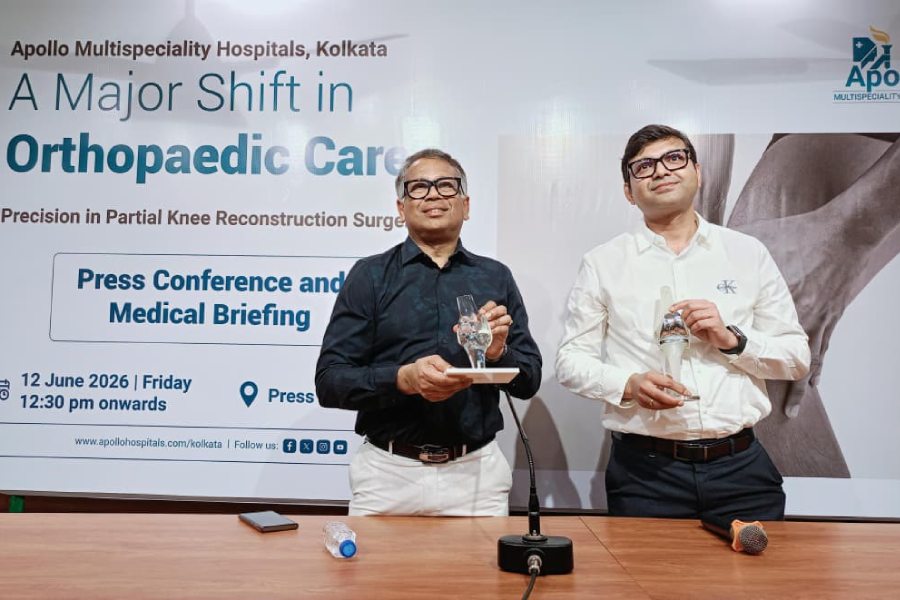
Apollo Multispecialty Hospitals, Kolkata, on Friday, announced a leap forward in orthopaedics with the official introduction of Precision Partial Knee Reconstruction Surgery. Announced during a briefing led by top orthopaedic experts, this advanced, patient-centric approach focusses on knee preservation, offering an effective alternative to traditional total knee replacements.
The briefing was spearheaded by Ranjan Kamilya, senior consultant orthopaedic surgeon, and Soumen Kar, consultant orthopaedic surgeon at Apollo Multispecialty Hospitals, Kolkata. The specialists demonstrated how precision technology allows surgeons to target and replace only the damaged portion of the knee, leaving healthy bone, surrounding tissues and natural ligaments completely intact. The clinical advantages of Partial Knee Reconstruction — specifically Unicompartmental Knee Replacement (UKR) — are backed by robust, long-term global data.
During the conference, the team highlighted several key metrics from the landmark Oxford Phase 3 UKR studies, which showcase exceptional durability with a 93% implant survival rate at 10 years and an 89% survival rate at 15 years. Furthermore, the procedure offers enhanced patient safety, as individuals undergoing UKR are 50% less likely to experience major medical complications within the first 30 days compared to traditional Total Knee Replacement (TKR). Long-term follow-ups show superior joint function, with the Oxford Knee Score (OKS) soaring from a pre-operative average of 23 to over 40 out of 48. This rapid rehabilitation allows patients to typically return to light activities and low-impact sports within 4 to 6 weeks, vastly outperforming the 3 to 6 months usually required for TKR recovery.
Kamilya explained that traditional knee replacement surgeries have long been considered the standard treatment for severe knee damage, but emphasised that many patients do not actually require a complete replacement. He noted that Precision Partial Knee Reconstruction Surgery enables the surgical team to treat only the affected area, which results in significantly less trauma to the body, quicker recovery times, and much better preservation of natural knee movement.
A key takeaway from the briefing was that debilitating knee pain is no longer exclusive to older generations. Due to modern lifestyle changes, prolonged physical inactivity, high joint stress, and repetitive movements, younger professionals are increasingly seeking treatment for early joint degeneration. Epidemiological data shared at the event highlights the scale of the issue, showing that the overall prevalence of knee osteoarthritis ranges between 22% and 39% in the general adult population, and rises sharply to between 44% and 50% among individuals over the age of 60.
Kamilya also emphasised that they are witnessing a growing number of younger patients seeking treatment for knee pain and early joint degeneration. He stated that the surgery offers a highly effective solution for selected patients, helping them return to their daily activities faster while maintaining a more natural-feeling joint. By utilising a minimally invasive approach, Precision Partial Knee Reconstruction significantly reduces post-operative discomfort, cuts down hospital stays, and accelerates the rehabilitation process.
More importantly, this precision-driven technique has the potential to alter traditional orthopedic timelines by effectively delaying or entirely preventing the need for a total knee replacement later in life.