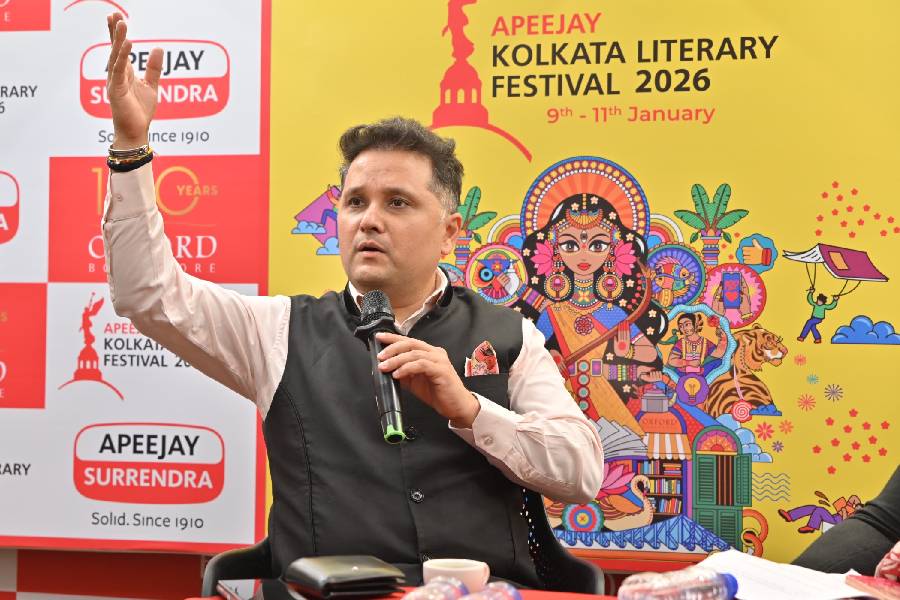
Bestselling author Amish Tripathi Monday urged Indians to confront historical questions with openness, but reject the rising ideological silos that are hollowing out public discourse.
Speaking at the Apeejay Kolkata Literary Festival Curtain Raiser at Oxford Bookstore, Tripathi said India’s tradition of civil, rigorous debate has been replaced by a combative culture driven by hardline attitude on both ends of the political spectrum.
“History is revisited repeatedly — nothing is ever settled,” he said, responding to a question from My Kolkata.
When asked whether he agrees with Salman Rushdie’s recent comments that history was being revisited in India to show Hindus in a good light and Muslims in bad, Amish argued that reinterpreting the past is not only unavoidable, but healthy. “Questioning is good, as long as it is done with manners. In our ancient approach to debate, you speak the truth but speak it with love. If you cannot speak with love, stay silent”.
Tripathi warned that social media, television and imported Western styles of “gladiatorial” confrontation have transformed disagreements into factional combat. “One of the challenges today is that we’ve imported too much of this Western approach where debates are seen as a gladiatorial contest. Some of our TV debates are so loud you can hear them even if you switch the TV off,” he said.
He argued that the ideological divide is being sharpened because both sides now operate inside their own echo chambers. “Leftists listen only to leftists. Rightists listen only to the right. This does not grow your brain,” Tripathi said, adding that intellectual resistance is essential for growth. “Muscles grow against resistance. Even the brain grows against resistance.”
The writer said he consciously reads scholars whose views oppose his own. “I don’t think the British Raj was a good idea. But Niall Ferguson thinks it was a damn good idea. David Starkey says the Empire did tonnes of good. I profoundly disagree. But they are the best point-of-view scholars — and reading them challenges my assumptions,” he said.
Tripathi cautioned that India must guard against ideological hard-liners on both extremes. “Indians need to protect ourselves from both the left-wing and right-wing extremists. They feed each other,” he said, describing the dynamic as a pair that thrives on mutual hostility.
He also expressed his confidence in the general public. “It is my confidence in the Indian people that makes me sure we are moving in the right direction,” he said. “We have seen such fast-paced change — hundreds of millions pulled out of poverty in 30 years. Whenever there is churning, there will be some poison. But the trajectory is sound.”
Tripathi also linked the debate over history to the long habit of framing Indian civilisation through lenses inherited from the colonial period. He argued that contestation over interpretations is part of reclaiming intellectual independence. What matters, he said, is tone and intention: “Good manners alone can build relationships. You’ll be surprised how much you can engage with others if you never shout, never scream, never use cuss words.”
The author, whose latest book Chola Tigers explores the Chola period, also told My Kolkata that he would come up with a new book in the Ramachandra series very soon.