“I wrote everything as it was,” senior IPS officer Amit Lodha, whose book inspired the Netflix series Khakee: The Bihar Chapter, reflected on self-censorship in crime thrillers at Apeejay Kolkata Literary Festival 2026, on Sunday, during a time when it is easy to invite offense and legal action.
The insightful session on crime fiction was held at Alipore Museum, once a colonial era prison intended to suppress the voice of major freedom fighters — an irony that was hard to overlook. Along with Lodha, journalist-turned-author Rudraneil Sengupta joined in the discussion about their latest novels, moderated by writer-columnist Jashodhara Chakraborti.
With writing about crime — be it fiction or non-fiction — the socio-political realities of the time play an important role. Given the current landscape in the country, do crime writers ever hold back themes with political connotations out of concern for how their work may be interpreted or reacted to? And does that change the story?

Having spent nearly three decades in the Bihar Cadre, Lodha emphasised on how his novels cannot be separated from lived reality.
“I worked in Bihar for a long time and you know how Bihar was,” the 51-year-old added, having mentioned earlier that everything in his latest book, Police Affairs, is also drawn from real events and moral dilemmas he has witnessed on the job despite it being a piece of fiction.
Agreeing with Lodha, Sengupta agreed that crime fiction is a mirror of the socio-political condition of each era, rejecting the idea of restricting oneself out of fear.

Rudraneil Sengupta concurred that crime fiction is a mirror of the socio-political condition of each era, rejecting the idea of restricting oneself out of fear
“I didn’t restrain myself from writing about anything except what I didn’t know enough to write about,” he said. “If I don’t know enough, I won’t put it in. Apart from that, I’m unsparing,” he added.
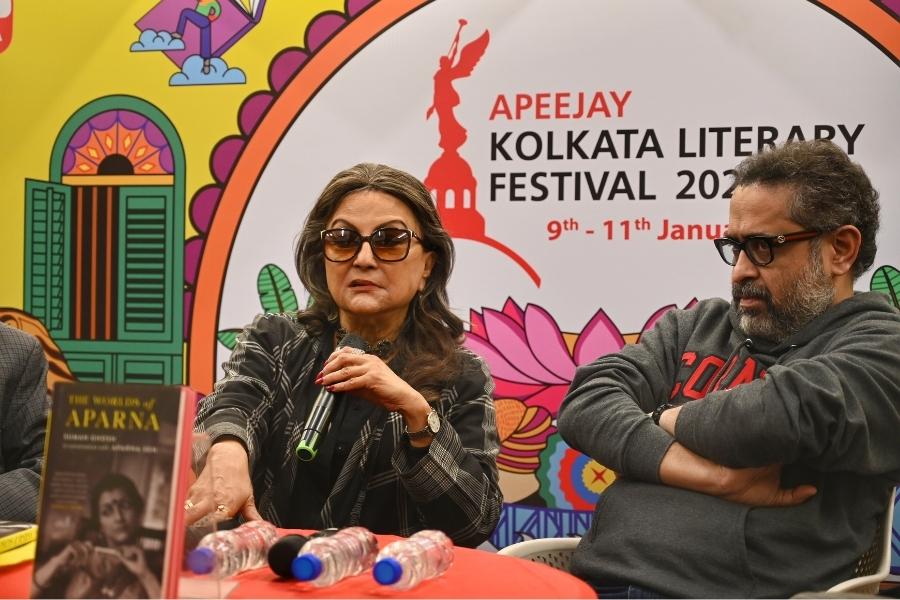
Chakraborti, author of two YA fantasy adventure novels and a translation of Hemendra Kumar Roy’s Jawkher Dhawn, pointed out a difference between fiction and non-fiction. “In non-fiction, it becomes telling truth to power, which is always a double-edged sword,” she said.

Jashodhara Chakraborti
Earlier in the discussion, Lodha and Sengupta reflected on how their personal and professional lives shaped their writing styles.
For Lodha, the time he spent in IIT Delhi years back was his foray into writing as it was a rollercoaster experience. He began maintaining journals, particularly about his memories of ragging and camaraderie between friends. It was only after his friend and author Chetan Bhagat, another IIT Delhi alumnus, published his first novel Five Point Someone, that Lodha realised that he missed an opportunity.
“I was very jealous of Chetan with his tremendous success, because I thought that I would have also written the same story,” Lodha, who chose to become an “escapist” with his new book, shared candidly.
For Sengupta, who published his first fiction novel The Beast Within, the journey was a bit unconventional. As a journalist working in Delhi in the crime beat, he began meeting police officers, criminals and people affected by crime after he finished writing his reports.
“I told them that after I'm done with my newspaper reports, I want to just hang out with them to understand their world. Whatever they were doing, whether they were on a raid, or you're just sitting and having lunch,” Sengupta said with a smile.
Despite both trying on styles that the other would usually write — Lodha with a traditional cop thriller and Sengupta a police procedural — both authors proved that crime fiction cannot be separated from society. After all, crime writing, as Rudraneil put it, is not only about the systems, but also about the lives of people.