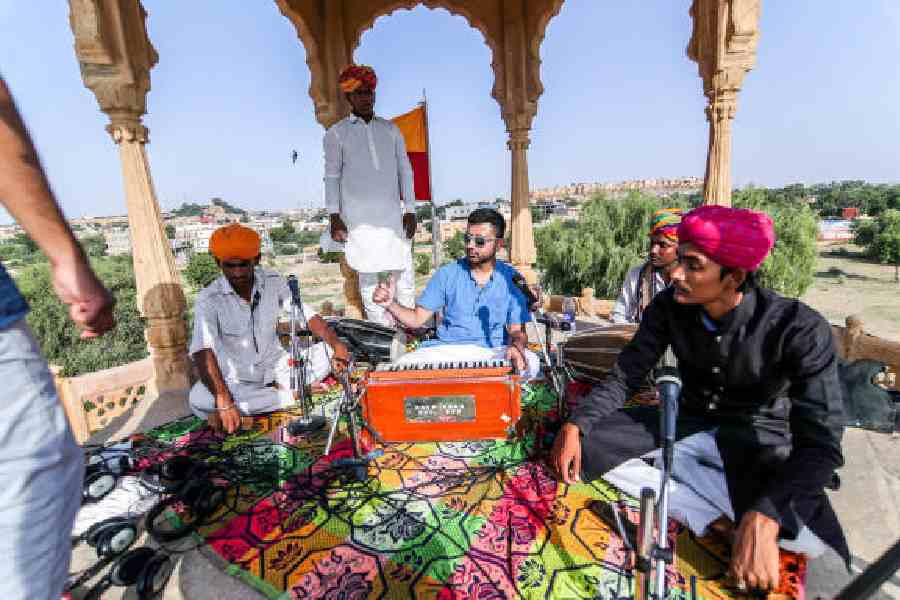
Folk music has long been defined by outsiders — anonymous, frozen in time. A new study by three Indian researchers is challenging that narrative. Abhinav Agrawal, Mudit Chaturvedi and Gaurang Agrawal, who together have worked with over 10,000 folk musicians over the past 13 years through the Anahad Foundation, presented their paper, ‘Co-designing culture: A grounded theory of participatory practice in Indian folk music,’ at the Design Research Society 2026 conference in Edinburgh.
Drawing on interviews with 23 first-generation folk artistes across 14 Indian states, the research argues that the prevailing, largely Western understanding of folk music — as anonymous, rural and passively inherited — has erased individual authorship and denied musicians copyright and compensation.
Instead, the study repositions folk music as a living, collaborative art form, with artistes as active changemakers and audiences as co-creators.
Abhinav Agrawal, lead researcher, currently pursuing a PhD in Design at IIT, spoke to this newspaper about why the old definition needed rewriting.
Your paper challenges the long-standing UNESCO and Western view that folk music is “anonymous and communal”. Why do you think the global community has clung to this “memory keeper” stereotype for so long, and what was the exact turning point in your field work that made you realise these artistes are actually intentional “cultural designers”?
The term ‘folk music’ was coined by Western anthropologists who used ethnographic methods like immersive fieldwork and participant observation to understand how music is used by a community to preserve its culture and bring people together. They tried to understand folk music through community, memory, culture, and tradition. Over time, a new field called ‘ethnomusicology’ developed, with the primary purpose of studying music within its cultural and social contexts.
Folk music, being so complex and informal in nature, could hardly enter formal music scholarship, where it could be studied structurally as an art form in its own right. Though the anthropological standpoint is valid, we also needed to study how folk music is created, the roles and purposes of individual creators, and the lived experiences shaping composition and songwriting. We started assuming that folk music is a communal cultural resource, and policies were shaped towards conservation and preservation rather than evolution.
In our decade-long travels across India, documenting over 10,000 folk musicians, we hardly met any musician who was ‘traditional’. Every person we met had a contemporary mindset and had deliberately taken up music as a profession to create some social impact. Most of the musicians we met were hesitant to be called ‘folk’, as they felt the term was associated with marginalised communities. This was our turning point: to offer a new perspective on folk music and use design methods to understand the creator and the process.
Your methodology specifically sampled first-generation folk artistes rather than hereditary musicians. Why was this distinction critical for proving individual creative agency over passive inheritance?
This distinction was critical because we wanted to understand how creativity flows within a community when it is not simply passed down through family lineage. If an artiste did not inherit music from their parents or ancestors, then the question becomes: how did they begin creating songs? What shaped their artistic voice?
By focusing on first-generation folk artistes, we could see that folk traditions are not built only through heredity. They are also built through shared learning, lived experiences, memory, observation, participation, and constant exchange with the community.
This helped us understand that folk art does not always move in a straight line from one generation to another. It grows through relationships and collective experience. The community shapes the artiste, and the artiste, in return, shapes the community.
So, first-generation artistes helped us prove that folk musicians are not passive inheritors of tradition. They are active creators who absorb the world around them, transform it through their own imagination, and give it back to society through song.
Having said that, future studies still require more diverse sampling, including hereditary and multi-generational musicians. This study is just a starting point, meant to spark a debate and open the field to new questions.
You mention that India’s Sangeet Natak Akademi and government policies focus almost entirely on “preservation” and treating folk traditions as endangered. If the ministry of culture were to adopt your “evolution” framework tomorrow, what is the very first policy change they should implement?
The first policy change should be to recognise that folk traditions are not only about preservation, but also about creation and evolution. Government programmes should not only document old songs; they should also support the creation of new folk songs.
The ministry should introduce schemes that welcome, commission, and fund new compositions by folk artistes. Many artistes are already writing new songs within traditional forms, but these works are rarely recognised as original creative output. They are often treated as just another part of ‘tradition’.
There are some programmes where artistes are encouraged to create new compositions, but usually there is no clear copyright claim, ownership structure, or royalty benefit attached to their work. That needs to change.
So, the first step should be a policy that officially recognises new folk compositions and protects the rights of the artists who create them. Preservation is important, but without supporting new creation, folk music will be treated like a museum object instead of a living tradition.
The paper dedicates a poignant section to the late Jumma Jogi of Rajasthan, who passed away during your research. How did his life’s work specifically validate your theory, and what happens to a community’s co-designed cultural artifacts when an anchor musician passes away?
As soon as an artiste leaves this world, like Jummaji, their song does not disappear with them. It becomes a living part of the community. His words and compositions remain alive because people continue to sing them, remember them, and pass them on.
For many folk artistes, the first priority is not money. Their purpose is to create songs that help their people, society, and community in some meaningful way. In that sense, the artiste consciously offers the song to the community. Jummaji observed society and wrote songs with the hope of bringing some change. His life’s work validated our theory in the most direct way. His songs were not anonymous inheritances. They were deliberate creative responses to what he saw around him, composed with a clear social purpose and then consciously offered to his people. That is exactly the process of cultural design our paper describes.
Once such a song becomes part of the community, future generations may take inspiration from it, perform it, add something new to it, and carry it forward in their own way. That is how folk traditions remain alive.
But community sharing and commercial exploitation are two different things. If someone uses that song commercially after 30 or 40 years without giving credit, permission, or benefit to the e’s legacy or community, then that becomes misuse. The song may belong culturally to the community, but that should not mean outsiders can profit from it without responsibility.