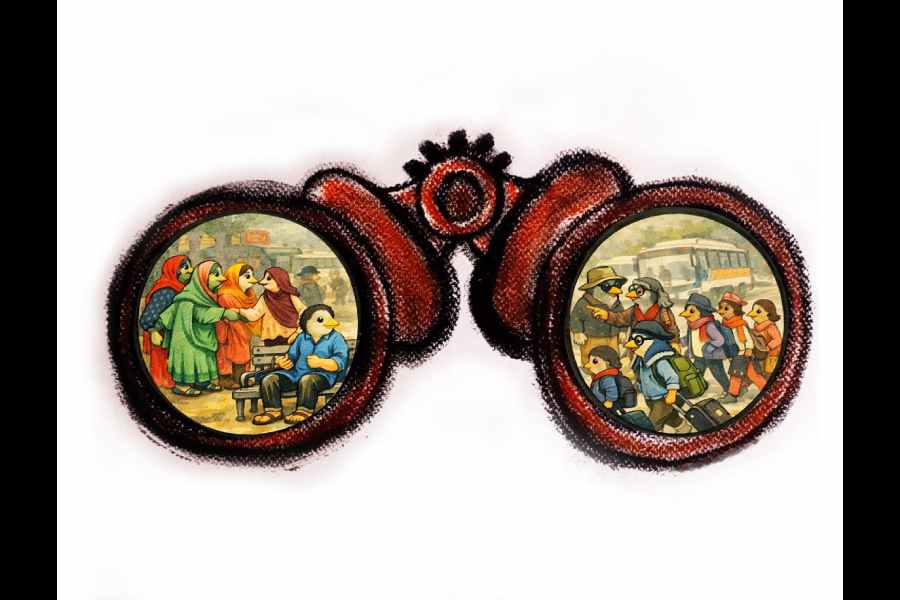
There was a time when you could tell the non-winged migratory visitors apart from the rest of the city’s populace by their feathers, but post-liberalisation, such distinctions have continued to fade. Add to that swollen numbers of domestic tourists and a level world, courtesy the Internet. Indeed, hair colour, camera model, accent, none of this is a clinching determinant of the migratory status anymore. Instead, you have to look for more subtle tells — the way they walk, the way they talk, where they go… The fun is in the guessing and in the part-knowing, when they agree to pause and share the stories of their journeys and stopovers.
Nandan
Kolkata International Film Festival. Amidst cinephiles rushing back and forth between screenings, there stands a lone figure of calm. The 60-something man is dressed in cotton shirt and trousers, he has a shawl draped over his shoulders. The traditional motifs on his chrome yellow shirt and his languid smile give him away. Name: Sudath Mahaadivulwewa. Home country: Sri Lanka. Profession: Filmmaker and chairman of the National Film Corporation of Sri Lanka. He is attending the festival as a jury member. Mahaadivulwewa says, “I was in my 20s when I last visited the city. I was here for the screening of my film Shades of Ash.” Behind him, a peacock blue kaftan darts about. Its wearer has bobbed silver hair that ends above her chin and green eyes lined with blue kajal. Rada Sesic from the Netherlands is easy to spot but it is difficult to make her pause, what with multiple overlapping film screenings. It is her 10th trip to Calcutta, a halting spot before she moves on to Mumbai and Bengaluru. There are also those walking around aimlessly, paying no heed to the silent and not-so-silent battles that the cinephiles are fighting over the limited seats. William Taudes, 30, from Canada is one of them. He is in Calcutta for a day, a few hours of layover between journeying from Assam to Maharashtra. Although Taudes has been to Indonesia, Japan, China, Singapore, he has not seen much of South Asia. And then there is Tripti Banik and her teenage daughters standing in front of a London-style phone booth pop-up, taking selfies. They have come from Santragachi. Tripti says, “We are not here for the films. We wanted to see what these festivities are all about.”
South Park Street Cemetery
A middle-aged British couple walks amidst rows of graves and solemn epitaphs. Neil has a camera slung around his neck and Helen is carrying a large canvas bag. They are from Sheffield in the UK. Neil says, “We are spending 17 nights in India. The trip began in Madhya Pradesh. We went on a safari to Kanha National Park, then we went to Odisha, saw the Konark Temple, and now we are here for just two days.” Helen says, “We went to College Street in the morning and now our friend Jhelum is telling us about the history of this cemetery. We are headed to Park Street for a light lunch. Then we will visit Tolly Club.”
Victoria Memorial
The pavement outside is dotted with tourists. Among them is a retired physics professor from Nashik, Rajendra Nimbalkar. He is doomscrolling on his phone while his wife is buying sankha-pola from a roadside souvenir stall. Their Calcutta checklist runs somewhat like this — Dakshineswar, Belur Math, Kalighat, Victoria Memorial, Indian Museum. On the facing pavement, a young man is sitting alone. He has earpods on and is listening to Kendrick Lamar. Billy, who is from Aizawl, is a tattoo artist. He is talking about how he has even signed up for a short tattooing course here, when a tempo traveller pulls up and a large group of women in brightly coloured salwar suits steps out. One of them, who identifies herself as Vandana Sharma, says, “Hum ladies ek saath travel karte hain.” They are from Kangra in Himachal Pradesh. Every year, they take a trip somewhere within the country. Last year, they went to Ayodhya and the year before that, it was the Andamans.
Near St Paul’s Cathedral
Nick is ambling towards Park Street around noon on a weekday in a white T-shirt and khaki shorts. He is from the UK and has been to Calcutta many times. The point of this trip — to catch a Test match between India and England at the Eden Gardens. On the other side of the road, Hendrick is waiting at the traffic signal. He is carrying a large backpack and sweating profusely. He says, “Last year, I landed in Delhi in May and oh God, it was so hot! My favourite thing to do is to buy a one-way ticket to India and spend a couple of months here. It’s my eighth time in this country.” Like Nick, he too does not seem to care for itineraries. His lone goal — to try some “authentic Calcutta food”. At a chaat stall on Hendrick’s side of the pavement, a group of young girls and boys and their adult companions are catching their breath. One of the girls says, “We are students of Mallika Sarabhai’s institute in Ahmedabad.” They were in the city to stage a production of Italo Calvino’s Invisible Cities. Their only plan for the day is to take a tram ride.
Outside Alipore Zoo
A woman with a baby is cautiously stepping off the escalator. Behind her, a man, possibly her husband, hovers protectively. She joins some women outside the ticket counter. Their spokesperson Sukla Mukherjee says, “I run a pharmacy in Hooghly. Today, I have brought my employees and their families to Calcutta for a day out. It’s our annual ritual.” The woman from the escalator, Mamata Bauri, says, “This is my first time taking an escalator ride.” At the exit gate, a little boy in a leather jacket is scowling at his parents. His mother Sujata Gurung is pointedly ignoring him. They are from Sikkim and on their first trip to Calcutta. The father Pempo Tshering Bhutia says, “My son thinks he is too old for a zoo. He wanted to go to Eco Park instead. That’s why he is angry.”
Gangasagar camp
The pavement lining the road to Babughat, and opposite Eden Gardens, is choc a bloc with visitors. Nisa Maurya, who is in an orange sari and rubber sandals, walks hand in hand with the elderly Sumitra Harijan. Turns out, they are neighbours in their hometown of Ayodhya. They are on a 14-day tour and have already been to Gaya, Chitrakoot, Benares and are now headed to Gangasagar. A group of 60 arrives from Sarol in Madhya Pradesh. The men head for the chhola-chaat stall, while the women, like moths to a flame, flock to the makeshift stalls selling glass bangles, second-hand jackets and woollens, sandals and plastic toys. Well beyond the camp entrance are long-distance buses parked one beside the other. Men, women and children in big groups are crossing the road with beddings tied to their backs. In their hands are blue and green plastic bags filled to the brim with utensils and clothes. Among this colourful lot are some swetambar sanyasis, only their foreheads aflame with tilak.
Park Street
A woman in yellow appears. She has a constellation of gold studs on both her ears. Hand-poked tattoos cover her neck and arms. She is Marina, a yoga teacher from Tuscany, Italy, travelling through India with her partner Alex. They had landed in Calcutta only for a night but ended up extending their stay by a fortnight. Alex says, “We are on our way back from Gangasagar. Everyone at the fair wanted to take photos with us.” Marina says, “I am spiritual, I have been practising yoga for a long time now. Of course, I am not Hindu, but I am very close to the religion.”