From high above the city, surrounded by the gleam of worldly goods and the promises they carry, it becomes easy to overlook what lies below. Vagabonds and pavement dwellers move through city streets, their roles changing with the hour, their presence absorbed into the background of urban life. This condition of looking and overlooking informed A Star Amongst Too Many, Chandra Bhattacharjee’s exhibition curated by Uma Ray at the Birla Academy of Art and Culture.
The title invited a question: who was this star amongst many — one of the anonymous figures that populated the exhibition or the artist himself? The ambiguity felt deliberate. What distinguished the exhibition was not simply its subject matter but its faith in drawing. In an art world still invested in hierarchies of media, there was something quietly defiant about an exhibition that entrusted so much to paper and charcoal.
In the early years, Bhattacharjee painted commercial hoardings across Calcutta. Perched on bamboo scaffolding, at the threshold of two opposing worlds, he gained a unique vantage point. If those years taught him how to magnify images, A Star Amongst Too Many revealed what he chose to magnify.
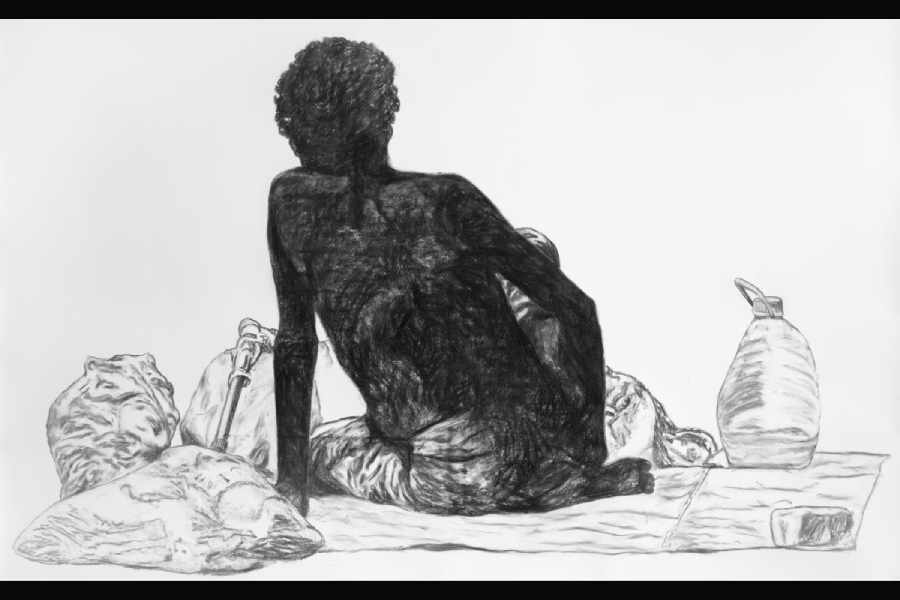
The charcoal figures that commanded the gallery walls recalled Ramkinkar Baij’s monumentality of marginal lives. A sleeping man stretched across a vast sheet of paper, a solitary walker, a woman seated in thought, a figure carrying a bag: these were not unfamiliar presences, yet here they held the gallery with extraordinary assurance
— often with surfaces marked by rust, yellow discs hovering like distant suns.
In a smaller series, bags, utensils, bedding and bundles — essentially, their homes — emerged through a white haze, as though glimpsed from a moving bus: visible, yet never fully apprehended.
The exhibition’s quiet force emerged from a double reversal: lives often consigned to the periphery occupied the centre of the gallery, while drawing itself was entrusted with a monumentality usually reserved for more celebrated media.