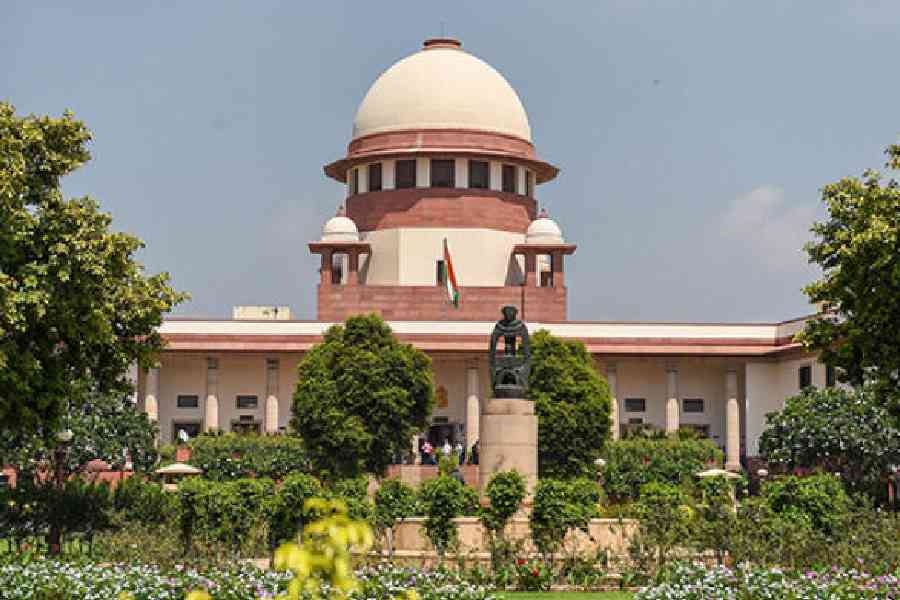
If you find your way blocked on a pavement, you can move court, the Supreme Court ruled on Friday.
A two-judge bench declared the right to walk unimpeded on clearly demarcated pavements as a fundamental right, and said citizens deprived of it could seek “constitutional and legal remedies” against authorities such as civic bodies, town planners and panchayats.
Seeking a “constitutional remedy” refers to moving a high court or the Supreme Court; seeking “legal remedy” means approaching a civil court or tribunal.
The judgment comes at a time when the new BJP government in Bengal has asked hawkers and traders to voluntarily remove their illegal stalls that block pavements, often forcing pedestrians onto the roads and increasing the risk of accidents.
The matter before the court involved the death of litigant Maniyar Iliyaz’s five-year-old son.
The child was knocked down by a truck while father and son were walking on a pavement towards the kid’s school. It isn't clear in which state the accident happened.
“The right to walk is a fundamental right under Part III of the Constitution. It is integral to the right to movement guaranteed under Article 19(1)(d) [right to move freely throughout India], read with Article 19(1)(a) [free speech and expression], Article 19(1)(b) [right to assemble peacefully], Article 19(1)(c) [right to form associations or unions] and Article 21 [life and personal liberty] of the Constitution of India,” the bench of Justice Pamidighantam Sri Narasimha and Justice Atul S. Chandurkar said.
“The fundamental right to walk will take within its sweep the right to demarcated footpaths. These rights are primary and shall have priority over movement by motorised vehicles.”
The bench added: “If the road exists, there is a duty to ensure that there are demarcated and well-maintained footpaths for walkers. The duty bearers are the urban development authorities, municipal corporations, municipalities and even panchayats, who must endeavour to demarcate, construct, maintain, and safeguard footpaths and other necessary pedestrian infrastructure, as walking is integral to life.
“The violation of the right to walk on demarcated footpaths will entitle the citizens to invoke constitutional and legal remedies against duty bearers for restitution and compensation. This remedy is independent of the remedies... available under the Motor Vehicles Act, 1988 (compensation to motor accident victims).”
People’s right to walk on a demarcated pavement “shall have priority over movement by motorised vehicles”, the bench said.
“The absence of safe and comfortable footpaths to walk on, and even when they exist, their subjugation to motor transport, has been a civilisational problem…,” it added.
Rows of two-wheelers and even cars can be seen parked illegally on pavements in many Indian cities. Often, construction materials such as bricks, sand or stone chips are dumped on pavements, blocking them.
“All that the fundamental right to walk demands is a comfortable space for an easy and carefree walk. Should this not be the minimum of the minimum duty that a municipal authority owes to the citizens?” the bench said.
“Unfortunately, we have failed to recognise these aspects to such an extent that the phrase ‘pedestrian’ has acquired pejorative shades.”
A citizen deprived of the right is entitled to restitutionary remedy “under the Constitution or under Sections 38-40 of the Specific Relief Act, 1963, for the enforcement of public duties (that) can be enforced against the urban development authorities, municipal corporations, municipalities, or the panchayats”.
The Motor Accidents Claims Tribunal had in May 2016 granted Iliyaz a compensation of ₹7,82,000, at 6 per cent annual interest from the date of the petition till the payment.
On an appeal from the insurer, however, the state high court reduced the compensation to ₹4,70,000, prompting Iliyaz to approach the apex court.
The top court increased the total compensation to ₹11,44,628 and directed that it be paid within two months.